How Decentralization Prevents Crypto Market Collapse
 Zamy
Zamy
A beginner-friendly guide to why decentralized networks remain standing even when centralized crypto companies fail.
What You’ll Learn
- What decentralization means in simple, beginner-friendly terms.
- Why decentralization gets stronger as more people join
- Why decentralization matters and how it prevents the collapse of the crypto market.
- Early red flags in centralized platforms.
- Practical steps beginners can use to stay safer in crypto.
Introduction
What do the latest global Cloudflare outage and a major crypto platform failure have in common? They both rely on a single point of control. When everything depends on one entity — one team, one system, one decision-maker — a single mistake can take the whole structure down.
And that leads to the real question: why do some systems collapse overnight while others keep running without interruption?
The answer comes from a principle your own body uses to stay alive: a strong immune system doesn’t depend on one cell to do all the work.
Decentralization works the same way. It keeps a crypto network functioning even when individual parts fail — especially at scale, where single points of failure become most dangerous.
In this guide, you’ll learn what decentralization really means, how it protects crypto during crises, and how to spot the red flags beginners often miss.
Table of Contents
- Introduction
- What Is Decentralization?
- Why Centralized Crypto Collapses
- How Decentralization Protects Crypto (Beginner Breakdown)
- Real Cases Where Decentralization Saved Crypto
- How Beginners Can Spot Centralized Danger Zones
- What Beginners Should Avoid (Must-Learn)
- Conclusion
- FAQs
What Is Decentralization?
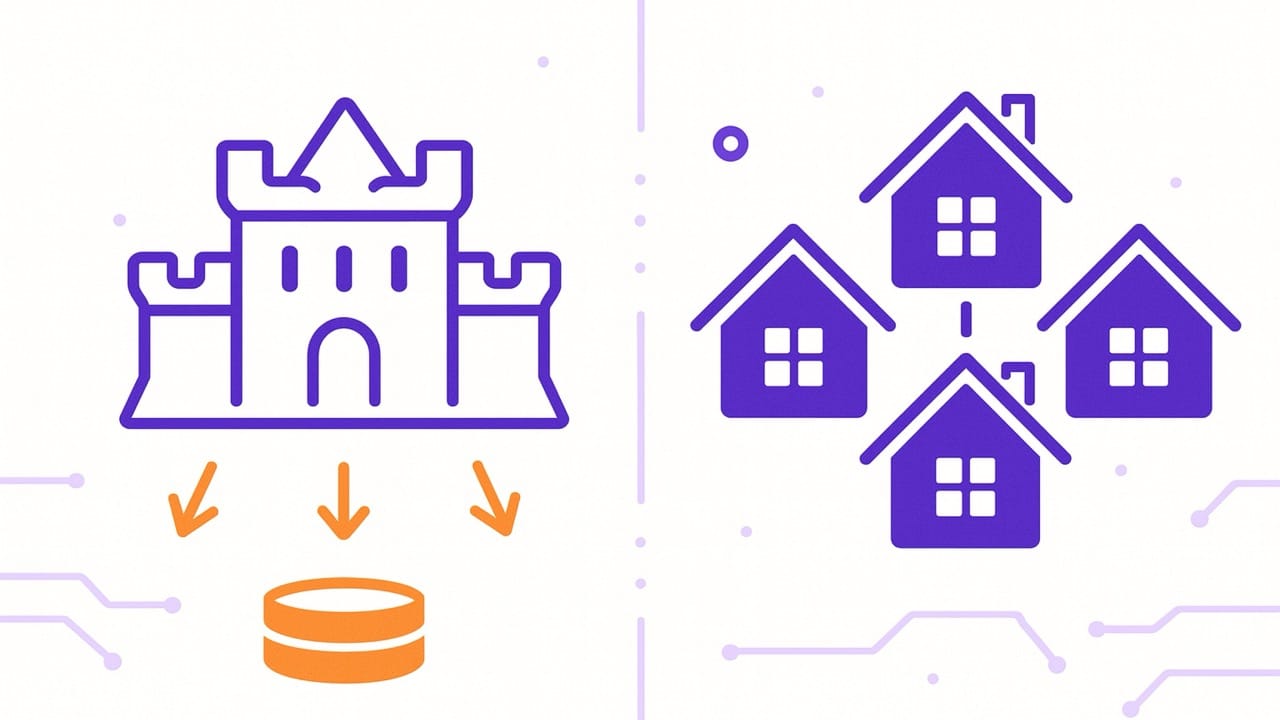
The word “decentralization” can sound like something only engineers truly understand. But the idea is much more grounded. Think of a centralized system as a single towering castle where all the keys, decisions, and information sit in one place. It looks powerful — but a crack in the wall can shake the entire kingdom.
A decentralized system works differently. It’s more like a village spread across thousands of small houses, each holding just a tiny piece of the whole. A few lights can go out, a few roofs can fall, and the village still stands. No single house carries the entire burden.
In crypto, we’ve seen this work in practice. In July 2021, an unexpected bug (a software glitch in a program) caused a temporary split in the network. As soon as the patched version was released, thousands of operators updated their software independently. No leader had to coordinate it. The network stayed alive because responsibility was already shared.
That’s the heart of decentralization, and crypto uses a few simple building blocks to make that village work:
- Node: a computer that stores and shares parts of the network’s data.
- Validator: a participant who checks that every action follows the rules.
- Governance: the shared process for making changes to the system.
- Network security: protection created when thousands of independent machines work together.
- Single point of failure: the weak spot that appears when too much power sits in one place.
When power, data, and responsibility are spread widely, no single mistake can break the system. That distribution is what gives decentralized networks their resilience.
Why Decentralization Gets Stronger as More People Join
Crypto isn’t resilient by accident. It’s resilient because thousands of people help run the network. Every new node, miner, or validator becomes another checkpoint, another independent copy of the data, another machine that verifies the rules without asking anyone’s permission.
That’s why issues that would shut down most centralized systems barely register on decentralized ones.
When the global Cloudflare outage disrupted huge parts of the internet, Bitcoin kept producing blocks. Miners run in different countries, on different providers, under different conditions — so one outage can’t bring the whole network down.
Decentralization grows stronger every time someone participates, and weaker only when control starts to concentrate again.
Activities like Bitcoin mining don’t just secure rewards for miners — they secure the entire network by reducing its dependence on any single company, provider, or region.
More participation means more resilience.
And that resilience is exactly why decentralized networks keep running even when everything around them is failing.
How Decentralization Protects Crypto (Beginner Breakdown)
If centralized systems fall like castles with weak foundations, decentralized ones survive for an entirely different reason: they’re built like networks of many hands, not one.
Here are the five structural choices that give them that resilience.
1. No Single Person Controls the System
Decentralized networks run on thousands of independent computers around the world. Each one stores data, checks transactions, and keeps the network alive. If a few go offline, the rest continue without interruption. There’s no master switch, no central office, and no leader who can suddenly shut things down.
This shared structure removes the biggest vulnerability, depending on a single operator.
2. On-Chain Transparency Prevents Hidden Risks
In decentralized systems —unlike centralized platforms where you can’t see what is happening behind the scenes— everything that matters is recorded directly on-chain.
You can see:
- Balances (what the platform holds)
- Debt positions (how much is owed)
- Collateral (assets locked as protection for loans)
It’s all public, so anyone can verify what’s real in real time. No waiting for announcements, and no room for hidden accounting tricks.
Transparency doesn’t remove risk, but it exposes problems early — the kind of issues that stayed hidden at FTX, Celsius, and Terra.
3. Nobody Can Freeze or Take Your Funds
The first time you hit a withdrawal freeze in crypto, something clicks. Not just because you might lose money — but because you finally see the truth: the decision was never fully yours to begin with.
Self-custody flips that dynamic completely. Your private keys act as your authorization. Funds move only when you sign — no middle layer, no internal approval, no hidden switch that can override you.
If the keys stay with you, the control stays with you.
4. Distributed Liquidity Prevents Bank Runs
One advantage of decentralized finance (DeFi) is how its “money pools” actually work.They don’t live inside a company. They sit on-chain — out in public — where anyone can check what’s there, any time.
How’s that? You can see the health of the pool before anything breaks: how much is in it, which assets support it, and whether the pool can handle a surge in activity
Here’s the difference in one clean glance:
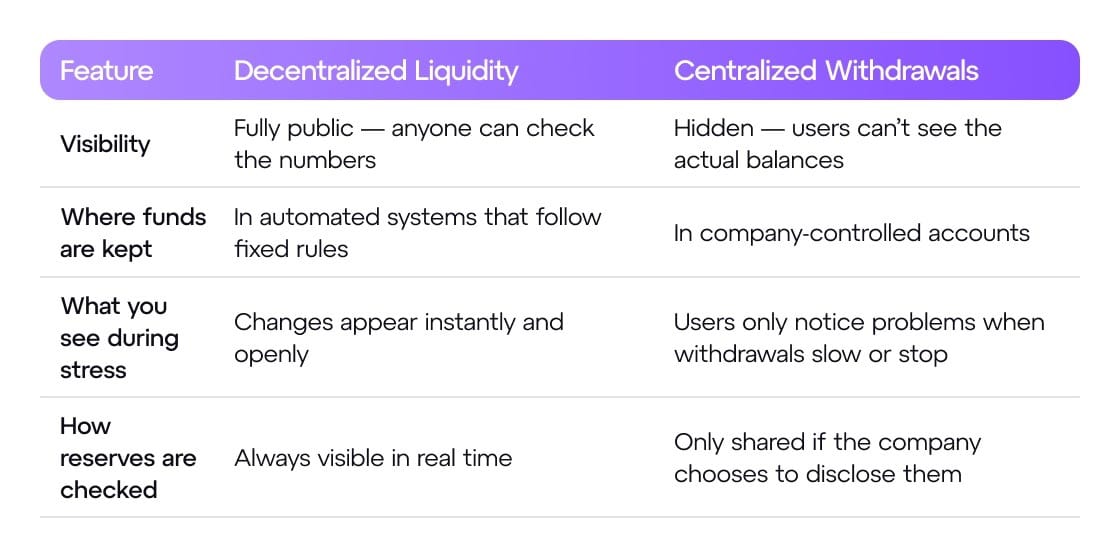
That’s why pressure doesn’t turn into panic when the whole system is open and distributed. Because nothing is hidden in the first place.
5. Incentives Make the System Stronger
Decentralized networks rely on math and incentives, not trust. The people who help run the network (called validators) earn money for keeping things honest and following the rules.
Trying to cheat isn’t just difficult — it’s expensive. Attackers risk losing the funds they’ve locked into the system and usually get outmatched by the honest majority.
In practice, honesty pays more than attacking. And as more participants join the network, the cost of breaking it rises even higher. That incentive structure is a big part of why decentralized systems grow stronger over time, not weaker.
Real Cases Where Decentralization Saved Crypto
Some of the strongest lessons about decentralization come from moments when the crypto world was under high pressure — when everything around a system was breaking, but the system itself kept going. Here are three real examples.
Bitcoin survived Mt.Gox
Mt.Gox was once the biggest place to buy and sell Bitcoin — almost everyone used it. When the company collapsed in 2014 and lost hundreds of thousands of customer money, people assumed Bitcoin itself would stop working. But the Bitcoin network didn’t blink. Blocks kept being mined, transactions kept going, and the system worked exactly as before. A single company failed, but the decentralized system underneath didn’t even pause.
Ethereum survived The Merge
In 2022, Ethereum changed how it secures the network — shifting from mining (which uses hardware) to a greener system called staking. Thousands of people around the world updated their computers independently, with no single leader coordinating the switch. The network stayed online the entire time, showing how strong decentralized systems can be. It was like swapping a plane’s engine mid-flight — and the aircraft never even wobbled.
DeFi survived the CeFi meltdown (2022)
In 2022, when big centralized finance (CeFi) companies like Celsius froze user funds, DeFi kept running like clockwork. There were no shutdowns — people could still trade and withdraw anytime. Even in the chaos, smart contracts (automated code that executes actions exactly as written) continued operating without interruption. DeFi proved its strength: you can’t lock the doors when no one controls them.
How Beginners Can Spot Centralized Danger Zones
Here’s a simple way to evaluate any platform. Think of these questions as your early warning system.
1. Who’s in charge — really?
If a single CEO or small team can change rules, pause withdrawals, or make major decisions on their own, the whole system depends on their judgment. That’s fragile by design.
2. Who holds your funds?
If the platform keeps your crypto in its own custody, you’re relying on it to stay solvent, honest, and operational. When companies fail, customer funds often get locked inside.
3. Can anyone see how the system works?
Closed code means users can’t verify the rules or safety mechanisms. Open-source systems let the community inspect and challenge the design — a healthier dynamic for beginners.
4. Are the reserves visible?
If a platform can’t show real proof of the assets backing it, users are left guessing. Hidden reserves were at the center of many past failures.
5. How concentrated is governance?
When a small group can rewrite rules instantly, users lose visibility and control. Broad governance slows things down, but protects the system from sudden shifts.
6. Can withdrawals be paused?
If a company can freeze or delay withdrawals, that’s centralized control — and it often happens when internal problems are already growing.
7. Is everything tied to one company, country, or leader?
Projects that depend on a single organization or jurisdiction are more vulnerable to outside pressure. Decentralization spreads that risk across the network.
What Beginners Should Avoid (Must-Learn)
You don’t need to memorize threats to stay safe in crypto — just understand how much control any platform actually holds. The questions below highlight the kinds of weak spots worth noticing early.
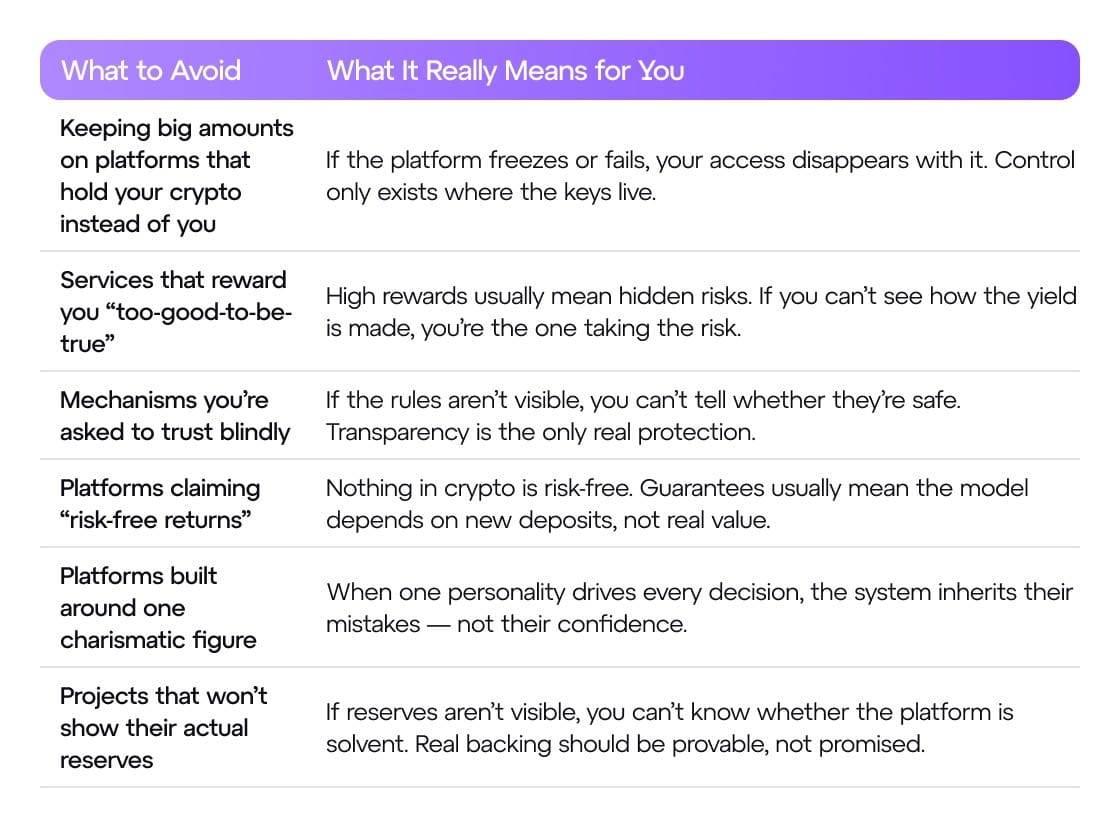
Once you know where control actually sits, you’re already two steps ahead of the risks most people never notice.
One More Thing You Should Know About Decentralization
Decentralization is powerful, but it isn’t magic. It trades speed for safety: decisions can take longer because no single group can push changes overnight. And while the system itself is harder to break, your own choices still matter. If you lose your keys, there’s no recovery button. If you trust a project with unclear rules or weak code, decentralization can’t shield you from those consequences either.
The systems are sturdy — but the responsibility shifts to you.
Conclusion
Decentralization works like crypto’s immune system: it keeps the network alive even when individual parts fail. That’s why the biggest crashes you hear about in the news aren’t failures of Bitcoin or Ethereum, but of the centralized companies built around them.
When decisions, reserves, and user funds sit in one place, the entire structure rests on trust. When those same responsibilities are shared across thousands of independent participants, the system becomes much harder to break.
Just remember: decentralization isn’t a shield for every mistake — it protects the network, not every choice inside it. And once you can see where control actually sits, what you’re verifying instead of trusting, and which decisions still depend on you, the whole picture becomes clearer.
Decentralized networks aren’t perfect, but they give you a sharper lens. Learn to read systems through that structure, and the entire space becomes easier — and far safer — to navigate.
FAQ
1. What is decentralization in crypto?
It’s when no single company or person controls the system. Instead, many independent participants share responsibility, so no one can rewrite rules, freeze funds, or shut things down on their own.
2. How does decentralization help prevent collapse?
Because there’s no single point holding everything together. If one part fails, the rest of the network keeps running. Centralized platforms fall all at once; decentralized networks fail in small, isolated pieces that don’t take the system down.
3. What’s the difference between centralized and decentralized crypto?
Centralized platforms hold your crypto for you and make the decisions behind the scenes. Decentralized systems give you direct control through your own keys — no middle layer that can stop or delay your access.
4. Why do crypto exchanges fail?
They act as one big container for everyone’s funds. When that container is mismanaged — through bad bets, missing reserves, or poor oversight — users are affected instantly because the whole system depends on one operator.
5. What’s the difference between CeFi and DeFi?
CeFi (centralized finance) runs through companies that manage your assets for you.DeFi (decentralized finance) runs on code that’s public, automated, and doesn’t require a company to approve your actions.
6. Why does decentralization matter for beginners?
It removes hidden dependencies. You can verify how a system works, who controls what, and where your funds sit — instead of relying on promises or waiting for announcements when things go wrong.
7. How does blockchain decentralization actually work?
Thousands of computers (nodes) store copies of the same data and check every transaction together. Because no one owns the network, it’s hard to shut down, censor, or manipulate.
8. Why did FTX collapse?
A small group controlled all customer funds and moved them into risky trades without users knowing. When the truth came out, withdrawals surged, and the platform didn’t have enough money to return. The blockchain didn’t fail — the company did.
9. What is on-chain transparency?
It means the important information — balances, reserves, system rules — is visible to everyone on the blockchain. You don’t have to trust a statement or wait for news; you can check the data yourself.
10. How do decentralized systems avoid collapse?
They spread power widely, make everything visible, run core actions through code instead of companies, and reward honesty. As more participants join, the system becomes harder — not easier — to break.
11. Is Bitcoin actually decentralized?
Yes. Bitcoin is run by thousands of independent miners and nodes around the world. No single group can change its rules or push transactions through — that wide distribution is what gives Bitcoin its stability.
12. Is Ethereum decentralized?
Yes, but in a different way than Bitcoin. Since moving to staking, Ethereum is secured by thousands of people who lock their assets to validate the network. No company or leader controls upgrades — they move forward only when the community agrees.