What Is Bitcoin Mining, and How Does It Work?
 Alex D
You’ve probably heard that Bitcoin is “mined” — but what does that actually mean? Are people running some mysterious program? And where do new Bitcoins come from?
Don’t worry — BTC mining is simpler than it sounds.
This Bitcoin mining guide covers the basics step by step: what it is, why it exists, and how the whole process works.
What Is Bitcoin Mining?
Simple Definition
Bitcoin mining is the process of using powerful computers to verify transactions and add them to the Bitcoin blockchain — a shared, public record of every Bitcoin transaction ever made, stored simultaneously across thousands of computers worldwide, so no single person controls it.
Miners who do this receive newly created Bitcoin as a reward.
Think of it like this: imagine a giant shared notebook where every transaction is written down. Miners check each new page, confirm everything is correct, and add it to the notebook. In return, they get paid in Bitcoin.
Mining ≠ Printing Money
A common beginner misconception is that mining “creates money out of thin air.” It doesn’t. Mining is work — real computational work that keeps the network secure.
It comes with real costs too: the biggest is electricity, since mining machines run continuously at full power; the other is the hardware itself, as professional ASIC machines can cost thousands of dollars.
The Bitcoin reward is payment for that work, not free money.
Why Bitcoin Needs Mining
Bitcoin has no central authority — no bank, no company, no government.
So how does the network make sure nobody cheats?
That’s where mining comes in.
Validation
Every time someone sends Bitcoin, that transaction needs to be checked. Miners validate these transactions, ensuring no one spends the same Bitcoin twice (known as “double-spending”). Only after a miner confirms a transaction does it become final.
Security
Miners protect the network from fraud.
To change or fake a transaction, an attacker an attacker would need to control more than 50% of the network’s total computing power, which is practically impossible.
Decentralization
Because anyone can become a miner, no single entity controls the network. Thousands of miners around the world compete independently, keeping Bitcoin truly decentralized.
How Bitcoin Mining Works
Here’s how the Bitcoin mining process works, step by step:
Step 1: Transactions Are Collected
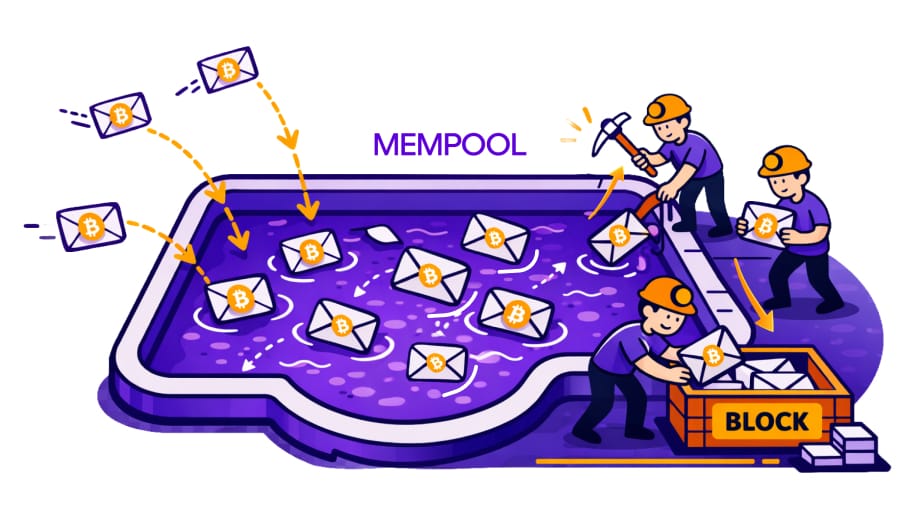
When people send Bitcoin, those transactions are sent out simultaneously to all computers participating in the network, and sit in a waiting area called the mempool — short for “memory pool.”
Think of it like a queue of passengers waiting to board a flight. Miners pick transactions from this queue and group them into a proposed block — a batch of records ready to be permanently added to the blockchain.
Why proposed? Because it still needs to be approved by the network.
Step 2: Proof of Work
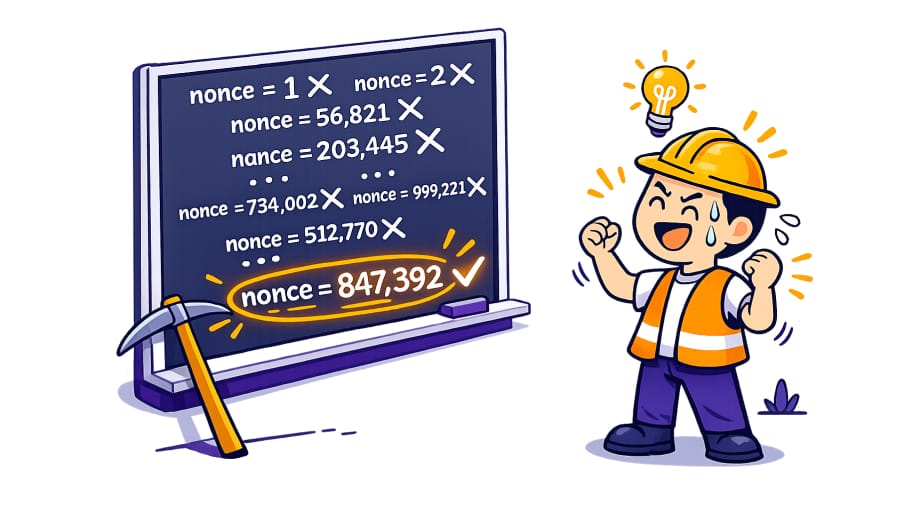
This is where the real mining happens.
To add their block to the blockchain, miners must solve a complex mathematical puzzle. They do this by rapidly guessing random numbers called a nonce — short for “number used once.” Each nonce guess is fed into a special function that produces a unique code called a hash, like a digital fingerprint for data.
What makes a hash special is that the same input always produces the same output, but you can’t work backwards from the hash to figure out what went in. Even changing a single character in the input produces a completely different hash. The goal? Find a hash that meets the network’s requirements.
This is called Proof of Work (PoW) — it proves the miner spent real computational effort. There’s no shortcut; you just have to keep guessing until you find the right answer.
“The proof-of-work also solves the problem of determining representation in majority decision making.” — Satoshi Nakamoto, Bitcoin Whitepaper (2008).
Published under a pseudonym, this nine-page document laid out the entire foundation of Bitcoin — including how mining works, why Proof of Work was chosen, and how a decentralized network could function without any central authority. Everything miners do today traces back to what was described in it.
This foundational document explains why Proof of Work was chosen as Bitcoin’s consensus mechanism — the rules the network uses to agree on what's true.
Step 3: Block Is Added
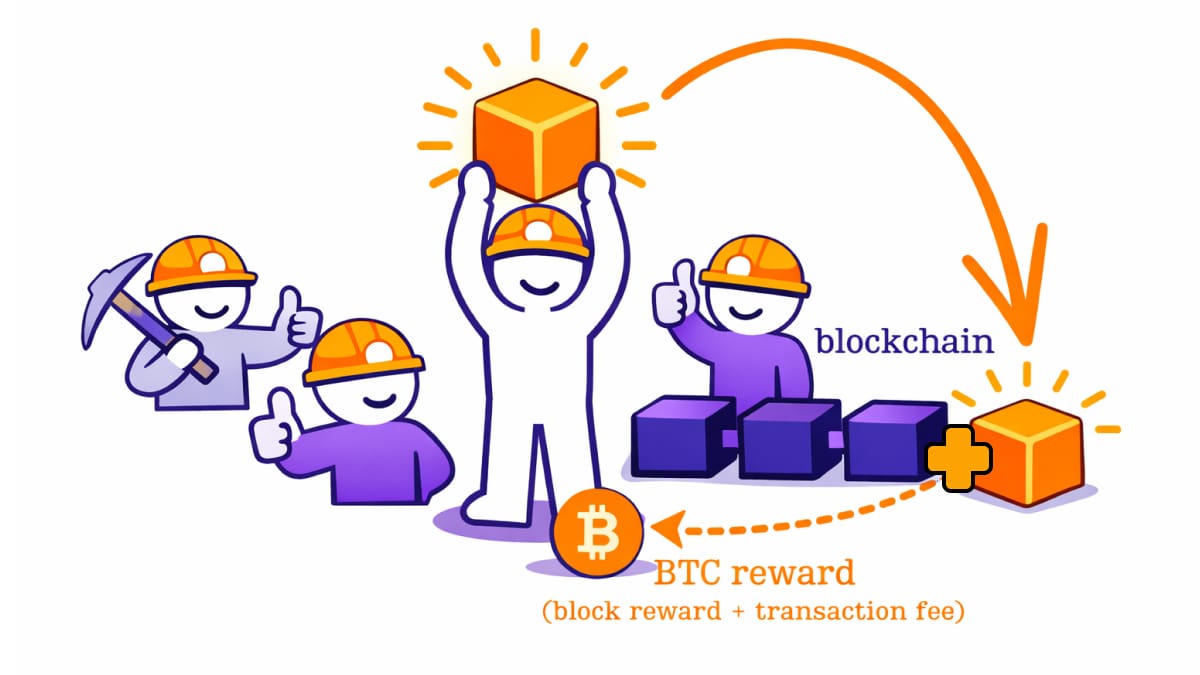
The first miner to find a valid hash broadcasts their block to the network. Other miners verify it, and once confirmed, the block is permanently added to the blockchain. The winning miner receives newly minted Bitcoin plus transaction fees — small amounts that senders voluntarily attach to their transaction to incentivize miners to include it in the next block.
Mining Difficulty
Bitcoin is designed to produce a new block roughly every 10 minutes. But as more miners join and computing power (called hashrate — the total number of hash guesses the entire network can make per second) increases, puzzles could be solved too quickly.
To keep the speed consistent, the network automatically adjusts the mining difficulty every 2,016 blocks (approximately every two weeks). If miners are solving blocks too fast, the difficulty increases. If they’re too slow, it decreases. This self-adjusting mechanism ensures that Bitcoin remains predictable, even if many more miners join the network.
Mining Rewards and Bitcoin Halving
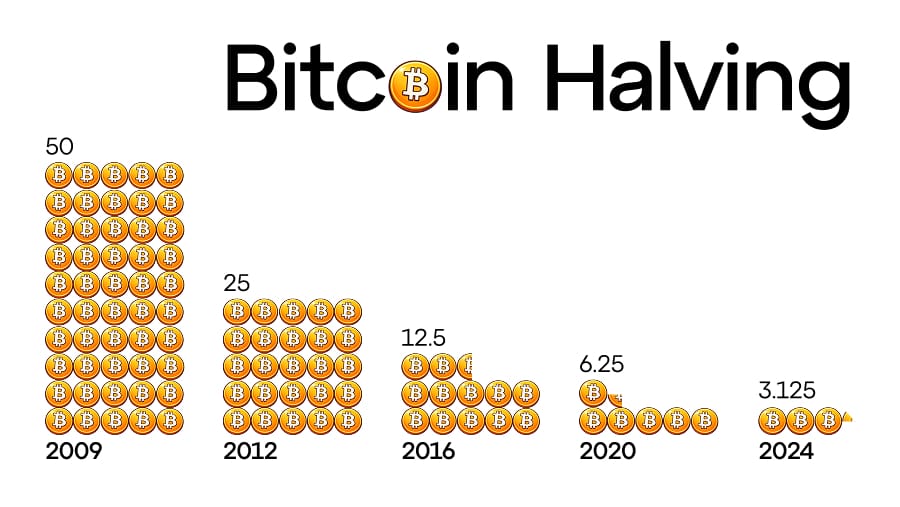
When a miner successfully adds a new block to the blockchain, they receive a block reward. When Bitcoin launched in 2009, this reward was 50 BTC per block.
But here’s the key detail: approximately every four years (every 210,000 blocks), this reward is cut in half — an event known as Bitcoin halving. After the most recent halving in April 2024, the reward dropped to 3.125 BTC per block.
Halving exists to control Bitcoin’s supply. There will only ever be 21 million Bitcoin. By reducing the reward over time, new Bitcoin enters circulation more slowly, making it increasingly scarce.
Bitcoin Mining Today
In the early days, anyone could mine Bitcoin on a regular laptop. That is no longer possible!
Today, Bitcoin mining is an industrial operation. Miners use specialized hardware called ASICs (Application-Specific Integrated Circuits) — machines built exclusively for mining.
A regular computer tries to do many things at once (browse the web, run apps, play video); an ASIC does exactly one thing: compute hashes, and it does it thousands of times faster. This is why home computers simply can’t compete anymore.
Large-scale mining farms are located in regions with cheap electricity and cool climates. Many individual miners now participate through mining pools — groups where miners combine their computing power and split the reward proportionally.
For example, if your miner contributes 1% of a pool’s total hashrate, you receive 1% of every block reward the pool wins, paid out regularly rather than waiting potentially years to win a block solo.
For those who want to participate in Bitcoin mining without buying hardware at all, platforms like GoMining offer another path. GoMining lets users own a digital miner — a unique digital asset tied to real ASIC hardware running in audited data centers around the world. Each digital miner represents a verified share of that physical equipment, which runs 24/7 generating Bitcoin on your behalf. No machines to set up, no electricity bills to manage, no technical expertise needed — GoMining takes care of all of that.
WARNING: Mining on a regular home computer is no longer profitable. The electricity costs alone would far exceed any potential earnings. If someone promises you easy profits from mining using your laptop or phone, be very cautious.
Common Beginner Myths
“Mining creates Bitcoin out of nothing.” Not true. Mining requires real computational power and electricity. The reward is compensation for securing the network, not free creation of value.
“Anyone can mine Bitcoin profitably at home.” This was true in 2009–2012. Today, mining requires specialized ASIC hardware and cheap electricity. Home computer mining is almost never profitable.
“Bitcoin mining is just wasting energy.” Mining does consume energy, but it serves a critical purpose: securing a decentralized financial network. The energy debate is real, but calling it “waste” oversimplifies a complex topic. We delved deeper into this topic in this lesson on Bitcoin's energy consumption debate.
Frequently Asked Questions
Is Bitcoin mining safe for beginners to try?
Mining itself isn’t dangerous, but it requires a large initial investment in hardware and electricity. Beginners should research thoroughly before spending money. We highly recommend GoMining!
How long does it take to mine one Bitcoin?
This depends entirely on your computing power. A single modern ASIC miner could take many years to mine a full Bitcoin solo — because you’re competing against the entire global network. That’s why some miners prefer a service like GoMining, where they earn small fractions of Bitcoin regularly instead of waiting to solve a block alone.
Where should a beginner start?
Start by understanding how mining works (you’re already doing that!). If you want to participate without buying hardware, look into GoMining. It’s a solid entry point in the world of mining, and you can start with small sums and work your way up as you get more comfortable.
Key Takeaways for Beginners
- BTC mining is the process of verifying transactions and adding them to the blockchain, in exchange for newly minted Bitcoin.
- Mining keeps Bitcoin secure, validated, and decentralized — it’s the backbone of the entire network.
- Miners compete to solve mathematical puzzles using Proof of Work. The winner earns the block reward.
- Mining difficulty adjusts automatically to keep block production steady at roughly one every 10 minutes.
- The block reward halves approximately every four years, making Bitcoin increasingly scarce.
- Today, mining is industrial — it requires ASIC hardware and significant electricity. Home mining on a regular computer is no longer viable.
- Before investing in mining, understand the costs, the risks, and remember that nothing in crypto is guaranteed.