Staking vs Yield Farming: What’s the Difference?
 Alex D
If you've spent any time exploring crypto, you've likely come across two promises that seem to appear everywhere: you can earn money by staking your tokens, or you can earn even more through something called yield farming.
Both sound appealing. Both involve putting your crypto to work instead of just holding it. But they are not the same thing — and choosing the wrong one for your situation, or diving in without understanding the risks, can be a costly mistake.
The good news is that once you see how each one actually works, the difference becomes clear. Here’s the simplest way to think about it.
Staking crypto is like putting your money into a savings account to help your bank stay secure. You lock it up, and the bank pays you interest for your commitment.
Yield farming is more like actively moving your money between different investment opportunities, trying to find the best return at any given time.
Before we go further, it helps to understand one foundational idea: crypto yield is not magic.
Every return you earn comes from somewhere — transaction fees, interest paid by borrowers, or newly created tokens. Some of those sources are sustainable, others aren't.
Keeping that in mind will help you read the numbers you'll encounter in this article more critically. If you want the full breakdown of how crypto yield works, we've covered it separately in our article “What is DeFi Yield, and How Does It Really Work?”
In this article, we'll look at from a different perspective. We’ll break down what staking and yield farming are, how they work, how they differ, and which one might be the right starting point for you.
What Is Staking?
Staking Explained: The Basics
Staking means locking your crypto tokens in a blockchain network to help it operate securely. In return, you earn rewards — typically paid in the network’s native token, which sometimes is the same token you staked.
But why does the network need your tokens in the first place?
The network needs your tokens because it needs to trust you. To confirm that transactions are valid and that nobody is cheating, a blockchain must reach consensus — meaning all participants agree on the same version of events. Some blockchains, such as Bitcoin, achieve this through massive computing power, a method called proof-of-work. But many modern blockchains — like Ethereum, Solana, and Cardano — use a different approach called proof-of-stake (PoS).
In a proof-of-stake system, instead of burning electricity to solve complex puzzles, the network selects validators — participants who stake (lock up) their tokens as a form of security deposit. These validators are responsible for confirming transactions and adding new blocks to the blockchain.
Here’s the key part: if a validator acts dishonestly or makes errors, the network can slash their stake — take their locked tokens away as a penalty. This is what keeps everyone honest: you have real money on the line.Think of it like a security deposit when you rent an apartment. If you take care of the place, you get your deposit back (plus rewards, in this case). If you cause damage, you lose part of it.
How Staking Rewards Work
When you stake your tokens, the network rewards you for your contribution to its security and operations. These staking rewards come from two main sources:
Newly minted tokens -The blockchain creates new tokens with each new block and distributes them to validators and stakers. The rate at which new tokens are created is set by the protocol's rules and cannot be changed by any single person or institution — it's built into the code from the start.
Transaction fees - Every time someone sends crypto or interacts with a smart contract, they pay a small fee. A portion of these fees goes to the validators who process those transactions.
Staking rewards come in two forms worth distinguishing:
- Rewards from transaction fees are considered real yield — actual money paid by real users for a real service, which makes them more sustainable over time.
- Rewards from newly minted tokens, on the other hand, increase the total token supply, which can dilute the value of existing tokens — this is known as inflationary yield.
If you want to go deeper on what makes yield sustainable versus not, our article on DeFi yield covers this in detail.
Do You Need to Run a Validator?
Running a validator node requires technical knowledge, dedicated hardware, and a significant amount of tokens. For example, becoming an Ethereum validator requires 32 ETH — a substantial investment!
But here’s the good news: most people don’t need to run a validator themselves. Instead, you can delegate your tokens to an existing validator. You keep ownership of your tokens, the validator does the technical work, and you both share the rewards. Many wallets and platforms make this as easy as pressing a button.
There’s also liquid staking — a newer approach in which you stake your tokens through a protocol and receive a “receipt token” in return (like stETH for staked ETH). This receipt token can be traded, used as collateral in DeFi, or deposited elsewhere to earn additional yield — all while your original tokens continue earning staking rewards in the background.
Typical Staking Returns
Staking yields tend to be modest but relatively predictable. Most major proof-of-stake networks offer somewhere between 3% and 12% APY (Annual Percentage Yield, with compound interest), depending on the network, the total amount staked, and current network activity.
These numbers might not look as exciting as triple-digit DeFi yields, but remember what we learned about sustainability: lower, fee-based returns tend to last much longer than flashy token emission rewards.
What Is Yield Farming?
Yield Farming Explained: The Basics
Yield farming in DeFi — also known as liquidity mining — is the practice of depositing your crypto into DeFi protocols to earn rewards. Unlike staking, which helps secure a blockchain network, yield farming provides liquidity or capital that DeFi protocols need to function.
DeFi protocols like decentralized exchanges — often called DEXs — and lending platforms can't operate on their own. A DEX needs tokens sitting in its liquidity pools so that traders can swap between them. A lending protocol needs deposits to lend out funds.
Without users providing that capital, these services simply don't function — and yield farming is how protocols attract it. If you want to understand how these protocols work under the hood, refer to our DeFi yield article.
Yield farming is how these protocols attract that capital. You deposit your tokens, the protocol puts them to work, and you earn yield in return.
How Yield Farming Works
The mechanics depend on the type of protocol you’re using:
- Providing liquidity to a DEX:You deposit a pair of tokens (say, ETH and USDC) into a liquidity pool. Traders who swap between these tokens pay a small fee, and you earn a share of those fees proportional to your deposit. This is fee-based, real yield — the most sustainable kind.
- Lending through a protocol: You deposit tokens into a lending pool, borrowers pay interest, and that interest flows back to you. Rates fluctuate based on borrowing demand — more borrowers mean higher rates for you.
- Earning bonus token rewards: On top of fees or interest, many protocols distribute their own governance tokens as extra incentives. This is the “farming” part that gives crypto yield farming its name. As we covered previously, these token rewards can be very attractive in the short term, but often aren’t sustainable if they rely on token emissions rather than real economic activity.
The Active Side of Yield Farming
Here’s where yield farming really differs from staking: it often rewards an active approach.
Experienced yield farmers don’t just deposit and forget. They constantly monitor rates across different protocols, move funds to wherever the best returns are, and compound their earnings by reinvesting rewards. Some use multiple strategies at once — for example, staking a receipt token from one protocol in another to earn yield on top of yield.
This can be lucrative, but it also means more time, more transactions (each costing gas fees), and more complexity. It’s closer to active portfolio management than passive investing.
Typical Yield Farming Returns
Yield farming returns vary enormously. Before we get to that, let’s define stablecoins. They are cryptocurrencies designed to hold a steady value, usually pegged to $1 USD (such as USDC or USDT). Stablecoin lending pools on established platforms might offer 2–10% APY — modest, but relatively stable. Newer protocols or more volatile token pairs can advertise 50%, 100%, or even 1,000%+ APY.
But as we explained in the DeFi yield article, those eye-catching numbers almost always rely heavily on token emissions. They attract deposits quickly, the rewards get diluted, and the rates drop — sometimes within days. By the time you see a “500% APY” headline, the best returns are likely already gone.
Key Differences: Staking vs Yield Farming
Now that you understand how each one works, let’s put them side by side. The table below summarizes the core differences:
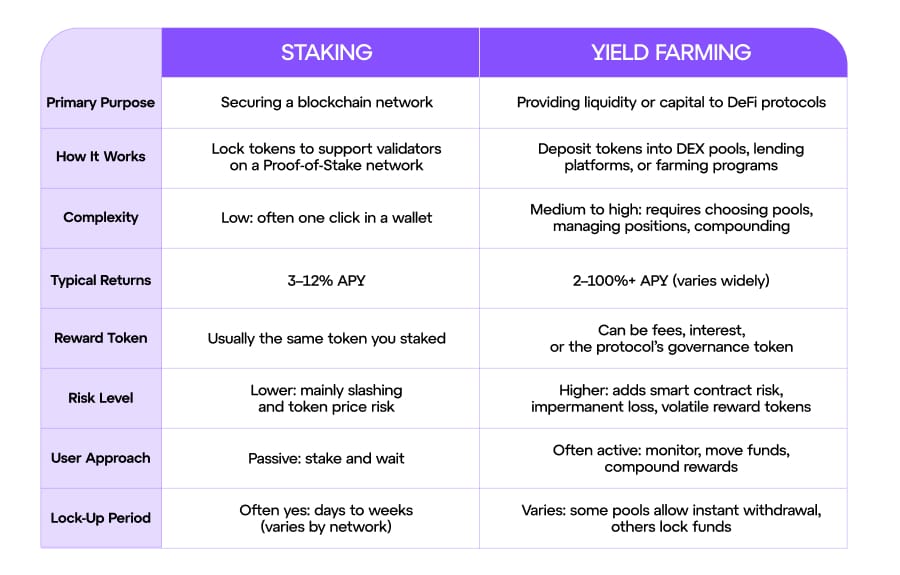
Let’s unpack a few of these differences in more detail.
Purpose: Security vs Liquidity
The fundamental difference is this: what are your tokens being used for?
When you stake, your tokens help keep a blockchain network secure and operational. When you yield farm, your tokens provide the liquidity that DeFi services depend on — enabling trades, loans, and other financial operations.
Neither is “better” in an absolute sense. They serve completely different functions in the crypto ecosystem.
Passive vs Active
Staking is largely a hands-off activity — you set it up once and just leave it running. You pick a network, delegate to a validator (or use a liquid staking protocol), and rewards accumulate automatically. You might check in every few weeks or months to review your rewards.
Yield farming, on the other hand, often rewards active management. New pools appear, rates change constantly — and so do incentives. The most successful yield farmers treat it almost like a part-time job — constantly optimizing their positions.
Return Predictability
Staking returns are relatively stable. They fluctuate with network activity, but major swings are uncommon. If a network is paying 5% APY today, it’ll likely be somewhere in that range next month.
Yield farming returns, however, can be wildly unpredictable. A pool offering 80% APY today might drop to 10% next week as more capital enters, or spike even higher if a new incentive program launches. This unpredictability is a big part of what makes yield farming more exciting — and more risky.
Risks: What Can Go Wrong?
Both staking and yield farming carry risks — and this is worth stating plainly: in DeFi, higher yield almost always comes with higher risk.
The two are not separate. When a protocol offers returns that seem unusually high, it's because the risk of losing some or all of your funds is also higher.
What differs between staking and yield farming is not whether risk exists, but what form it takes.
Staking Risks
- Slashing. If the validator you’ve delegated to acts dishonestly — for example, by trying to approve fraudulent transactions — or goes offline for too long, a portion of staked tokens can be slashed. This is rare with reputable validators, but it’s a risk worth understanding.
Always research a validator’s track record before delegating.
- Lock-up periods. Many staking protocols require you to wait before you can withdraw your tokens. On Ethereum, for example, unstaking can take several days. If the market drops sharply during that period, you can’t sell to cut your losses.
- Token price volatility. You might earn 8% APY in staking rewards, but if the token’s price drops 40%, you’re still at a significant loss overall. Staking rewards don’t protect you from market downturns.
Yield Farming Risks
Yield farming carries all the risks of staking plus several additional ones:
- Smart contract risk. Your tokens are deposited into smart contracts — pieces of code that manage funds automatically. If that code has a bug or vulnerability, your funds can be lost or stolen. Even audited protocols aren’t immune. The more protocols you interact with, the more exposure you have.
- Impermanent loss. If you’re providing liquidity to a DEX pool, price changes between the two tokens in your pair can result in you ending up with less value than if you’d simply held the tokens. This is called impermanent loss — and despite the name, the losses can become very permanent if you withdraw at the wrong time.
- Volatile reward tokens. As we covered in the DeFi yield article, earning yield in a governance token is very different from earning in a stablecoin. If the reward token drops in price, your “100% APY” can quickly become much less impressive in dollar terms.
- Rug pulls and exploits. Newer, unaudited protocols offering the highest yields also carry the highest risk of outright fraud or exploits. A protocol could be designed from the start to steal user deposits, or it might simply be poorly built and vulnerable to attacks.
WARNING: The higher the advertised yield, the more carefully you should investigate the risks. If a protocol offers 500% APY with no clear explanation of where that yield comes from, treat it as a major red flag.
Which Is Better for Beginners?
If you’re just starting in DeFi, staking is almost always considered the better place to begin. Here’s why:
It’s simpler: Staking usually involves just one action: choosing a validator (or a liquid staking protocol) and locking your tokens. There’s no need to manage token pairs, monitor fluctuating rates across multiple protocols, or worry about impermanent loss.
It’s more predictable: Staking returns are modest but relatively stable. You're far less likely to see your rewards collapse overnight compared to yield farming, where a reward token crashing can wipe out your APY almost instantly.
It carries fewer risks: With staking, your primary risks are token price changes, slashing (rare with good validators), and lock-up periods. Yield farming adds layers of smart contract risk, impermanent loss, and volatile reward tokens on top of those.
It teaches the fundamentals: Staking helps you understand how blockchains work, what validators do, and what it means to earn yield from network participation. These concepts form the foundation for everything else in DeFi.
Once you’re comfortable with staking and have a solid understanding of how DeFi protocols work, you can explore yield farming — starting with low-risk strategies like stablecoin lending pools on established platforms before moving to more complex strategies.
A Common Beginner Misconception
Many beginners assume that higher APY automatically means a better opportunity. This is one of the most dangerous misconceptions in DeFi.
A staking reward of 5% APY on Ethereum is backed by one of the largest and most secure blockchain networks in the world. A yield farming pool advertising 300% APY on an unknown protocol might look ten times better on paper — but it could vanish tomorrow, leaving you with worthless tokens or no tokens at all.
Common Beginner Mistakes
Knowing what not to do is just as important as knowing what to do. Here are the most common mistakes beginners make when getting into staking and yield farming:
Chasing the highest APY without understanding it. A triple-digit APY is almost always driven by token emissions, not sustainable fees. Before depositing anywhere, understand where the yield comes from.
Ignoring lock-up periods. Some staking protocols lock your tokens for weeks. Some yield farming programs have exit penalties. Always check the terms before you deposit — you don’t want to discover you can’t withdraw right when you need to.
Using unaudited or unknown protocols. New protocols can offer incredible rates, but they also carry the highest risk of bugs, exploits, or outright fraud. Stick with established, audited protocols until you have enough experience to evaluate newer ones.
Forgetting about gas fees. Every transaction on a blockchain costs a gas fee. If you’re constantly moving funds between pools or compounding small positions, gas fees can eat into your returns significantly — sometimes wiping out your yield entirely.
Not accounting for token price risk. You might earn 10% APY in staking or farming rewards, but if the underlying token loses 50% of its value, you’re still losing a lot overall. Always consider the overall market risk, not just the yield percentage.
Depositing more than you can afford to lose. DeFi is exciting, but it’s not a savings account. Smart contracts can be exploited, tokens can crash, and protocols can fail. Only use funds that you’re genuinely prepared to lose.
Frequently Asked Questions
Is staking safe for beginners?
Staking on major proof-of-stake networks (like Ethereum, Solana, or Cardano) through reputable validators is one of the lower-risk activities in DeFi. However, “lower risk” doesn’t mean “no risk.” You’re still exposed to token price volatility, potential slashing, and lock-up periods. Start with a small amount and learn the mechanics before deciding to commit more.
Can I lose money yield farming?
Yes. You can lose money through impermanent loss, smart contract exploits, reward token price drops, or by depositing into a fraudulent protocol. Yield farming is not a guaranteed income stream — it’s an activity that carries real financial risk.
Can I do both staking and yield farming at the same time?
Absolutely. Many experienced users stake part of their portfolio for steady, lower-risk returns while farming with another portion for potentially higher (but riskier) rewards. Liquid staking even lets you do both simultaneously — your tokens earn staking rewards while the receipt token is used in DeFi protocols.
Where should a complete beginner start?
Start with staking a well-known token (like ETH or SOL) through a reputable platform or liquid staking protocol. Focus on understanding how rewards accumulate, what lock-up periods mean, and how the blockchain you’re staking on works. Once you’re comfortable, explore a stablecoin lending pool on a major platform as your first step into yield farming.
How much money do I need to start?
There’s no minimum for most staking and yield farming opportunities — but keep gas fees in mind. If you’re depositing $20 and the transaction costs $5 in gas, you’re already starting at a 25% loss. Make sure your deposit size makes the fees worthwhile.
Key Takeaways
Staking secures a blockchain network. It’s simpler, more predictable, and carries fewer risks — making it an ideal starting point for beginners.
Yield farming provides liquidity to DeFi protocols. It offers potentially higher returns but comes with more complexity and additional risks like impermanent loss and smart contract vulnerabilities.
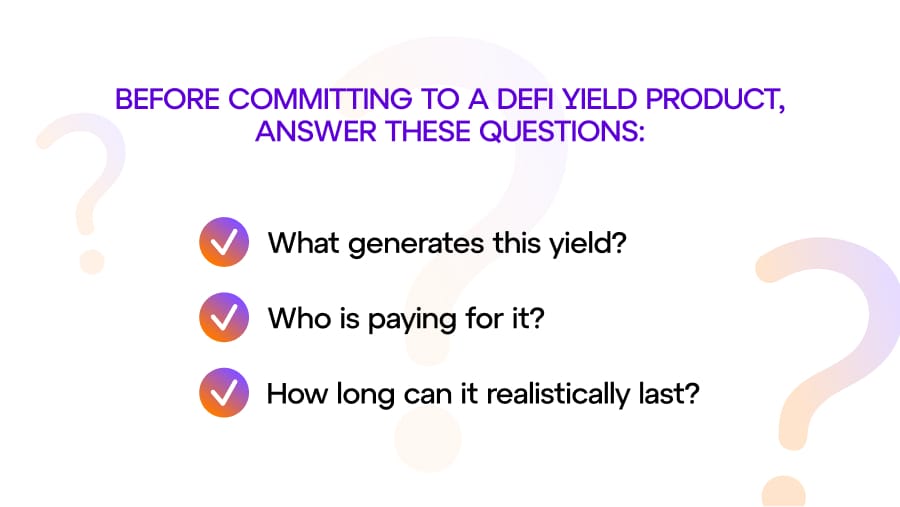
Higher APY doesn’t mean better. Always understand what generates the yield, who pays for it, and how long it can last before committing your funds.
Start small and simple. Begin with staking on a major network, learn the fundamentals, and expand into yield farming gradually as your knowledge grows.
Remember: in DeFi, knowledge is your best protection. The more you understand about how these systems work, the better equipped you’ll be to earn yield safely and avoid costly mistakes.