Bitcoin Mining Difficulty Explained
 Zamy
Zamy
A beginner-friendly breakdown of Bitcoin mining difficulty, why it changes, and what those changes mean for miners and the network.
What You’ll Learn
- What Bitcoin mining difficulty really measures
- Why difficulty adjusts every 2,016 blocks
- Why difficulty usually rises — and when it falls
- How difficulty affects rewards and profitability
- How to read difficulty charts without overthinking them
The Engine Behind Bitcoin’s Mining Difficulty
Mining difficulty is one of those Bitcoin metrics everyone talks about — and almost no one explains clearly.
You see it rising on charts. You hear it mentioned alongside mining profitability, halvings, and hashrate. And it’s easy to assume that higher difficulty simply means mining is getting worse.
But that assumption misses what difficulty actually does.
Mining difficulty is not a score or a warning. It’s a control system that keeps Bitcoin running on time, no matter how many miners join or leave the network.
In this guide, you’ll learn what mining difficulty really measures, why it changes, and how to read it without guessing. By the end, difficulty will stop feeling like an abstract number and start feeling like a signal you can actually use.
A few terms will show up again and again in this guide. You don’t need to memorize them — this is just a quick reference to keep things clear as you read.
Mini glossary (keep this in mind as you read)
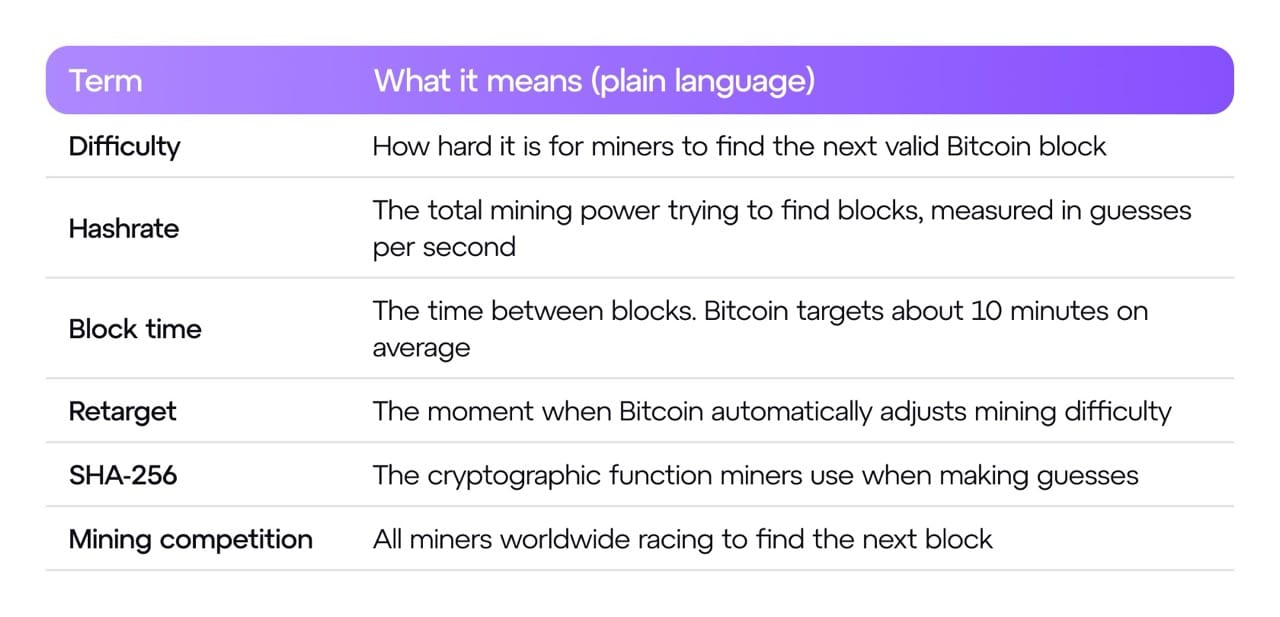
Table of Contents
- What Is Bitcoin Mining Difficulty? (Explain Like I’m 10)
- How Bitcoin Mining Difficulty Works (Beginner Breakdown)
- Why Mining Difficulty Usually Rises (But Sometimes Falls)
- Difficulty vs Hashrate — What’s the Difference?
- How Difficulty Affects Miners and Profitability
- Difficulty After Halvings — What Beginners Should Expect
- How to Track Bitcoin Difficulty (Beginner Tools)
- What Difficulty Means If You’re Thinking About Mining
- Conclusion
- FAQ
What Is Bitcoin Mining Difficulty? (Explain Like I’m 10)
Bitcoin mining works like a global lottery, except the winning rule keeps changing. Miners submit guesses nonstop. Each guess is just a number, and only one kind of number counts.
When the Bitcoin network wants mining to slow down, it increases how many zeros are required. When it wants mining to speed up, it allows fewer. Nothing else about the lottery changes — only how strict the winning rule is.
That adjustable rule is mining difficulty. Miners don’t set it, and they can’t bypass it. Bitcoin updates it automatically based on how fast blocks are being found.
Beginner Definition
In plain language, Bitcoin mining difficulty describes how hard it is to find the next valid Bitcoin block.
Behind the scenes, miners’ guesses are generated by running a cryptographic function called SHA-256. For a block to count, one of those results must fall below a target set by the network. That target is simply a cutoff number that separates winning guesses from the rest.
When the target is stricter, fewer guesses qualify. When it is looser, more do.
Bitcoin adjusts this target automatically so blocks keep arriving at a steady pace — about one every 10 minutes — no matter how many miners are competing.
Why Difficulty Exists
Mining difficulty exists to keep Bitcoin running on a predictable schedule, even as miners come and go.
First, it prevents blocks from being mined too quickly. If a large amount of mining power suddenly comes online, blocks would otherwise arrive faster and faster. Difficulty steps in to slow the network back toward its target pace.
Second, it keeps Bitcoin’s supply schedule predictable. Because new blocks are added at a steady rhythm, new BTC enters circulation on a timeline the network can rely on.
Third, it balances global mining competition. Miners operate across different countries, power grids, and hardware setups. Difficulty adjusts so sudden shifts in mining power do not permanently disrupt block timing for everyone else.
Without difficulty, Bitcoin’s pace would constantly speed up and slow down depending on who plugged in or shut off. With it, the network stays steady even as miners, machines, and locations change.
How Bitcoin Mining Difficulty Works (Beginner Breakdown)
The Target Block Time — 10 Minutes
Bitcoin aims to produce one new block about every 10 minutes, on average.
If blocks start arriving faster than that, it means the network has too much mining power online, and blocks are being found too easily. Difficulty goes up.If blocks start arriving slower than that, it means mining power dropped or conditions changed. Difficulty goes down.
Difficulty isn’t trying to reward or punish anyone. It’s simply trying to pull block timing back toward the 10-minute target.
The 2016-Block Adjustment Rule
Bitcoin doesn’t change difficulty after every block. Instead, it waits and looks at a larger sample.
- It reviews the last 2,016 blocks.
- It checks how long they actually took to mine.
- Then it adjusts difficulty for the next set of blocks.
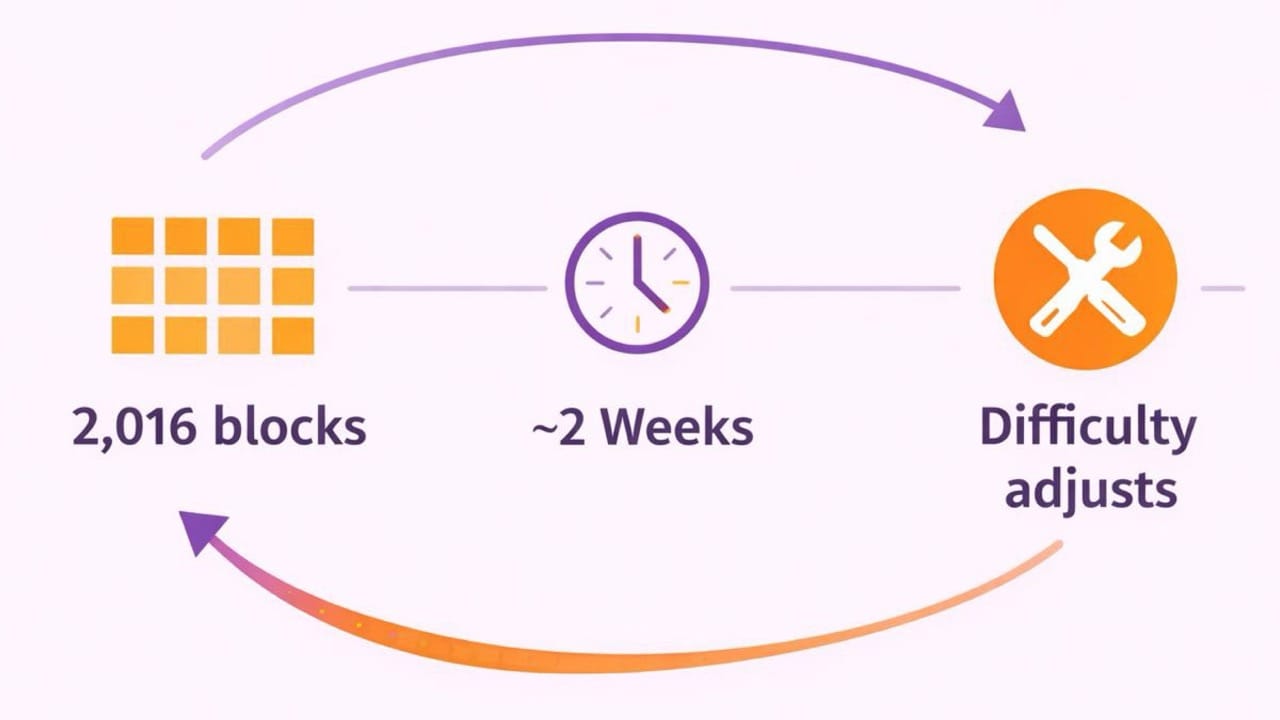
Difficulty adjusts every 2,016 blocks based on how fast the previous blocks were mined.
Why 2,016 blocks?
Because:
2,016 blocks × 10 minutes ≈ 20,160 minutes — about two weeks.
Looking at a full two-week stretch helps avoid reacting to short-term swings. Some blocks are found quickly, others take longer, so Bitcoin waits before making any changes.
About every two weeks, the network asks one simple question:
“Were blocks arriving too fast or too slow?”
Bitcoin expects the last 2,016 blocks to take about two weeks.
If those blocks were mined in closer to 12 or 13 days, that tells the network miners were working faster than expected. At the next adjustment, Bitcoin increases difficulty so the next blocks take longer to find.
If the same 2,016 blocks took more than two weeks, the opposite happens. Difficulty drops so blocks are easier to find and the pace speeds back up.
The update happens automatically and applies to everyone at the same time.
Difficulty Formula
You don’t need the full math. Bitcoin is making a simple comparison.
At a high level, it looks like this:
Difficulty ≈ expected time ÷ actual time
The expected time is about two weeks for 2,016 blocks. The actual time is how long those blocks really took to mine.
If blocks are mined faster than expected, difficulty goes up.If they are mined slower than expected, difficulty goes down.
That’s it. Bitcoin compares how fast blocks arrived versus how fast they were supposed to arrive, then adjusts difficulty to keep timing steady.
Why Mining Difficulty Usually Rises (But Sometimes Falls)
If you zoom out on a Bitcoin difficulty chart, one pattern stands out: difficulty tends to climb over time, with occasional drops along the way. Those drops are usually temporary.
Why difficulty usually rises
Difficulty rises for one simple reason: blocks start arriving faster than the network expects.
That can happen in different ways — more miners joining, miners upgrading their machines, or mining becoming more attractive when price rises. In each case, the effect is the same: more guesses per second, faster blocks, and a higher difficulty at the next adjustment.
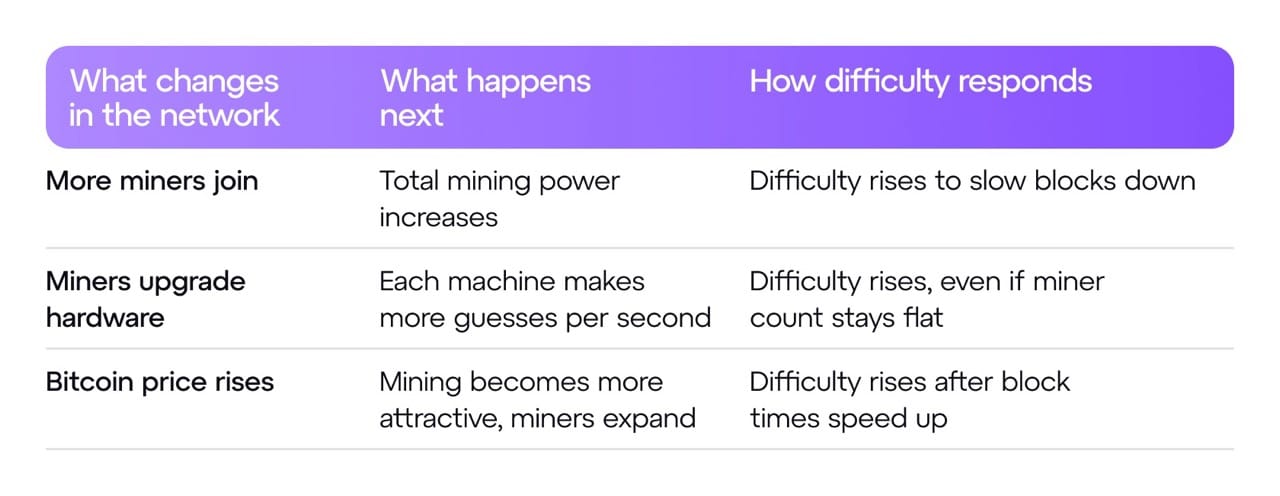
The important thing to notice is that difficulty doesn’t rise because of a single cause. It rises whenever mining power increases faster than the network expects, no matter why that increase happens.
When Difficulty Falls
Difficulty can drop when large amounts of mining power go offline in a short time.
This happened in 2021 after the China mining ban, when many miners shut down at once. Blocks slowed down, and difficulty adjusted lower in the following periods.
Similar drops can happen during power outages, regulatory changes, or sudden cost increases. When fewer miners are active, blocks take longer to find, and difficulty decreases at the next update.
During these periods, miners who stay online face less competition and temporarily earn a larger share of rewards. These drops are usually short-lived. As mining power returns, difficulty usually resumes its upward trend.
Difficulty vs Hashrate — What’s the Difference?
These two terms are often mentioned together, which is why most people mix them up. They are closely related, but they are not the same thing.
A useful way to remember the difference is this: hashrate is what miners contribute. Difficulty is how the network reacts.
Hashrate = Mining power
Hashrate measures how much total computing power is actively trying to mine Bitcoin at any moment.
In practical terms, it reflects how many SHA-256 guesses miners are making every second across the network. When more machines come online, or when miners upgrade to faster hardware, that number goes up.
Higher hashrate means more work is being done to secure the network. It shows how much mining activity and competition exists right now.
Difficulty = Network’s Response
Difficulty is Bitcoin’s way of reacting to that mining power.
The network watches how quickly blocks are being found. If blocks start arriving faster than the target pace, difficulty increases. If they arrive too slowly, difficulty decreases.
Importantly, difficulty does not change in real time. It only updates at scheduled adjustment points, based on how blocks were found during the previous period.
Hashrate moves first. Difficulty follows.
Difficulty reacts to changes in hashrate to keep block timing on track.
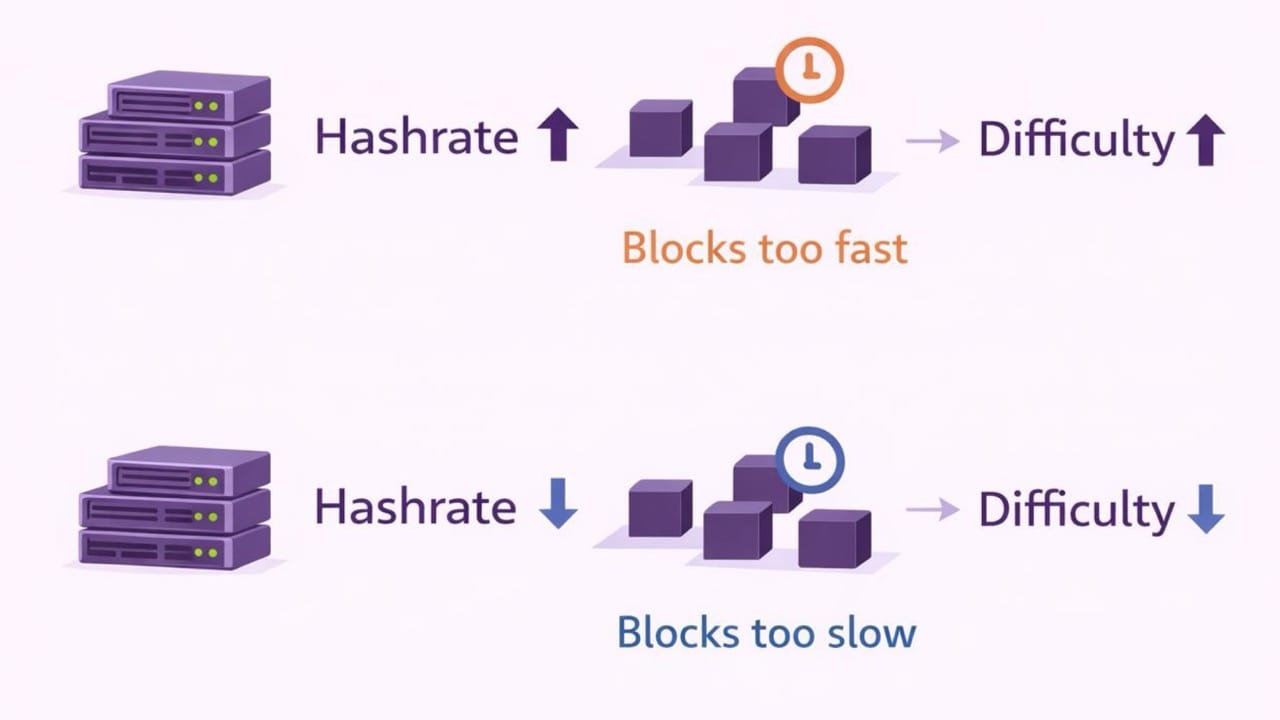
Hashrate is the pressure pushing on the system. Difficulty is the mechanism that keeps Bitcoin running on schedule.
How Network Difficulty Affects Miners and Profitability
Mining difficulty doesn’t live on charts only. It shows up directly in rewards, costs, and who can stay online as competition grows.
Higher Difficulty = Lower BTC Rewards per Miner
When difficulty rises, more mining power is competing for the same blocks. Each miner earns a smaller share, even if nothing about their setup changes.
Lower Difficulty = Higher BTC Output (Temporarily)
When difficulty drops, competition briefly eases. Miners who stay online can earn more BTC per unit of mining power until difficulty adjusts again.
Difficulty and ROI on ASICs
Difficulty plays a major role in how long it takes hardware to pay for itself. Rising difficulty stretches break-even timelines, especially for older machines.
Difficulty + Electricity Costs
As difficulty increases, inefficient setups feel pressure first. High electricity costs get pushed out before efficient ones.
How these effects connect in practice
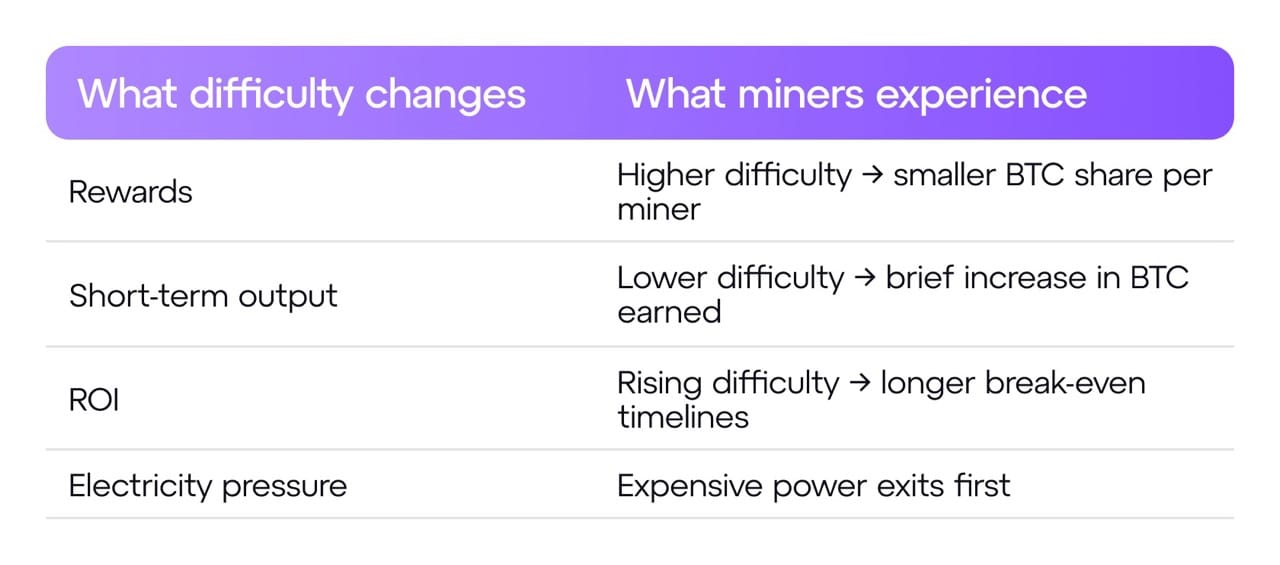
As difficulty rises, slow hardware and expensive power are the first to stop working.
Difficulty After Halvings — What Beginners Should Expect
Bitcoin halvings often get a lot of attention, and for good reason. They change how much BTC miners earn for each block they produce.
A halving is a scheduled event, roughly every four years, where the reward miners receive for each block is cut in half.
But it’s important to separate what the halving directly changes from what it does not.
What a Halving Changes (and What It Doesn’t)
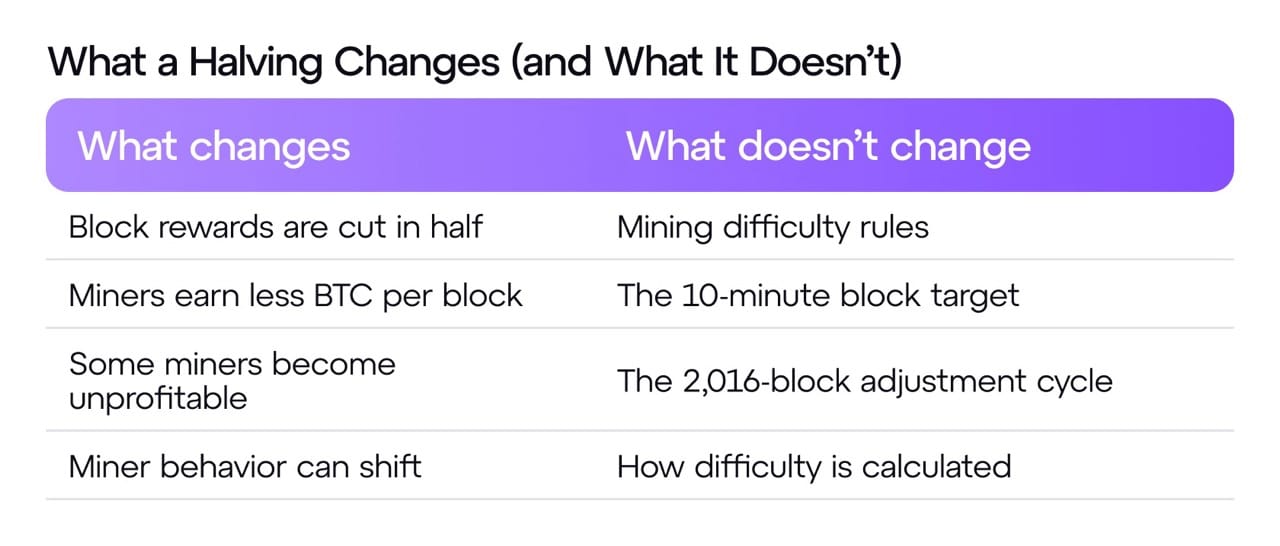
The key point is that difficulty doesn’t react to the halving itself. It reacts to how miners respond once rewards change.
Many miners turn off after halving
After a halving, miners earn less BTC for the same operating costs. For setups with expensive electricity or older hardware, margins can flip negative.
When miners shut down at scale:
- total hashrate drops
- blocks arrive more slowly
- difficulty can dip at the next adjustment
That dip reflects miners exiting. It is not caused by the halving itself, but by how miners respond to lower rewards.
What usually happens after the adjustment
Once difficulty adjusts, mining begins to settle again. Inefficient setups remain offline, while others upgrade hardware, relocate, or expand.
As competition rebuilds, hashrate increases and difficulty moves upward with it — following mining activity, not the halving event.
How to Track Bitcoin Difficulty (Beginner Tools)
You don’t need complex tools to follow mining difficulty. One clear chart is enough. There are several reliable places to track Bitcoin difficulty and mining data.
Here are commonly used options:
- Mempool.space → Shows Bitcoin difficulty, hashrate, and recent blocks in near real time.
- BTC.com → Straightforward charts for difficulty and mining stats.
- Glassnode → Advanced mining metrics for deeper analysis (some features are paid).
- Bitcoin Magazine Pro → Clean charts focused on network activity and difficulty.
- Mining pool dashboards → Pools like AntPool or Foundry publish live difficulty and pool performance.
Pick one or two and stick with them. Familiarity matters more than having five dashboards open.
How to read difficulty charts
Most difficulty charts look similar. What changes is how you interpret the moves.
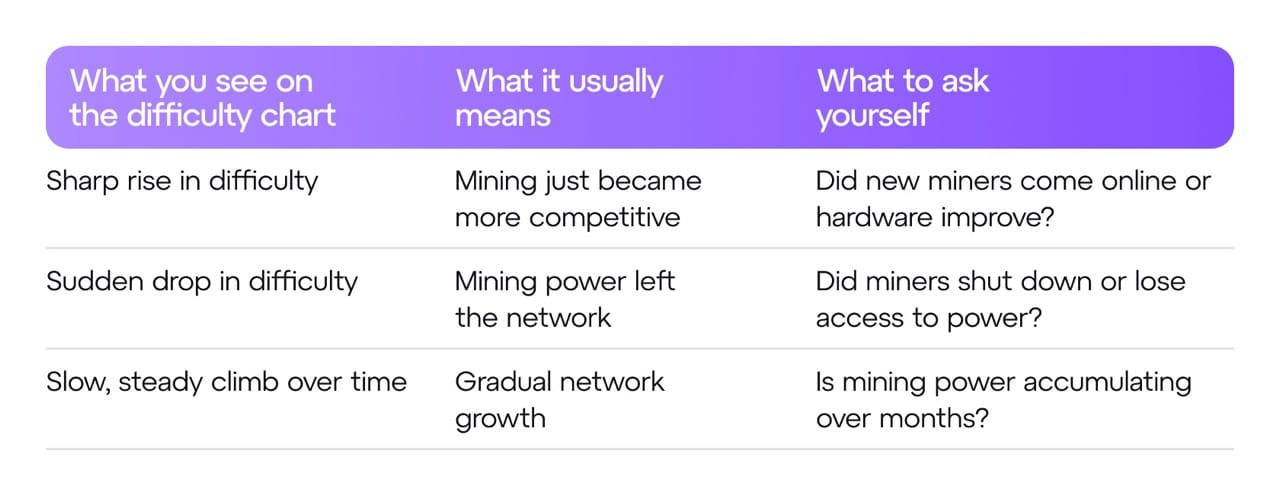
Difficulty reflects what already happened. It explains recent changes in mining power, not what will happen next.
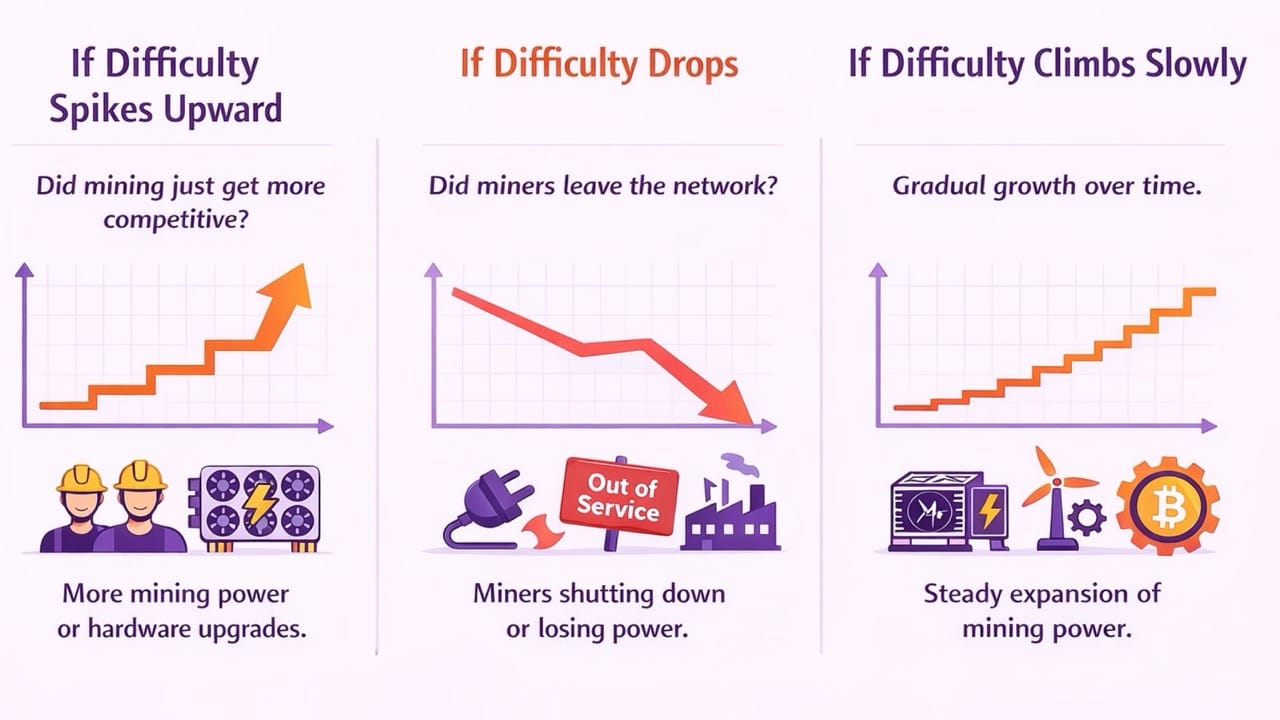
Difficulty charts tell stories through shape, not precision. Here, the pattern matters more than the exact number.
What Difficulty Means If You’re Thinking About Mining
By now, difficulty should feel less like a threat and more like a signal. What that signal means depends on how you’re involved with Bitcoin.
How difficulty shows up in different situations
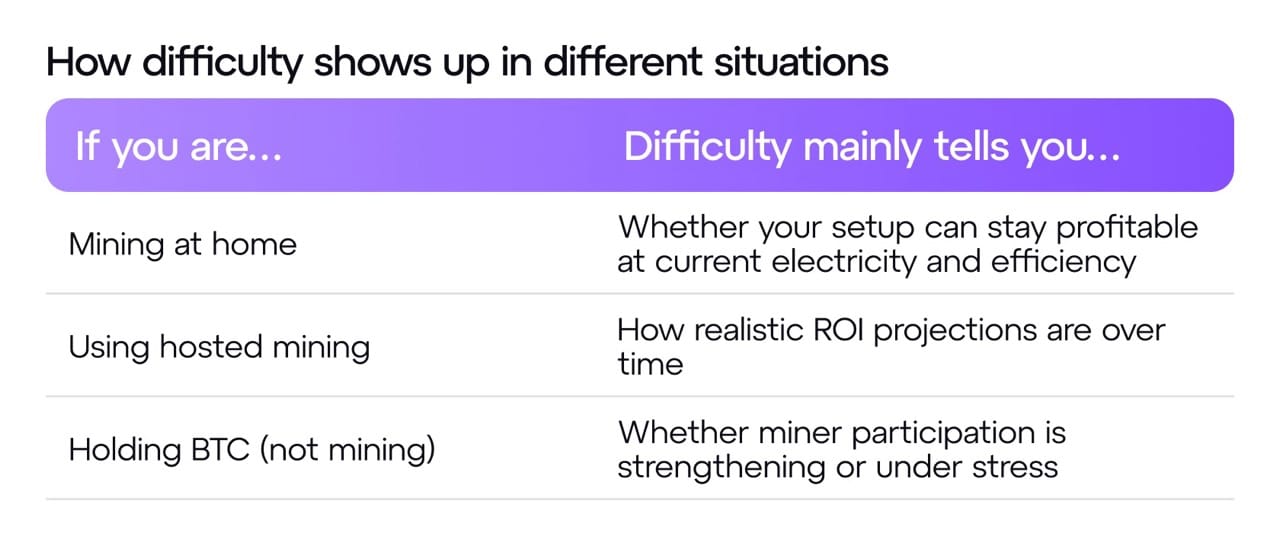
How to read it, at a glance
- High and rising difficulty: Mining is becoming more competitive. Inefficient setups feel pressure first.
- Short-term difficulty drops: Some miners went offline. Remaining miners briefly face less competition.
- Slow, steady increases: Mining power is accumulating gradually. This is typical long-term network growth.
If you want exposure to mining without running hardware yourself, options like GoMining are designed to reflect these difficulty dynamics without requiring direct operation.
Conclusion
Mining difficulty is what keeps Bitcoin steady.
It holds block timing close to 10 minutes and quietly balances competition between miners, no matter how much mining power comes online or goes offline.
For beginners, difficulty is worth tracking because it explains changes you actually notice: shrinking rewards, miner exits, or sudden slowdowns. It shows what already happened inside the network, not what headlines predict.
If you understand difficulty, mining stops looking random. You can read network health more clearly, set realistic expectations, and avoid common mistakes about profitability.
That’s what difficulty really is: the system keeping Bitcoin on time.
FAQ
Why does Bitcoin mining difficulty only adjust every 2,016 blocks?Because adjusting after every block would be too noisy. By waiting about two weeks’ worth of blocks, Bitcoin smooths out randomness and keeps block timing close to 10 minutes.
Will mining difficulty always go up forever?
No. It usually trends upward over long periods, but it can fall during disruptions, miner exits, or when mining becomes unprofitable for many operators.
Can mining difficulty ever crash?
Yes, if a large amount of mining power goes offline quickly. Blocks slow down first, then difficulty drops at the next adjustment to restore normal timing.
Does mining difficulty affect Bitcoin’s price?
Not directly. Price and difficulty influence each other through miner behavior, but neither controls the other.
Is mining still profitable when difficulty is high?
It can be. Profitability depends on electricity costs, hardware efficiency, and BTC price. High difficulty mainly removes inefficient setups faster.
How can I tell if difficulty is likely to increase or decrease next?
Look at recent block times. Faster blocks suggest a possible increase; slower blocks suggest a decrease. These are estimates until the official adjustment.
Does mining difficulty affect transaction fees?
No. Fees depend on demand for block space. Difficulty affects how hard blocks are to mine, not how full they are.