What Are Governance Tokens? Definition, Benefits & Examples
 Zamy
Zamy
A governance token is like unlocking a superpower in crypto: the power of voice.
They unlock the ability to help decide how a project evolves.
These tokens sit at the heart of decentralized finance (DeFi) and are spreading into the wider Web3 world, where communities —not just founders— steer the rules. They’ve already turned everyday users into stakeholders who can fund projects, approve upgrades, or tweak protocol fees.
But every superpower has its kryptonite, and governance tokens face a few: low voter participation, concentrated power, and messy debates. Still, adoption keeps growing across diverse fields.
By the end of this guide, you’ll understand what governance tokens are, how they work, where they succeed or fail, and why they’re becoming impossible to ignore in today’s digital economies.
What Are Governance Tokens?
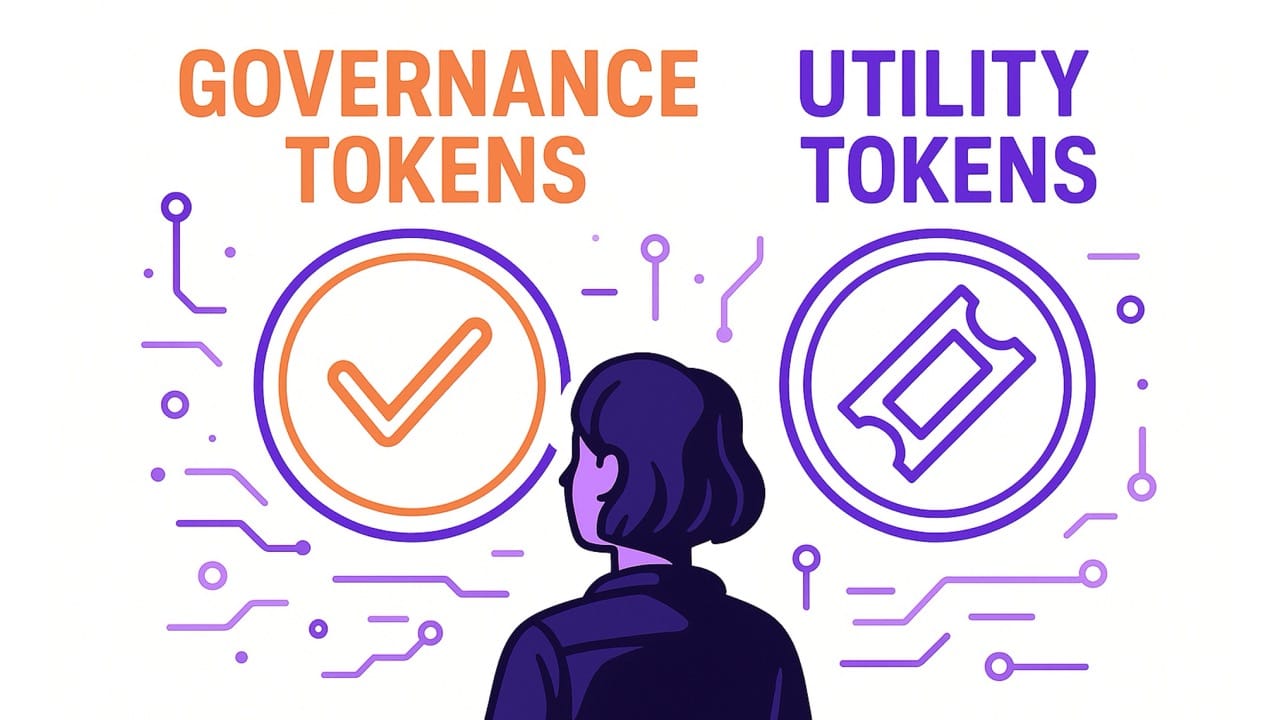
A governance token is like a superpowered digital voting sticker in a group chat where everyone helps decide what to do next — except instead of picking pizza toppings, you're shaping how a crypto project works. That’s why they’re different from utility tokens. Utility tokens are like tickets for access. Governance tokens hand you a voice: you’re not just using the service, you’re co-owning it, helping to decide rules and upgrades alongside everyone else.
The purpose is simple: shift control from a single team to the wider community. Instead of one founder or company calling the shots, decisions about upgrades, funding, or new features are opened up to those who own the tokens (token holders). You don’t need to be a coder or finance expert to join in — the point is to allow decentralized projects to evolve through community input, not top-down control.
So in short:
Governance tokens give you a seat in a project’s group decision-making. The more you hold, the louder you speak.
How Do Governance Tokens Work?
Now that you’ve got your superpowered sticker in the chat, how do group decisions actually play out? Let’s walk through the three moving parts that shape the outcome: who gets a voice, how proposals move forward, and how communities step in to guide direction.
Voting Power
In the group chat, every governance token works like a digital sticker you can use to vote. In most systems, one token equals one vote. If you hold more tokens, your voice carries more weight when results are counted. This turns tokens into both a membership badge and a voting chip, shifting influence from a single leader to the combined strength of the community.
Governance Mechanisms
Anyone can suggest a change — lowering fees, adding a feature, or shifting community funds — but it only sticks if enough people vote “yes.” In on-chain governance, proposals and votes are recorded directly on the blockchain, and once approved, smart contracts (self-running code) carry out the decision automatically. In off-chain governance, ideas are debated in forums or community calls before moving on-chain for final votes. This mix allows for both open discussion and automated enforcement.
Community Involvement
Voting power and rules only matter if people actually participate. Votes represent communities steering their own projects. Token owners can delegate their votes to trusted representatives, join debates in online forums, or propose new initiatives. Most of this happens inside DAOs, short for decentralized autonomous organizations — digital councils that translate thousands of individual preferences into collective decisions. This layer of coordination is what keeps governance tokens from being just symbolic and can turn them into an active force that shapes a protocol’s evolution.
That’s how a token stops being just a line of code and starts working like a superpower communities can actually use to shape their digital worlds.
Benefits of Governance Tokens
Why do people get excited about these tokens? It has a lot to do with their ability to create ripple effects far beyond the ballot box. Let’s look at the upsides that show up again and again when governance works well.
Decentralized decision-making: No single founder holds the kill switch. Rules don’t hinge on one company or personality: if a core developer leaves, if regulators raise questions, or if markets swing wildly, the community can still propose fixes and vote them through. Power spread across many hands usually makes the system harder to break.
Empowering everyday users: You’re not just a spectator anymore. Got an idea? You can draft a proposal, rally votes, and help decide the outcome. Participation turns users into co-owners.
Incentivizing engagement: Interesting things happen when crypto projects reward people for showing up. Gitcoin — a platform that funds open-source software — has directed over $67 million to projects chosen by community votes, showing how thousands of small voices can add up to major impact.
Driving innovation: When decisions come from many perspectives, projects avoid getting stuck in one way of thinking. Fresh voices bring fresh ideas and when thousands of people can weigh in, better solutions often surface than they would in a boardroom. Collective intelligence makes protocols more adaptable and creative.
When governance tokens work well, they turn a project into something beyond code: a living community that funds, debates, and builds together.
Risks and Challenges of Governance Tokens
Every superpower has its kryptonite, and governance tokens are no exception. Online discussions are split between those who see them as crypto’s fairest system and those who point to the cracks: concentrated power, low turnout, and governance attacks.
Concentration of power is the first. In theory, spreading tokens means spreading decision-making. In practice, the reality can look very different. A 2021 vote in Uniswap — one of the largest decentralized exchanges — made that clear. A Harvard-linked group requested 1 million UNI tokens from the project’s treasury. Most of the community opposed it, but just four large wallets carried enough voting power to approve the grant. The fund then quickly sold half the tokens for $10 million, breaking its own promise to release them gradually. For many smaller holders, it was proof that concentrated power can override broad participation.
Low participation is another overlooked risk. In Decentraland — a virtual world run by its community — fewer than 1% of holders usually take part in votes. It’s like a town meeting where almost every chair is empty, leaving a handful of voices to set the rules for everyone else. When turnout is that low, decisions can slide through without much debate, making the system look democratic on paper but fragile in practice.
Governance attacks show how rules can be weaponized. In 2022, Beanstalk — a lending protocol that relied on token voting — was drained of $181 million. The attacker used a flash loan, basically borrowing a massive pile of tokens for just a few seconds. That was long enough to seize majority voting power, push through a malicious proposal, and execute it before the community could react.
Complexity for everyday users can be the hardest obstacle. Reading a governance proposal can feel like wading through legal code, with pages of technical detail and confusing parameters. On top of that, voting sometimes costs several dollars in transaction fees. With that kind of friction, many smaller holders simply walk away from voting.
Every superpower faces a stress test. For governance tokens, it comes down to how communities use — or misuse — their voice. To see the stakes, we need to look at what happened when live projects put their rules to the test.
Examples of Governance Tokens
The best way to see governance tokens in action is to watch how real communities have tested their powers. Each project works like a classroom where crypto democracy plays out: sometimes inspiring, sometimes messy.
MakerDAO (MKR) is one of the oldest projects in decentralized finance. Its community votes on how to keep DAI — a digital dollar meant to stay close to $1 — safe and reliable. Members decide which assets can back DAI and how much risk to allow. The lesson: shared decision-making can keep a system strong, but if the community approves the wrong assets, even a stable digital dollar can be shaken.
Compound (COMP) works like a crypto savings and loans club. Token holders vote on which assets people can borrow or deposit, and how interest rates should work. Here, governance directly shapes who gets access to credit and on what terms. It’s a clear example of how voting can influence everyday financial activity.
Uniswap (UNI) is a giant among decentralized exchanges, where people trade tokens without banks or middlemen. UNI holders not only approve upgrades — they also oversee a community treasury worth billions. Managing shared resources at that scale shows governance is about stewardship as much as it is about votes.
Aave (AAVE) is another lending platform, standing out for high levels of innovation like flash loans and automated risk management. Its community voted in cross-chain features that let people borrow or lend across multiple blockchains. This shows coordination is possible when thousands share the load and have clear structures to keep decisions moving.
ENS (Ethereum Name Service) is the “.com” of crypto, turning long crypto addresses into simple names like alice.eth. When ENS launched its token in 2021, it dropped half a billion dollars’ worth into the community. But before claiming, users had to vote on four constitutional principles — a civic ritual that made members co-authors of the rules from day one. It showed governance can start with responsibility, not just rewards.
Together, these examples show governance tokens in action: stabilizing a digital dollar, setting loan rules, steering exchanges, managing treasuries, or even naming your wallet address. Each highlights how communities can take the driver’s seat — and the trade-offs that come with that power.
The Role of Governance Tokens in DeFi
Governance tokens in decentralized finance (DeFi) are more than voting stickers — they’re steering wheels for how lending, borrowing, and earning opportunities work. Instead of a CEO setting the rules, token holders shape them directly.
Shaping lending, borrowing, and yield: Imagine a lending protocol as a digital co-op. Anyone with the right collateral (assets locked as security) can take out a loan, and all the terms — how much collateral is needed, what the interest rates are, even whether new assets get added — are tuned by votes from governance token holders. Each vote shapes how the platform balances safety and growth.
Incentives for liquidity providers and developers: DeFi flips users into stakeholders. People who supply funds (liquidity providers) aren’t just earning interest; they’re often rewarded with governance tokens. That means they pocket rewards and gain a louder voice in the system’s future. Developers also get a direct channel: they can pitch upgrades or expansions, and if the community backs them, the work gets funded.
Integration with DAOs for decentralization: Most of this happens inside DAOs (decentralized autonomous organizations). Here, governance tokens are the keys: they let members propose, debate, and approve changes in public, with rules enforced by code and consensus rather than a few insiders.
DeFi is basically a borderless financial co-op, and governance tokens are how the members decide what’s next.
Future of Governance Tokens
The story of governance tokens is still unfolding, and new twists keep surprising even the people who’ve been around since the start. What began in DeFi lending and trading is now spreading to gaming communities, NFT projects, and even early tests with real-world assets like property or carbon credits.
Communities are also experimenting with ways to fix flaws in the first wave of governance. One promising idea is quadratic voting. Instead of one token always equaling one vote, each extra vote costs more. That means a small holder can make their voice heard without being drowned out by a single giant wallet. Optimism, a scaling project, has already tried this to level the playing field.
Cross-chain voting is another step forward. Normally, you’d have to move your tokens onto the chain where a proposal is being decided — a process that can be expensive or risky. Now, some systems let you vote securely from one chain while keeping your assets safe on another. Aave even found a way to shrink voting costs from about $50 in fees to under $1, making it much easier for everyday users to participate.
AI is also joining the mix. MakerDAO has tested bots that turn long, technical proposals into short, readable summaries. Other groups are exploring AI “delegates” — agents you can program with your values so they’ll vote on your behalf when you’re too busy to read every proposal. Supporters see this as a way to cut through the noise; critics worry it might encourage people to check out entirely.
And then there’s regulation. Some governments see governance tokens as securities, others treat them more like utility tokens, and the debate isn’t settled. In practice, that means projects need to keep innovating while bracing for legal changes.
What ties all of this together is the same idea that made governance tokens exciting in the first place: shifting control from insiders to communities. The next few years will bring more experiments, more missteps, and more breakthroughs. Whether it’s in DeFi, NFTs, gaming, or real-world assets, governance tokens are becoming the labs where digital democracy is tested in real time.
Conclusion
Governance tokens have come a long way from being “just voting chips.” They’re now the levers communities use to run lending platforms, fund open-source projects, steer exchanges, and even shape virtual worlds. In that sense, they’ve grown into something bigger: the control layer of the digital economy.
But the heart of the story hasn’t changed. These tokens matter because they spread power. Done right, they give thousands of people a real say in systems worth billions. Done poorly, they hand influence to a few whales or bury smaller voices under layers of complexity.
The future will bring new experiments — from AI tools that make voting easier to systems like quadratic voting that give smaller holders more weight. Real-world assets like property and carbon credits are already entering the mix. Regulation will also set boundaries, for better or worse.
For now, the takeaway is simple: governance tokens are not just about protocols, they’re about people. Their promise is a digital democracy where participation beats passivity. The risk is that without care, the same old power imbalances reappear.
The superpower is real. But like all superpowers, it requires wisdom to wield responsibly.