What Is Crypto Market Capitalization And How To Use It?
 Zamy
Zamy
Crypto market capitalization (or “market cap”) is a simple way to measure the size of a cryptocurrency.
It is calculated using this formula:
Market Cap = Current Price × Number of Coins in Circulation
For example, if a coin costs $1 and there are 20 million coins currently available on the market, the market cap would be:
$1 × 20,000,000 = $20 000 000 million
Due to liquidity dynamics, this number is easy to inflate: sometimes a relatively small amount of real demand can push market cap tens of times higher than intuition suggests. This is why headlines like “trillions wiped from the market” often describe revaluation at the last traded price, not actual cash leaving the system.
To avoid this trap, it’s not enough to look at Coin Market Cap alone. You must check how many tokens are actually circulating and how many are still scheduled to enter the market. A project can look moderate by market cap while having an enormous Fully Diluted Valuation, which means future token unlocks may put heavy pressure on price.
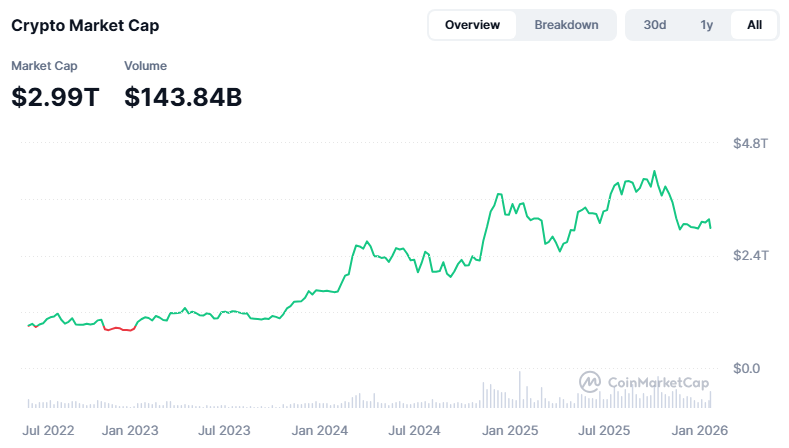
In this article, we break down the basic formula, explain where market cap can be misleading, show how to read the difference between circulating supply and total issuance, and explain how to use Market Cap as a risk-management tool in 2026 — to understand risk rather than chase “the next coin to explode.”
How Crypto Market Capitalization Is Calculated — and Why the Formula Is Deceptively Simple
Crypto market capitalization is calculated using a basic formula:

If Bitcoin trades at $100,000 and roughly 20 million coins are in circulation, its market capitalization is close to $2 trillion. The formula looks logical and familiar to anyone with experience in traditional equity markets. But this is exactly where the first major misunderstanding begins.
Market Cap is not the amount of money “sitting” in an asset. It is the valuation of the entire network based on the last traded price. If the most recent transaction happens at a higher price, the entire network is instantly revalued — even if the actual volume traded was small.
The Liquidity Illusion: Why Market Cap ≠ Money Invested
One of the most common beginner mistakes is believing that a $100 billion increase in market cap means $100 billion of real money flowed into the market. In reality, the liquidity multiplier effect is at work. It happens because prices move based on the last traded price, not on the total amount of money invested.
In a thin order book, even a relatively small amount of buying can push the price sharply higher — and with it, the market cap of the entire asset. Analysts at major banks have repeatedly noted that in illiquid markets, the ratio between real capital inflow and valuation growth can reach 1:20 or higher. In other words, $1 million of real demand can “create” $20 million in market capitalization.
To separate real capital inflows from paper valuation, analysts use Realized Capitalization (Realized Cap). This metric values each coin at the price it last moved on-chain. It is the closest approximation of how much money actually entered the system.
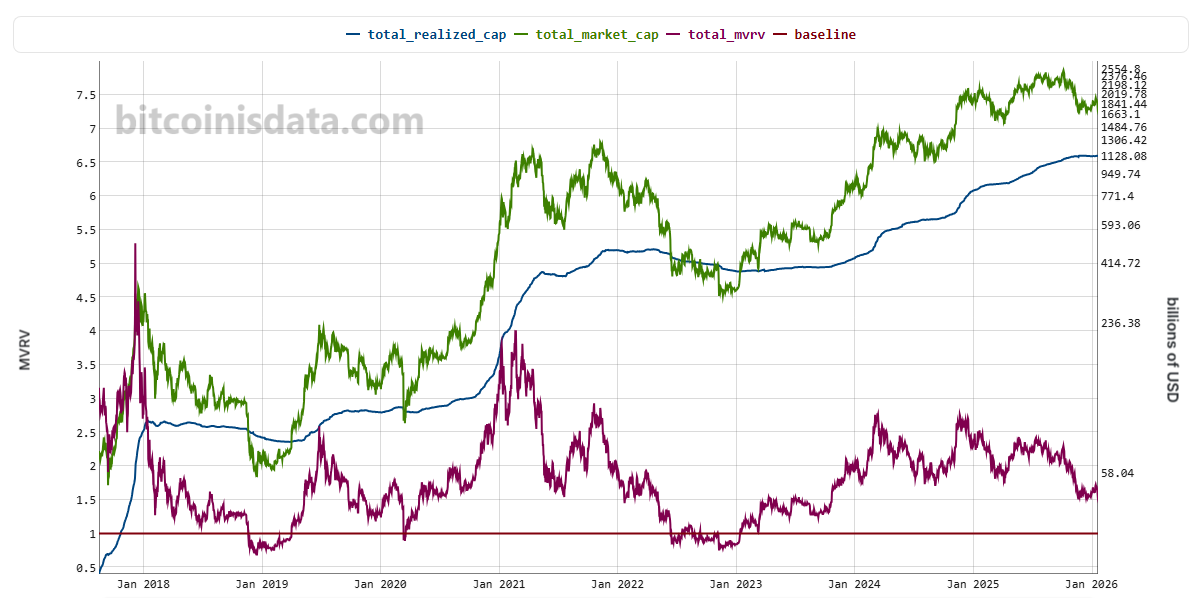
Source: bitcoinisdata.com
This is why, during sharp downturns, commentators say the market “lost trillions.” In many cases, those trillions never existed as real money in the first place.
As some digital asset market makers often say, “Price is what you see. Value is what survives liquidity.”
Realized Cap rises slowly and falls slowly, which is precisely why it better reflects whether real capital is entering or leaving the market.
Crypto Market Cap as a Risk-Management Tool
Market Cap is useful not for prediction, but for risk assessment. It tells you how large a project currently is, but it does not tell you whether the price will go up or down.
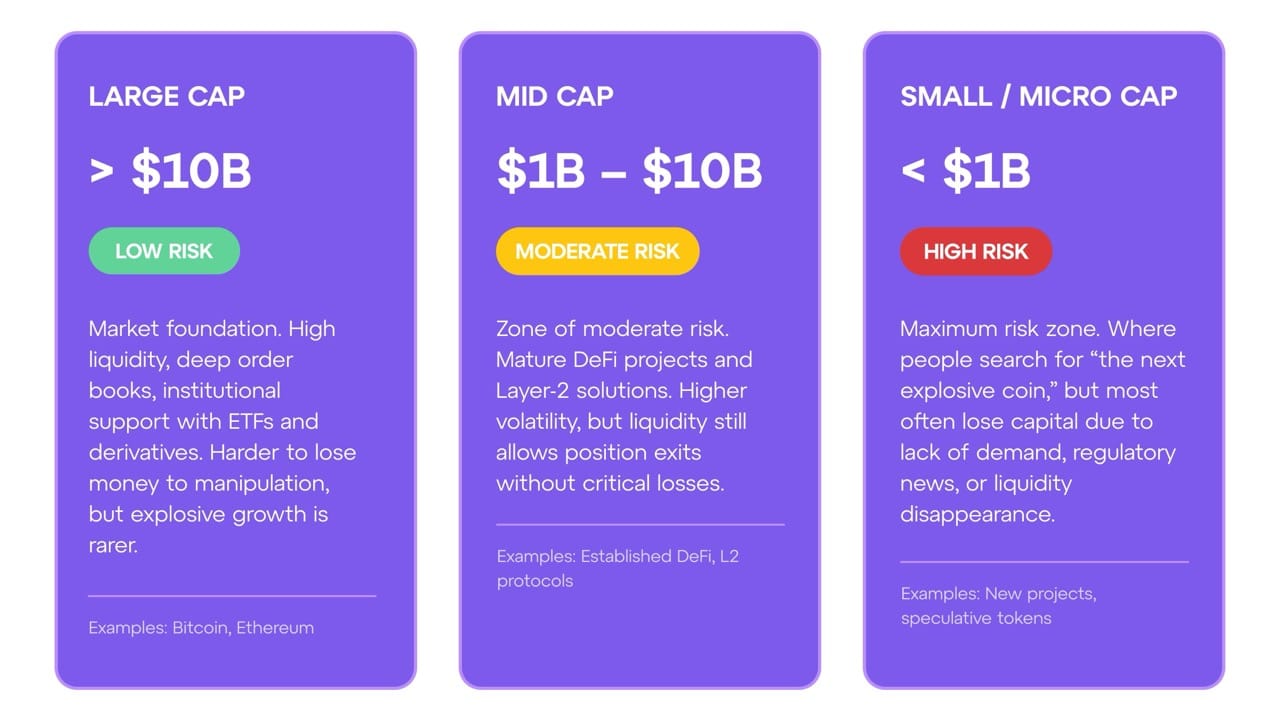
Cryptocurrencies are often grouped into tiers based on capitalization.
Large Cap assets ($10B+) form the foundation of the market. Bitcoin and Ethereum offer high liquidity, deep order books, and strong infrastructure support through ETFs, derivatives, and institutional demand. Manipulation risk is lower here, but explosive upside is rarer.
Mid Cap assets ($1B–$10B) sit in a zone of moderate risk. This category includes mature DeFi projects and Layer-2 solutions. Volatility is higher, but liquidity is usually sufficient to exit positions without severe losses.
Small and Micro Caps (below $1B) represent the highest-risk segment. This is where investors search for “the next crypto to explode” — and where capital is most often lost due to lack of demand, regulatory news, or sudden liquidity disappearance.
Why Fully Diluted Valuation (FDV) Is One of the Most Dangerous Traps
Fully Diluted Valuation shows how much a project would be worth if all tokens were in circulation:

Problems arise when a project launches with a very low circulating supply. For example, only 10% of tokens may be unlocked. Market Cap looks modest at $100 million, while FDV sits at $1 billion.
This means 90% of tokens have not yet been sold to the market. As these tokens unlock, supply increases sharply. If demand does not grow proportionally, price pressure becomes almost inevitable.
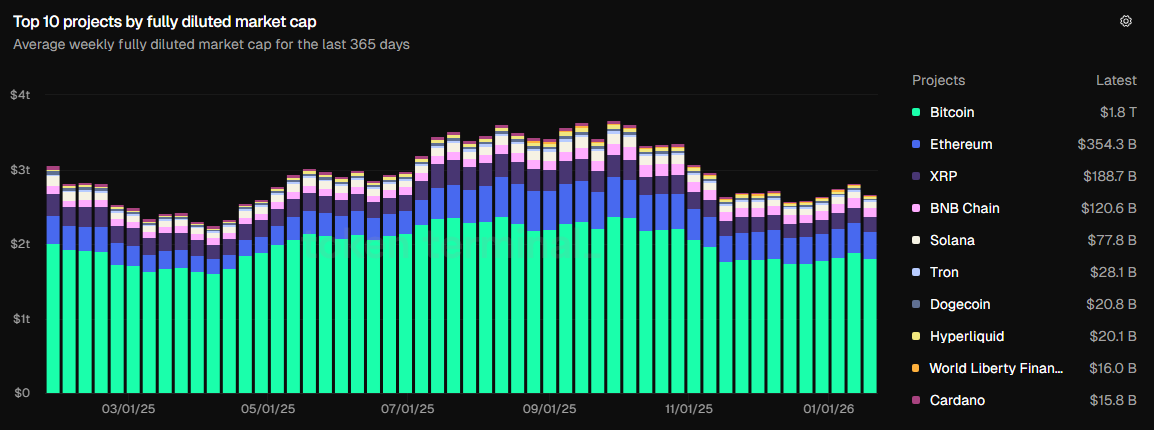
This is why projects with high FDV often look “strong” in market cap rankings — yet steadily lose value as new tokens enter circulation.
Market Dominance and Why Bitcoin Controls Altcoins
Market dominance shows what percentage of the total crypto market cap is held by a single asset. For Bitcoin, the historical range is roughly 40% to 60%.
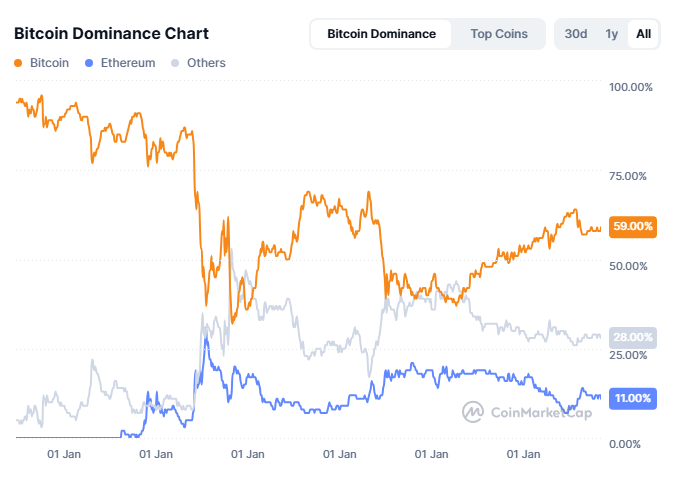
When Bitcoin dominance rises, capital typically flows from altcoins into the more resilient asset. During such periods, altcoins often fall even if the overall market is rising. When dominance declines, alternative projects tend to outperform.
Ethereum occupies an intermediate position in this system. Bitcoin functions as the crypto market’s defensive asset, while Ethereum acts as its technology platform. The ratio between them says a lot about cycle phases and overall risk appetite.
When Crypto Market Cap Lies
Market Cap is easily distorted in low-liquidity environments. There are also “dead coins,” including lost Bitcoins, which are counted in market cap but will never be sold. This artificially inflates valuations.
Smaller projects often use wash trading — fake transactions between related addresses — to create the illusion of volume and legitimacy. Price rises, market cap increases, but real demand is absent.
Even stablecoins are not risk-free. The TerraUST collapse showed that tens of billions in market capitalization can disappear within hours if trust in the peg mechanism breaks down.
Another psychological trap is unit bias. A coin priced at $0.0001 feels “cheap” compared to Bitcoin, yet its market cap may be higher. The price of a single unit is meaningless without considering supply.
Conclusion
Crypto market capitalization is a ranking and risk-assessment tool, not a bank account. It shows how the market values an asset at the last traded price — not how much capital was invested.
To avoid losses, you must always dig deeper: check FDV, compare circulating and total supply, account for liquidity, and monitor market dominance. Market Cap is useful only when its limitations are clearly understood and when it is used as part of a broader analytical picture.
Follow GoMining Academy and get access to the our free crypto courses and articles.
FAQ
What is the total crypto market cap? The combined market capitalization of all crypto assets. It is closely linked to global liquidity and overall risk appetite.
Can a low-priced coin have a high market cap? Yes. XRP is a classic example due to its large supply and low unit price.
Does Market Cap predict a crypto bull run? Growth in total market cap often signals rising liquidity, but it does not guarantee a sustainable bull market.
Why does market cap fall faster than money leaves the market? Because of the liquidity multiplier effect: prices adjust quickly, while real transactions are limited.
Which matters more: Market Cap or FDV? For risk assessment, FDV is often more important — especially for new projects.
How can you avoid losing money in small caps? Understand liquidity, token unlock schedules, and be prepared for extreme volatility.
Why does Bitcoin dominate altcoins? It is widely perceived as the least risky asset in the crypto market.
Does a high market cap always mean reliability? No. Without liquidity and trust, market cap figures can be highly misleading.