How to Make Your Own Crypto: From Easiest to Most Advanced Level
 Zamy
Zamy
A beginner-friendly guide for crypto users who want to understand how tokens get created, from no-code tools to full blockchains, and what changes at each level.
What you’ll Learn
- The three paths to creating a cryptocurrency, from simple no-code tools to full blockchains
- What no-code token generators do, and where they stop being enough
- Why standards like ERC-20 help wallets and apps recognize tokens
- How smart contracts change what a token can do, and what that means for creators
- When building a blockchain makes sense, and why most projects never need it
- A quick way to tell which level a project is actually using
Introduction
What does it really mean to create your own crypto?
In its simplest form, creating a crypto token feels less like writing code and more like designing a digital gift card inside a store that already handles security and checkout for you. That’s the first level on the crypto creation ladder: the creator sets a few rules, and the network takes care of the rest.
Beyond that basic version, tokens can “learn” new behaviors through smart contracts. Smart contracts add small pieces of automated logic that shape how a token acts. As you go higher up the ladder, full blockchains appear — systems with their own rules, their own security model, and their own way of agreeing on every update.
By the end, you’ll know what people mean when they say “we’re creating a token” and how big that job is, depending on the level.
Table of Contents
- How to Make a Cryptocurrency: The Three Levels of Complexity
- Level 1: Create Your Own Crypto With No-Code Tools
- Level 2: Deploy a Token With Code on Existing Blockchains
- Level 3: Build Your Own Blockchain From Scratch
- How to Choose Your Level Safely
How to Make a Cryptocurrency: The Three Levels
Three people in a room can say, “I want to make a cryptocurrency,” but they’re not all talking about the same thing. One person might imagine a simple community token. Another might be thinking about a programmable asset with rules. Someone else might be picturing an entire blockchain. Same words, very different jobs.
At the first level, projects are mostly choosing settings — a name, a symbol, a supply — and using a tool that publishes a basic token on an existing blockchain. It’s like designing a gift card while the store handles everything behind the counter.
At the next level, the role changes. Smart contracts enter the picture, and the focus shifts from selecting options to defining behavior. The token becomes a small automated program that follows specific rules on the network.
At the top of the ladder, the environment itself becomes the work. Building a blockchain means shaping the shared ledger — how data moves, how the network stays secure, and how new blocks are agreed on.
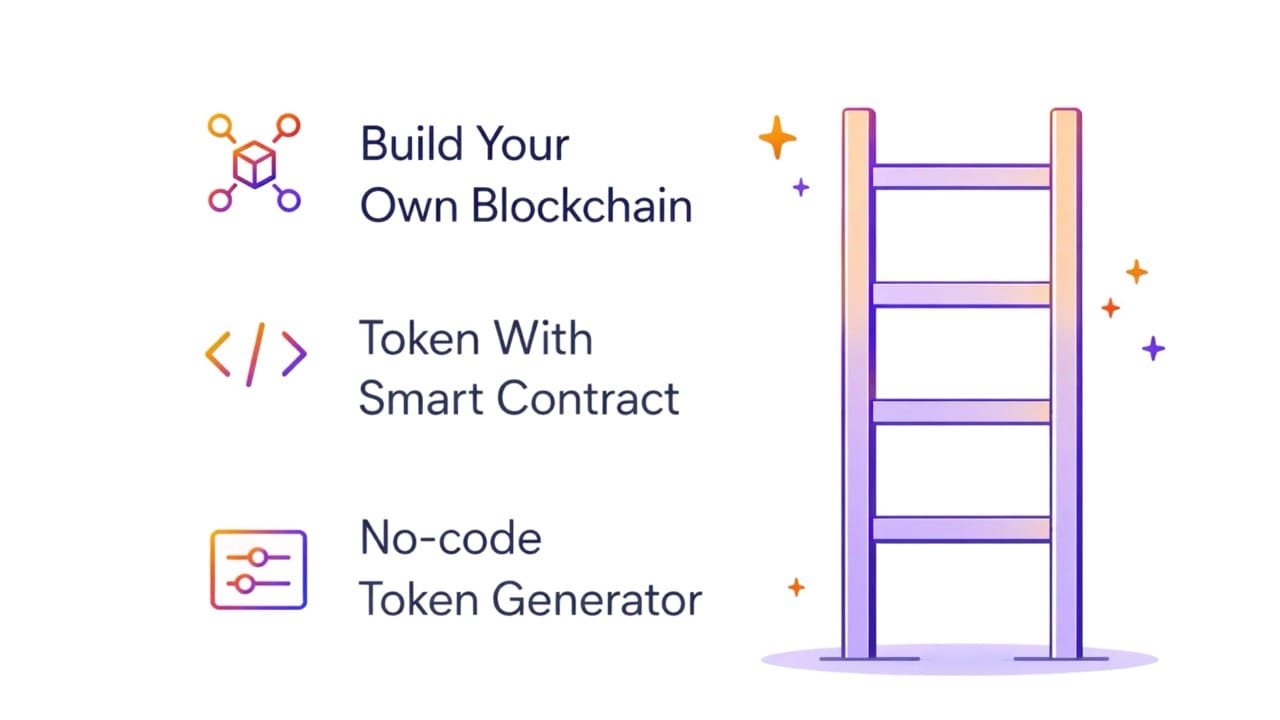
Each level asks projects to take on a different kind of responsibility. The question becomes less “Can someone make a cryptocurrency?” and more What kind of work that creation actually involves?
Level 1: Create Your Own Crypto With No-Code Tools
What no-code token generators actually do
At this level, token creation usually starts with a simple setup screen. It shows a few basic fields: the token’s name, its symbol, the total supply, and a dropdown to choose the blockchain. The experience feels closer to configuring an app than building anything technical.
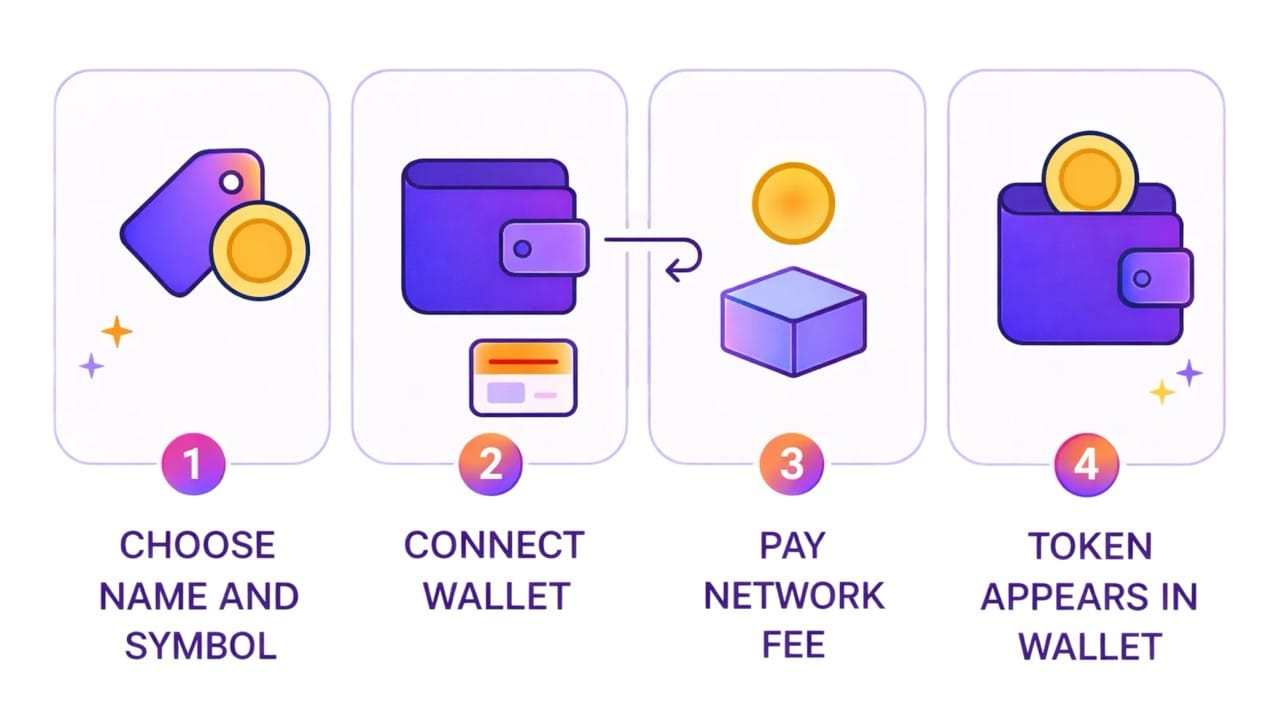
Level 1 in practice: most no-code tools follow this simple 4-step flow.
When these details are filled in, the tool assembles a template in the background. This template is a ready-made set of rules the blockchain already understands, and it defines how the token will behave at a basic level.
Before the token is published, the tool requires a wallet connection. This authorizes the action and covers a small network fee, which the blockchain charges to process the transaction.
Once the request is sent, the network confirms it, and the token appears on-chain. From the outside, the entire process looks like a short setup, a network fee, and a single confirmation step.
When is Level 1 enough, and when does it fall short?
Level 1 is built for speed. It works well for community tokens, event badges, prototypes, or any situation where a basic asset needs to exist on-chain quickly. The tool handles the technical details, while the token itself remains straightforward.
The limitations appear as soon as a project needs more than a token that simply exists. Templates at this level cannot support:
- custom rules
- timed unlocks
- permissions
- reward logic
- voting mechanisms
- anything that requires programmed behavior
That’s the line between Level 1 and Level 2.
A quick comparison
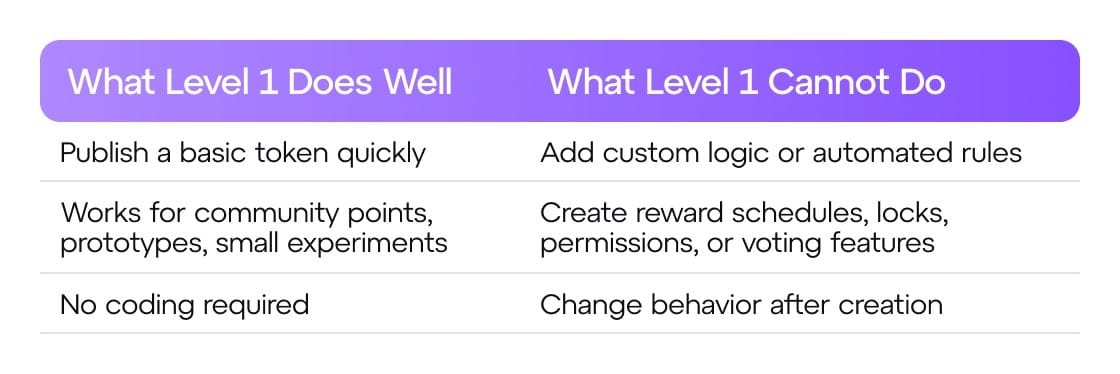
Level 1 teaches what a token is. When projects need tokens to follow rules or react to conditions, they move beyond templates and into Level 2.
Level 2: Deploy a Token With Code on Existing Blockchains
The move to Level 2 usually begins when a project reaches the limits of a template. A community creates a simple loyalty token with a no-code tool — it works fine until they want features the template can’t express: locked tokens, timed rewards, permissions, or rules that react to specific actions. That gap is what pushes creators toward smart contracts.
ERC-20, SPL, and other token standards in plain language
This is the point where token standards enter the picture. A standard is a shared recipe that tells wallets, apps, and exchanges how a token behaves.
- On Ethereum, that recipe is ERC-20.
- On Solana, it is SPL.
- On Binance Smart Chain, most tokens follow BEP-20.
These standards give tokens a familiar structure. Even if projects add their own logic, the base rules make the token readable across the ecosystem.
As the Ethereum Foundation explains:
“ERC-20 plays its role! This standard allows developers to build token applications that are interoperable with other products and services.” Ethereum Foundation
Standards provide predictability. Custom logic is what makes one token behave differently from another.
What Сhanges When a Smart Contract Is Involved
Level 2 looks very different from Level 1 because the visual interface disappears and the rules become explicit. Instead of selecting preset options, the token’s behavior is defined inside a smart contract.
A smart contract is a small program the blockchain enforces automatically. It can define things like:
- how supply works
- who has special permissions
- whether the token can pause, update certain features, or support voting
- any rules that run without human involvement
Some well-known tokens follow this path.Uniswap’s UNI and Lido’s LDO both use the ERC-20 standard but extend it with their own logic for distribution, permissions, and governance. Those behaviors cannot be created through a template, they live entirely in the contract.
And once that contract is published, its rules are usually permanent. (Some projects use upgradeable designs, but most contracts behave exactly as written from day one.)
Benefits, Risks, and Responsibilities
Level 2 gives projects real control. A token can represent voting power, rewards, access rights, or any behavior that can be defined in code.
But the control comes with higher responsibility:
- A mistake in the code can freeze tokens or break a system.
- Fixing it is often impossible after the contract goes live.
- Publishing contracts costs more than basic transactions, especially on Ethereum.
- Many teams rely on audits — external reviews — to catch issues before launch.
At this level, token creation becomes system design. Every rule matters, because the blockchain will enforce it exactly as written.
Level 3: Build Your Own Blockchain From Scratch
What does “your own blockchain” really mean?
A blockchain isn’t a token with extra features — it’s the entire system that tokens depend on: the ledger, the security rules, and the way the network agrees on every update.
Building one means shaping that whole system instead of placing a token inside an existing one.
This is the key difference:
- A token lives on a blockchain.
- A blockchain is the environment tokens live in.
Solana is a good example. It wasn’t created as a token — it was built as a full network with its own token standard, its own way of ordering transactions, and its own method for reaching agreement across thousands of machines.
So having “your own chain” doesn’t mean it’s private or closed. It simply means the project built the foundation instead of relying on one that already existed.
Consensus, Nodes, and Security at This Level
Running a blockchain means taking care of the parts that stay invisible at Levels 1 and 2.
The data has to live somewhere, so the blockchain needs nodes — computers that store the chain and keep it consistent. Someone must also approve new blocks, which is where validators come in. And the whole system needs a rulebook for how those validators agree on a single history. That rulebook is the consensus method.
Different blockchains make different choices for this rulebook, and those choices shape everything from speed to security.
- Bitcoin, for example, prioritizes security and durability, even if that means slower throughput.
- Solana is built for high speed, which requires a more complex structure underneath.
- Chains built on Ethereum can inherit Ethereum’s security and focus on cheaper, faster transactions instead of running their own full validator network.
These differences show how much design work happens under the surface. When projects create their own chain, they are responsible for choosing those priorities and maintaining the system as it grows.
Those decisions shape how the network behaves day to day. They also define how much long-term responsibility comes with Level 3.
Do You actually Need Your Own Blockchain?
For most projects, the answer is no.
Building a blockchain is closer to running an entire supermarket chain than printing a product. Responsibility extends far beyond the token itself and includes:
- the infrastructure,
- the security,
- the updates,
- the validator community,
- and the long-term health of the network.
That’s why Level 3 is rare. It’s used when a project truly needs capabilities no existing chain can offer — or when researchers are experimenting with new models for distributed networks.
For almost everyone else, Levels 1 and 2 offer more than enough control without the operational weight that comes with running a chain.
How to Read the Three Levels Safely
Now that the three levels are clear, the final step is understanding how they’re usually used in practice. Each level exists for a different kind of problem, and each one comes with a different scope of responsibility.
The Crypto Creation Ladder at a Glance
Think of this table as a reference map. It shows what each level enables, what it depends on, and the kinds of projects it’s typically used for.
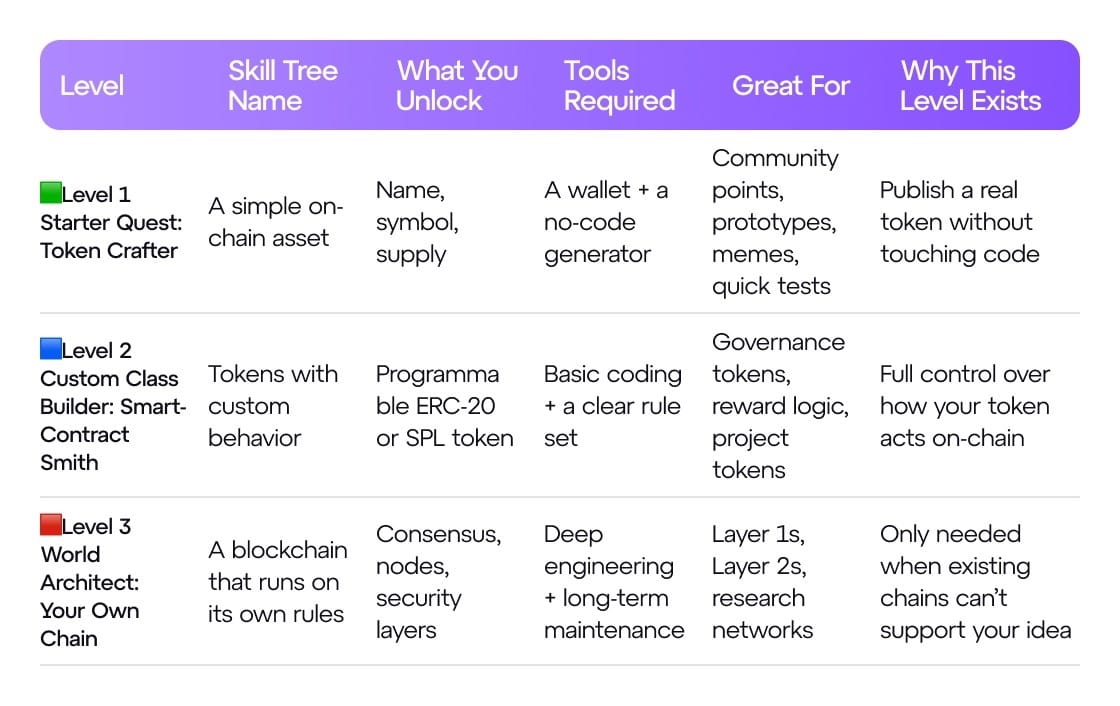
How These Levels Show Up in Real Projects
A useful way to understand the ladder is to listen to how a project describes what its token does.
If a token mainly exists to be sent, held, or traded, it usually fits the first level. These projects rely on existing networks and standard templates, keeping complexity low.
When a token includes rules — such as timed unlocks, different roles, automated rewards, or governance — it typically belongs at the second level. Here, behavior matters more than simple existence.
Projects only reach the third level when the token itself isn’t enough. At that point, the project needs control over the environment: how the network stays secure, how it scales, and how participants coordinate. This is rare, and usually tied to infrastructure-level innovation.
Why Time And Scope Matter
The technical side is only half the equation. The commitment changes at each level:
- Level 1 projects tend to move quickly and experiment freely.
- Level 2 projects require careful design, because every rule becomes part of the system.
- Level 3 projects are ongoing efforts, closer to maintaining a platform than launching a product.
This is why many ideas that sound ambitious still stay at Level 1 or Level 2. The structure has to match not just the goal, but the scope of what the project can realistically maintain.
Seen this way, the ladder isn’t about aiming higher but understanding how much system is actually needed for a given idea.
Final Thoughts
Creating a cryptocurrency isn’t a single action. It happens across distinct levels, each one designed for a different kind of problem. Some projects only need a simple token that can exist and move on-chain. Others need rules and automation. A much smaller group needs to design the system itself.
Understanding these levels helps make sense of the crypto landscape. It explains why some tokens are quick to launch, why others come with complex rules, and why building a blockchain is rare and high-stakes. What looks like the same word — “token” or “cryptocurrency” — often hides very different structures underneath.
Once this structure is clear, “create your own crypto” stops sounding mysterious or intimidating. It becomes a way to describe how projects are built, what tradeoffs they make, and how much responsibility sits behind each design choice.
FAQs
1. Do you need to know how to code to create a cryptocurrency?
Not always. Some cryptocurrencies are created using no-code tools that rely on prebuilt templates. Coding becomes necessary only when a token needs custom rules or automated behavior. Building a full blockchain requires advanced engineering.
2. How much does it cost to create a cryptocurrency?
Costs vary by level. Simple tokens usually only require a basic network fee. More advanced tokens and blockchains involve higher costs due to smart contracts, infrastructure, and ongoing maintenance.
3. Is a no-code (Level 1) token a “real” cryptocurrency?
Yes. These tokens exist on-chain like any other. The difference isn’t authenticity, but flexibility. Template-based tokens follow fixed rules and can’t be customized beyond basic settings.
4. What’s the difference between a token and a smart contract?
A token is the asset people hold or transfer. A smart contract is the program that defines how that asset behaves. At more advanced levels, the contract controls things like permissions, rules, and automated actions.
5. Why are standards like ERC-20 or SPL important?
Standards give tokens a common structure. This makes them readable by wallets, apps, and exchanges without special instructions. That shared format is what allows different tools to work together.
6. When does a project need its own blockchain?
Very rarely. A custom blockchain is only needed when a project requires changes to the network itself, such as how security works or how blocks are created. Most tokens function perfectly on existing blockchains.
7. Can tokens be changed after they go live?
Usually not. Most smart contracts are permanent once published. Some systems are designed to allow updates, but in general, the rules written at launch are the rules the token will follow.
8. What’s the simplest way to understand how crypto tokens are created?
Looking at Level 1 examples. They show how tokens appear on-chain, interact with wallets, and move between users, without the complexity of custom logic or full networks.