What Is TVL in DeFi?
 Alex D
If you have spent any time exploring DeFi, or decentralized finance, you have probably seen protocols boasting about billions of dollars in TVL. But what does that number actually mean — and should you trust it?
TVL — Total Value Locked — is one of the most widely cited metrics in decentralized finance. It appears on dashboards, in news headlines, and across crypto analytics platforms. For many people, it is the first number they check when evaluating a protocol.
But like any single metric, TVL can be misleading if you don’t understand what it measures, what it leaves out, and why it changes. In this article, we have TVL explained — from the basics to how the value locked in crypto protocols is calculated and how to interpret it correctly.
Let’s break it down!
Key Takeaways for Beginners
- TVL — Total Value Locked — measures the total dollar value of crypto assets deposited into a DeFi protocol’s smart contracts. It is a useful starting point for understanding a protocol’s scale and liquidity.
- TVL does not measure revenue, profit, safety, or sustainability. A high number alone does not mean a protocol is trustworthy or well-run.
- TVL changes constantly due to token price movements, user deposits and withdrawals, incentive programs, and broader market cycles.
- Smart beginners combine TVL with other data — such as revenue, user activity, and security audits — to form a more complete picture. Never rely on a single metric when making decisions in DeFi.
- Start by exploring reputable DeFi data platforms, learn to read TVL trend charts, and always ask: where is this value really coming from?
What Is TVL?
Simple Definition
TVL stands for Total Value Locked.
In simplest terms, the TVL meaning is straightforward: the total dollar value of all crypto assets currently deposited into a DeFi protocol’s smart contracts — self-running programs on the blockchain that automatically handle transactions.
Think of it this way: if a lending protocol holds 10,000 ETH and each ETH is worth $2,000, that protocol’s TVL is $20 million. It is essentially a snapshot of how much capital users have entrusted to that protocol at any given moment.
TVL has become one of the most popular DeFi metrics because it offers a quick, easy-to-read number that signals how much money is flowing into a particular system. You will see crypto TVL figures quoted across news sites, research reports, and DeFi dashboards alike.
What “Locked” Actually Means
The word “locked” can be confusing. It does not always mean your tokens are frozen or inaccessible. In most cases, “locked” simply means “deposited into a smart contract.”
When you deposit tokens into a lending pool, a liquidity pool, or a staking contract, those tokens leave your personal wallet and sit inside the protocol’s smart contract. They are “locked” in the sense that they are being actively used by the protocol — not just sitting idle in someone’s wallet.
Some protocols require a commitment period — for example, 30 or 90 days — when your tokens cannot be withdrawn. But many DeFi protocols let you withdraw at any time. The key point is that “locked” refers to assets held within a protocol, whether or not there is a mandatory lock-up period.
Why TVL Exists as a Metric
DeFi has no central authority publishing quarterly reports or official statistics. Protocols are open and run on public blockchains, so anyone can see how much capital is sitting in their smart contracts.
The TVL metric became the default standard because it is easy to calculate from on-chain data and gives a rough sense of scale. A protocol with $5 billion in TVL is handling far more capital than one with $5 million. For users, analysts, and DeFi dashboards, it became a convenient shorthand for “how big and active is this protocol?”
However, as you will see later in this article, size alone does not tell the whole story.
How TVL Is Calculated
Formula Explanation
The basic idea behind calculating TVL is simple:
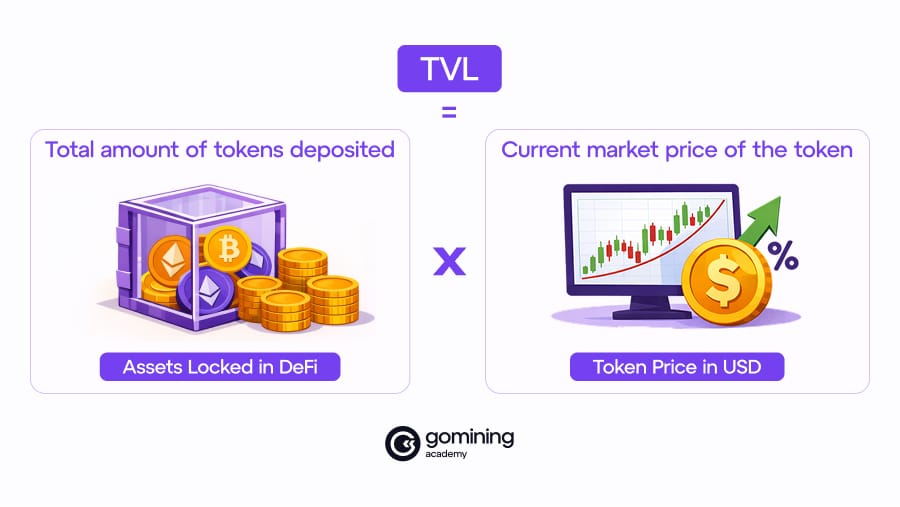
TVL = Total amount of each token deposited × Current market price of that token
For example, imagine a protocol holds 5,000 ETH and 10 million USDC. If ETH is currently priced at $2,500, then:
ETH portion: 5,000 × $2,500 = $12.5 million
USDC portion: 10,000,000 × $1.00 = $10 million
Total TVL = $22.5 million
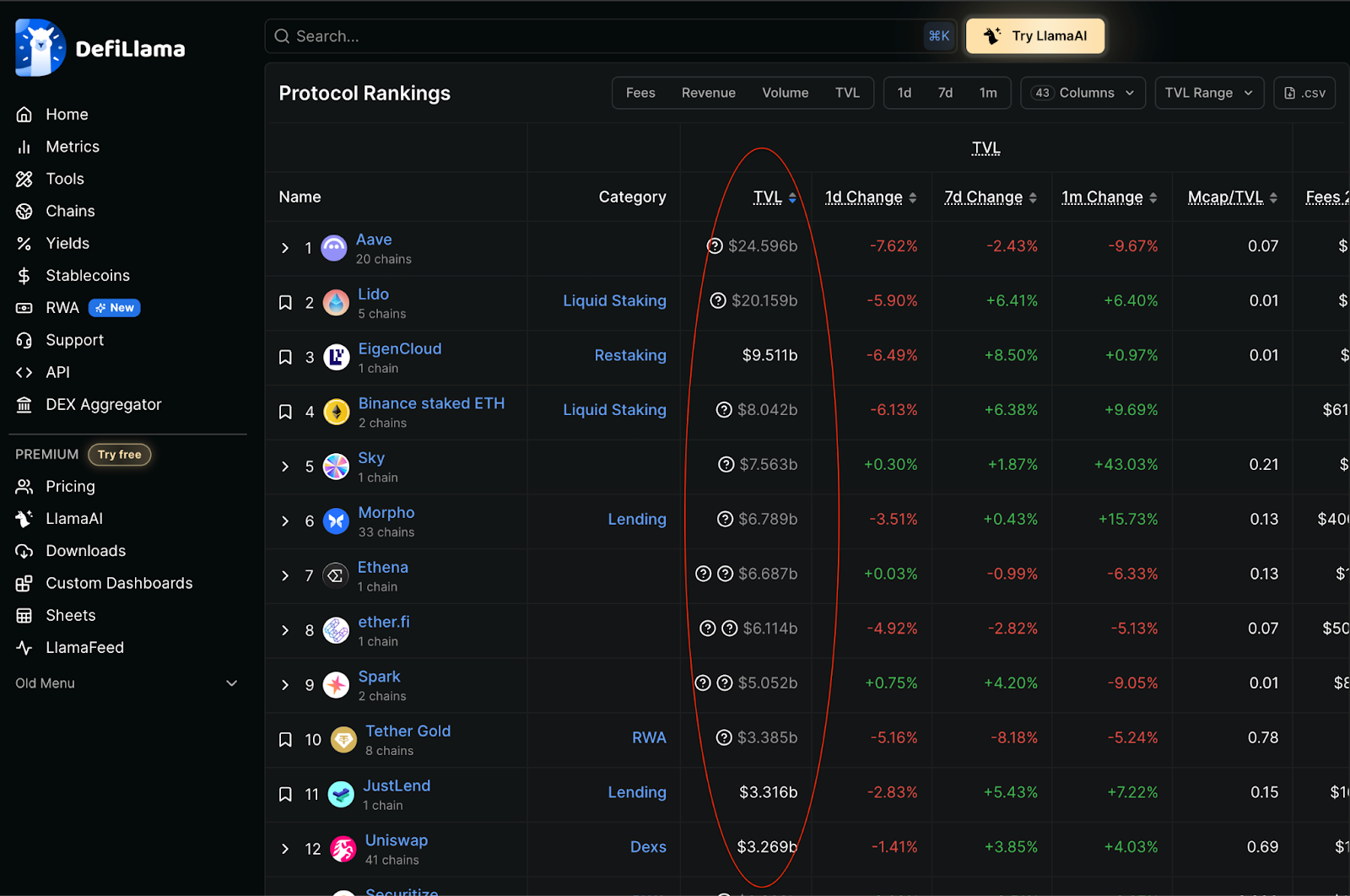
Crypto analytics platforms like DefiLlama aggregate this data automatically by reading the balances of known smart contracts across multiple blockchains.
Why Token Prices Affect TVL
Here is something important to understand: TVL can change even if nobody deposits or withdraws a single token.
Because TVL is measured in dollar terms, it rises and falls with the market price of the deposited assets. If ETH’s price goes from $2,500 to $3,000, the TVL of every protocol holding ETH increases automatically — without any new deposits.
This means a rising TVL does not always signal growing user confidence or new capital entering the protocol. It might simply reflect a larger shift in the market. The reverse is also true: TVL can drop sharply during a market decline even if no users actually leave.
Multi-Chain TVL Considerations
Many DeFi protocols operate across multiple blockchains — for example, Ethereum, BNB Chain, and Solana.
When a platform reports its total TVL, it usually combines the value locked across all chains. This gives you the big-picture number, but it can hide important details. A protocol might show $1 billion in total TVL, but 90% of that could be on a single chain while the other chains have very little activity.
If you are evaluating a protocol on a specific blockchain, look at the chain-level TVL rather than just the combined figure. Most DeFi data platforms let you filter by chain, so you can see exactly where a protocol's liquidity actually sits.
Why TVL Matters
Liquidity Signal
At its most basic level, TVL tells you how much liquidity a protocol has — readily available funds that users have deposited. Liquidity in DeFi matters because protocols use these deposited funds to power real services — letting users trade, borrow, and earn.
More liquidity generally means better conditions for everyone: lower slippage when trading, more funds available for borrowers, and more stable operations overall.
A lending protocol with $500 million in TVL can serve far more borrowers than one with $5 million, and a decentralized exchange with high liquidity lets you make larger trades without significantly moving the price.
User Participation Indicator
TVL also serves as a rough proxy for user trust. When people deposit their crypto into a protocol, they express a degree of confidence that the protocol will handle their assets safely and deliver the promised returns.
A rising TVL over time suggests that more users are choosing to deposit — or that existing users are depositing more. A declining TVL might signal that users are withdrawing their funds, possibly because they found better opportunities elsewhere or lost confidence in the protocol.
Protocol Comparison Tool
TVL is one of the easiest ways to compare DeFi protocols at a glance. If two lending platforms offer similar services, the one with significantly higher TVL is likely handling more activity and has attracted more user deposits.
That said, TVL alone is not enough to declare one protocol “better” than another. A smaller protocol might be more capital-efficient, generate more revenue per dollar locked, or serve a specific market more effectively. TVL is a starting point for comparison — not the final answer.
TVL vs Market Cap
What Market Cap Measures
Market cap — short for market capitalization — is the total value of a token’s circulating supply. It is calculated by multiplying the current token price by the number of tokens in circulation. For example, if a protocol’s governance token is priced at $5 and there are 100 million tokens circulating, the market cap is $500 million.
Market cap reflects how the market values the protocol’s token. It is driven by trading activity, investor sentiment, and speculation about the protocol’s future.
What TVL Measures
TVL, by contrast, measures the actual assets deposited into the protocol’s smart contracts. It tells you how much real capital users have committed to the platform — not how much speculators think a token is worth.
In other words, market cap is about the token’s perceived value, while TVL is about the protocol’s actual usage.
TVL-to-Market-Cap Ratio
The ratio of TVL to market cap can be a useful indicator. A high ratio — where TVL greatly exceeds market cap — might suggest the protocol is heavily used relative to how the market values its token, which some analysts interpret as undervaluation.
A low ratio — where market cap is much larger than TVL — could signal that the token’s price is driven more by speculation than by actual protocol usage.
Neither ratio is automatically “good” or “bad.” It is just one more data point to consider alongside other DeFi analytics when evaluating a protocol.
What Causes TVL to Change?
Asset Price Volatility
As mentioned earlier, TVL is measured in dollars — which means it moves with the market even when user behavior hasn't changed at all. If ETH's price rises overnight, every protocol holding ETH shows higher TVL by morning, without a single new deposit.
Deposits and Withdrawals
The other driver is simpler: people moving money in and out. This is the more meaningful signal — it reflects actual user decisions.
When a protocol launches a popular new product or offers competitive yields, deposits flow in and TVL climbs. When users find better opportunities elsewhere or lose confidence, they withdraw their funds and TVL declines.
Incentive Programs
Many protocols offer temporary reward programs — distributing bonus tokens to users who deposit funds. These incentive programs — a practice known as liquidity mining, where users earn bonus tokens for depositing funds — can cause dramatic TVL spikes as users rush to capture the rewards.
The catch is that this capital is often purely reward-driven — it flows in for the rewards and flows right back out when the program ends. A sudden TVL surge driven by incentives does not necessarily mean the protocol has earned lasting user commitment.
Market Cycles
Broader market conditions play a significant role. During bull markets — periods of rising prices and optimism — more users enter DeFi, new protocols launch, and TVL across the entire DeFi ecosystem tends to climb.
During bear markets — periods of falling prices and pessimism — users pull capital out to reduce risk, and total DeFi TVL contracts.
Understanding where you are in the market cycle helps you interpret TVL changes more accurately.
Limitations of TVL
TVL Does Not Equal Revenue
A protocol can have billions in TVL and generate very little revenue. TVL measures how much capital is sitting in the protocol, not how much income that capital produces. A lending protocol with $2 billion in TVL but very few active borrowers may earn almost nothing in fees.
Always check a protocol’s revenue alongside its TVL to get a more complete picture.
TVL Does Not Equal Profit
Even when a protocol does generate revenue, that revenue may be entirely spent on incentive programs to attract depositors. If a protocol pays out more in token rewards than it earns in fees, it is operating at a loss — regardless of how impressive its TVL looks.
Double Counting Risks
In DeFi, assets are frequently reused across multiple protocols. Let’s say you deposit $2000 worth of ETH into a staking protocol, receive a liquid staking token (stETH) in return, and then deposit that token into a lending platform. Both protocols count those assets, resulting in a +$4000 increase in TVL, whereas you only deposited $2000.
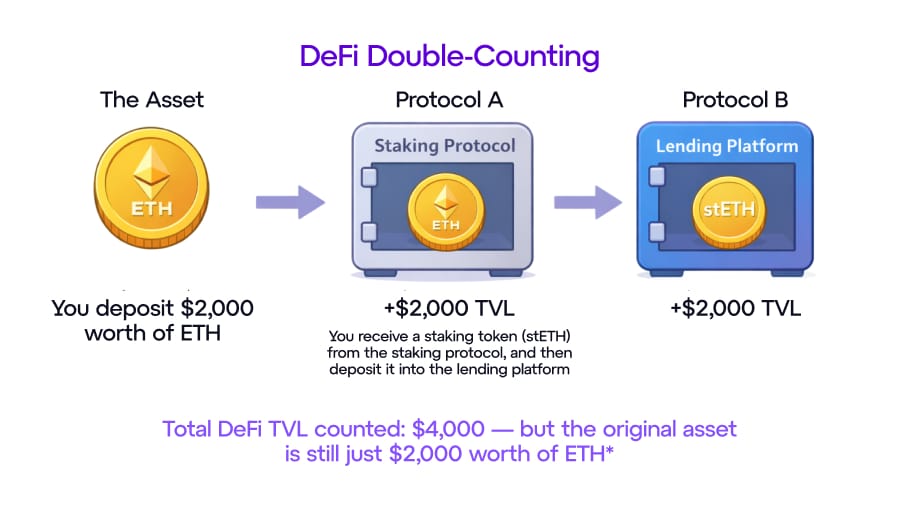
This means the same underlying value can appear in the TVL of two or more protocols simultaneously, inflating the total DeFi TVL figure.
DeFi data platforms try to account for this — DefiLlama, for example, flags double-counted assets in its methodology — but it is worth checking how any platform you use handles this before trusting its total DeFi TVL figure.
Capital Efficiency Differences
Not all TVL is equally productive. Some protocols are designed to do more with less. For example, concentrated liquidity — where liquidity providers focus their funds within a specific price range — lets a protocol handle the same trading volume with a fraction of the capital.
A protocol with lower TVL but higher capital efficiency may actually serve users better than a protocol with massive TVL and idle capital. Comparing raw TVL numbers without considering efficiency can be misleading.
Risks Behind High TVL
Smart Contract Risk
Every dollar locked in a DeFi protocol sits inside a smart contract. If that code contains a vulnerability, all deposited funds are at risk. High TVL makes a protocol a more attractive target for attackers, because there is simply more money to steal.
Even protocols that have been audited are not immune. Audits reduce risk but do not eliminate it. Treat a clean audit as one positive signal — not a guarantee of safety.
Liquidity Concentration Risk
When a large share of a protocol’s TVL comes from a small number of depositors — often called “whales” — the protocol becomes vulnerable to sudden outflows. If one or two major depositors withdraw, TVL can drop dramatically, destabilizing the protocol and affecting other users.
Protocol Design Risk
Some protocols achieve high TVL through aggressive incentive programs or complex mechanisms that may not be sustainable. A protocol offering extremely high rewards to attract deposits might look healthy by the TVL number, but the underlying economics could be fragile.
WARNING: A high TVL number does not guarantee that a protocol is safe, well-designed, or sustainable. Always look beyond the headline figure.
How to Evaluate TVL Responsibly
Check Trends, Not Just the Number
A single TVL snapshot tells you very little. Is TVL growing steadily, or did it spike overnight due to an incentive program? Has it been declining for months? Trends over weeks and months reveal far more about a protocol’s health than any single number.
DeFi dashboards like DefiLlama, DappRadar, and Token Terminal typically show TVL history charts —use them to spot trends rather than just reading the current number.
Compare TVL with Revenue
TVL and revenue together paint a much clearer picture. A protocol with high TVL and growing revenue is likely generating real demand for its services. A protocol with high TVL but minimal revenue might be relying entirely on incentive programs to attract capital.
Always check a protocol's revenue alongside its TVL to get a more complete picture — DefiLlama and Token Terminal both track protocol revenue and fees.
Analyze User Activity
Check how many active users the protocol has, how many transactions it processes, and whether on-chain metrics like unique wallets and transaction volume are growing. A protocol with massive TVL but very few active users may not be as healthy as it appears.
Avoid the “Bigger = Safer” Assumption
WARNING: One of the most common beginner mistakes is assuming that a protocol with high TVL must be safe. Size and safety are not the same thing. A protocol can have billions in TVL and still suffer a smart contract exploit, a governance failure, or an economic design flaw. Always do your own research beyond the TVL figure!
Frequently Asked Questions
Is High TVL Good?
High TVL generally indicates strong liquidity and user participation, which can be positive signs. However, it does not guarantee safety, profitability, or sustainability. A protocol with high TVL driven entirely by temporary incentives may be less healthy than a smaller protocol earning consistent fee-based revenue.
Does TVL Guarantee Safety?
No. TVL measures how much capital is deposited, not how secure the protocol is. A high-TVL protocol can still have smart contract bugs, governance risks, or unsustainable economics. Always evaluate security audits, protocol design, and track record alongside TVL.
Why Can TVL Drop Suddenly?
TVL can fall quickly for several reasons: a sharp drop in token prices, the end of an incentive program, large depositors withdrawing funds, a security incident, or a shift in market sentiment. Because TVL responds to both price changes and capital flows, sudden drops are common in volatile markets.
Is TVL the Most Important DeFi Metric?
TVL is one of the most widely used DeFi metrics, but it is far from the only one that matters. Revenue, fees generated, number of active users, transaction volume, and protocol profitability all provide important context. The best approach is to look at TVL as part of a broader set of defi analytics and on-chain metrics, not in isolation.