What Is Liquidity in Crypto?
 Alex D
Imagine you want to sell something quickly — say, a concert ticket.
If hundreds of people want that ticket, you can sell it in seconds at a fair price. But if nobody is interested, you either wait a long time or accept far less money than the ticket is worth.
That, in simple terms, is liquidity. It describes how easily and quickly you can buy or sell an asset without significantly affecting its price. In the world of crypto, understanding liquidity is one of the most practical things you can learn — because it directly affects the price you pay, the price you receive, and how much risk you take on with every trade.
In this article, we explain the meaning of liquidity in crypto, demonstrate why it matters, how it works in decentralized finance — where there are no traditional order books or brokers — and how to spot low-liquidity traps before they cost you money.
Key Takeaways
- Liquidity in crypto describes how easily you can buy or sell a token without causing a significant price change. It is one of the most important factors affecting your trading experience.
- High liquidity means stable prices, fast trades, and lower fees. Low liquidity means the opposite — unpredictable prices, difficulty selling, and higher slippage.
- In DeFi, liquidity comes from pools of user-deposited tokens rather than traditional order books. The size of these pools directly determines how smoothly trades execute.
- Slippage — the gap between the price you expect and the price you get — is the most direct consequence of low liquidity. Always check your expected slippage before confirming a trade.
- Before trading any token, check its trading volume, order book depth, or DeFi pool size. Start with small amounts if you are unsure.
What Is Liquidity?
A Plain-Language Definition
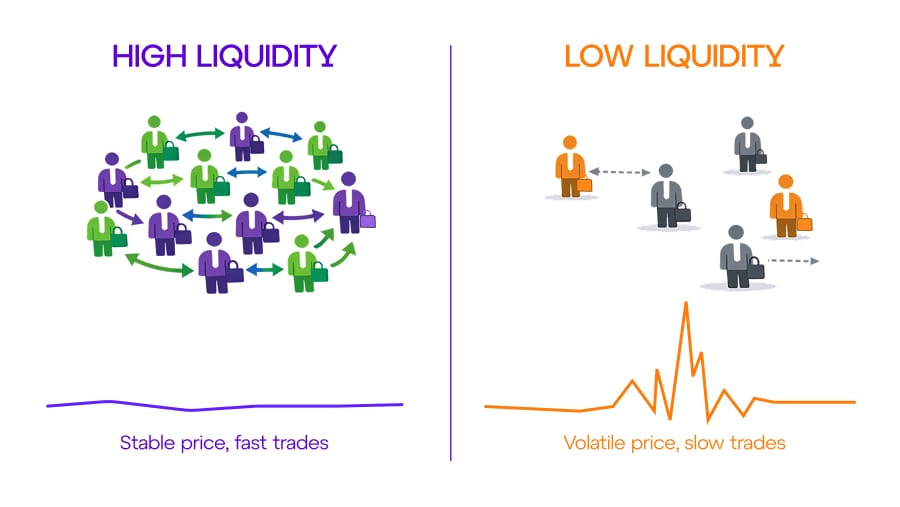
Crypto liquidity is the ease with which a cryptocurrency can be bought or sold at a stable price.
When a market is liquid, there are plenty of buyers and sellers active at any given moment, so trades happen fast and prices stay steady. When a market is illiquid, even a small trade can push the price up or down sharply.
Think of it this way: a busy farmers’ market with dozens of stalls and hundreds of shoppers is highly liquid. You can buy tomatoes instantly at a predictable price.
A single roadside stand in the middle of nowhere is illiquid — you might wait hours for a customer, and you might have to drop your price just to make a sale.
Why Does Liquidity Exist?
Markets need buyers and sellers active at the same time to function — and liquidity is what makes that possible. Without enough participants, trading becomes slow, expensive, and unpredictable.
In crypto specifically, liquidity comes from individual traders, professional market makers — firms or algorithms that continuously place orders to buy and sell, keeping markets active — and, in decentralized finance, from users who deposit tokens into liquidity pools.
If you saw our article on DeFi yield, you already know that liquidity providers earn fees precisely because their deposits make trading possible.
Why Liquidity Matters
There are a few key ways liquidity affects your experience as a trader — and they are more practical than you might expect.
Whether you are buying your first token or managing a larger position, each of the following factors shows up in real trades, in real money:
- Market liquidity in crypto is not an abstract concept — it has a direct, measurable impact on your trading experience.
- Price stability: In a liquid market, prices reflect genuine supply and demand. A single large order does not dramatically move the price. In an illiquid market, one big buy or sell can cause the price to jump or crash.
- Speed of execution: Liquid markets let you enter and exit positions quickly. If you need to sell during a sudden drop, liquidity is what lets you do so without waiting or accepting a terrible price.
- Lower trading costs: Liquid markets tend to have tighter spreads — the gap between the highest price a buyer is willing to pay and the lowest price a seller is willing to accept. A narrow spread means you lose less value on each trade.
- Fair pricing: When many participants are trading, the market price is more likely to reflect the true value of the asset. Markets with low liquidity are easier to manipulate.
High vs. Low Liquidity
The difference between high and low liquidity in crypto is something you can feel the moment you try to trade.
High-liquidity assets — like Bitcoin or Ethereum on major exchanges — have deep order books. An order book is a real-time list of all open buy and sell orders for a given asset, organized by price. When the order book is deep, it means there are many orders at many price levels. You can trade significant amounts and the price barely moves.
Low-liquidity assets — newly launched tokens, obscure altcoins, or tokens on small exchanges — have thin order books with wide gaps between buy and sell prices. If you try to sell even a modest amount, you may push the price down significantly, and getting back in later may cost more than expected.
A useful way to check liquidity is to look at trading volume — the total amount of an asset traded over a given period, usually 24 hours — and order book depth, which shows how many orders exist at various price levels. High volume and deep order books generally mean strong liquidity.
Liquidity in DeFi
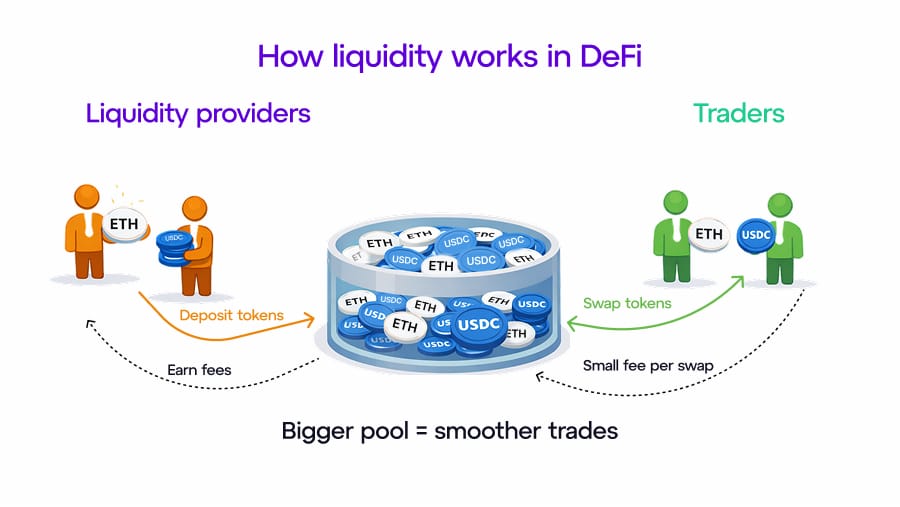
In decentralized exchanges — platforms that let you trade crypto without a central company managing the process — there is no traditional order book. Instead, traders swap tokens directly with pools of crypto deposited by other users.
Here is how liquidity in DeFi works in practice.
Liquidity providers deposit pairs of tokens — for example, ETH and USDC — into a smart contract. When another user wants to swap ETH for USDC, the protocol pulls the tokens from this pool and automatically calculates the exchange rate using a mathematical formula. The liquidity provider earns a small fee from every swap.
The size of the pool matters enormously. A large pool with millions of dollars in deposits can handle big trades with barely any price impact. A small pool with only a few thousand dollars will see its price shift dramatically even on modest trades. This price impact is the core reason why liquidity DeFi discussions matter so much — the depth of the pool directly determines the quality of your trade.
Some protocols also incentivize deposits through extra token rewards. These incentives can temporarily boost pool sizes, but they do not guarantee that the liquidity will remain once the rewards end. All of this — pool size, deposit levels, token ratios — feeds directly into one practical number you will encounter on every DeFi trade: slippage.
Slippage Explained
Slippage is the difference between the price you expect to pay for a trade and the price you actually receive. It happens in every market, but it becomes a real problem when liquidity is low.
Here is a simple example. You want to buy a token currently priced at $1.00. You place the order, but by the time it executes, the price has shifted to $1.03. That $0.03 difference is slippage.
In a highly liquid market, slippage is typically tiny — fractions of a cent. In a low-liquidity market, it can be several percent of the total trade.
In DeFi, slippage is especially relevant because swaps happen against liquidity pools with a fixed amount of tokens. The larger your trade relative to the pool size, the more the price shifts against you.
Most decentralized exchanges let you set a slippage tolerance — a maximum percentage you are willing to lose to slippage. If the actual slippage exceeds your limit, the trade is automatically cancelled.
WARNING: If you find yourself needing to set a high slippage tolerance (above 1–2%) just to get a trade through, that is a strong signal the market lacks sufficient liquidity. Proceed with extreme caution. |
Risks of Low Liquidity
Low liquidity is one of the most underestimated risks in crypto. Here is what can go wrong:
- You cannot exit when you need to: If the market for a token is thin and the price starts falling, you may not be able to sell quickly enough. By the time your trade goes through, the price may have dropped further — or there may be no buyer at all at the price you want.
- Prices can be easily manipulated: In a low-liquidity market, a single large trade can move the price dramatically. Dishonest traders can use this to inflate a token’s price artificially — often called a “pump” — and then sell their tokens while others are still buying, leaving those buyers with a loss.
- Slippage reduces your returns: As explained above, low liquidity means higher slippage. If you are trading frequently or with larger amounts, slippage can significantly reduce your overall returns.
- DeFi-specific risks: In decentralized pools, low liquidity makes impermanent loss — the change in value that happens because the ratio of tokens in a pool shifts as prices move — more severe. Small pools are also more vulnerable to exploits. For example, DeFi protocols rely on price oracles — external data feeds that tell them what assets are worth — and those can be tricked.
A common beginner misconception is that if a token has a high listed price, it must be easy to sell at that price. In reality, if no one is actively buying at that price — in other words, if liquidity is low — the listed price is essentially meaningless. The price you actually receive when selling could be far lower.
How Beginners Should Check Liquidity
You do not need advanced tools to assess crypto liquidity before making a trade. Here are a few practical steps.
Check 24-hour trading volume. Most exchanges and data aggregators — such as CoinGecko or CoinMarketCap — track crypto prices and display daily trading volume. As a general guideline, tokens with consistently low 24-hour volume (under a few hundred thousand dollars) are likely to have liquidity problems.
Look at the order book. On centralized exchanges, you can view the order book directly. Look for tight spreads and many orders clustered near the current price. Wide gaps between buy and sell orders are a warning sign.
Check pool sizes in DeFi. Before swapping tokens on a decentralized exchange, check the total value locked (TVL) in the relevant liquidity pool. Larger pools generally mean smoother trades with less slippage. Many DeFi interfaces show you the expected price impact before you confirm a trade — use this information.
Watch for sudden volume spikes. A token that normally trades $50,000 per day but suddenly shows $5 million in volume may be experiencing artificial activity or short-term speculation. This does not necessarily mean sustainable liquidity.
Start small. If you are unsure about a token’s liquidity, try a small trade first. This lets you see the actual slippage and execution quality before committing a larger amount.
Frequently Asked Questions
- Is It Safe to Trade Low-Liquidity Tokens? It is riskier. Low-liquidity tokens are harder to sell quickly, more likely to experience sharp price swings, and more vulnerable to manipulation. If you choose to trade them, use small amounts you can afford to lose and always check the order book or pool size beforehand.
- How Much Liquidity Is Enough? There is no universal number, because it depends on how much you plan to trade. As a rough guide, if your planned trade represents more than 1–2% of the token’s daily volume or of a DeFi pool’s total size, expect noticeable slippage. Major tokens like Bitcoin and Ethereum on large exchanges typically have more than enough liquidity for individual traders.
- Can Liquidity Disappear Suddenly? Yes. In DeFi, liquidity providers can withdraw their deposits at any time, which can shrink a pool quickly. On centralized exchanges, market makers may pull their orders during extreme volatility. Liquidity is never guaranteed, which is why checking it regularly — especially before larger trades — is a good habit.
Where Should a Beginner Start?
Stick with well-known tokens on well-established exchanges or DeFi protocols. Bitcoin, Ethereum, and major stablecoins tend to have deep liquidity across many platforms. As you gain experience and learn to read order books and pool sizes, you can explore smaller markets more confidently.
WARNING: Liquidity can change at any time. A pool or market that looks healthy today may be empty tomorrow. Never assume that current conditions will last, and never invest more than you can afford to lose. |