What Is FDV in Crypto? Fully Diluted Valuation Explained
 Alex D
Have you ever checked a crypto project valued at billions of dollars, only to realize the token just launched a few weeks ago? Where does that number come from — and should you trust it?
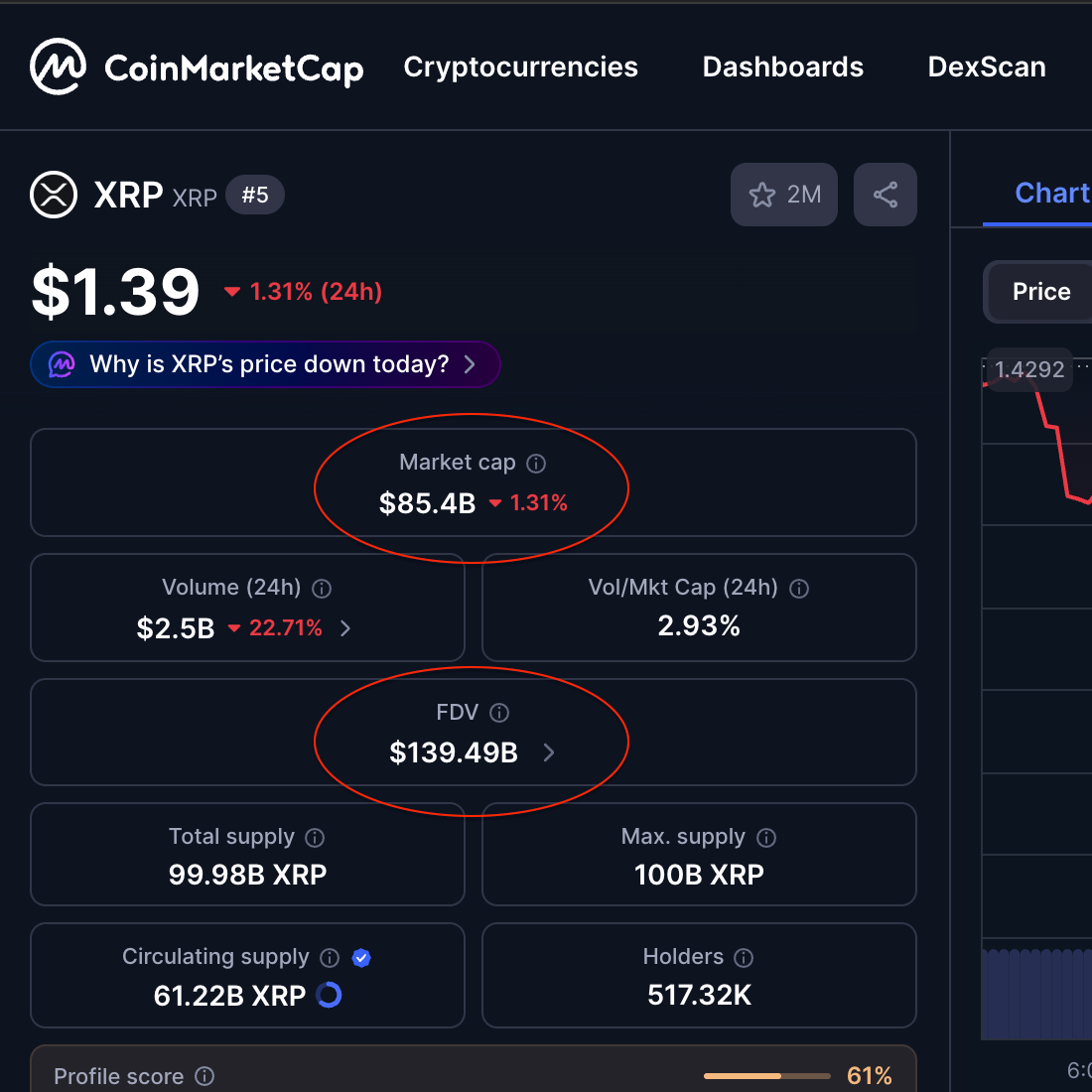
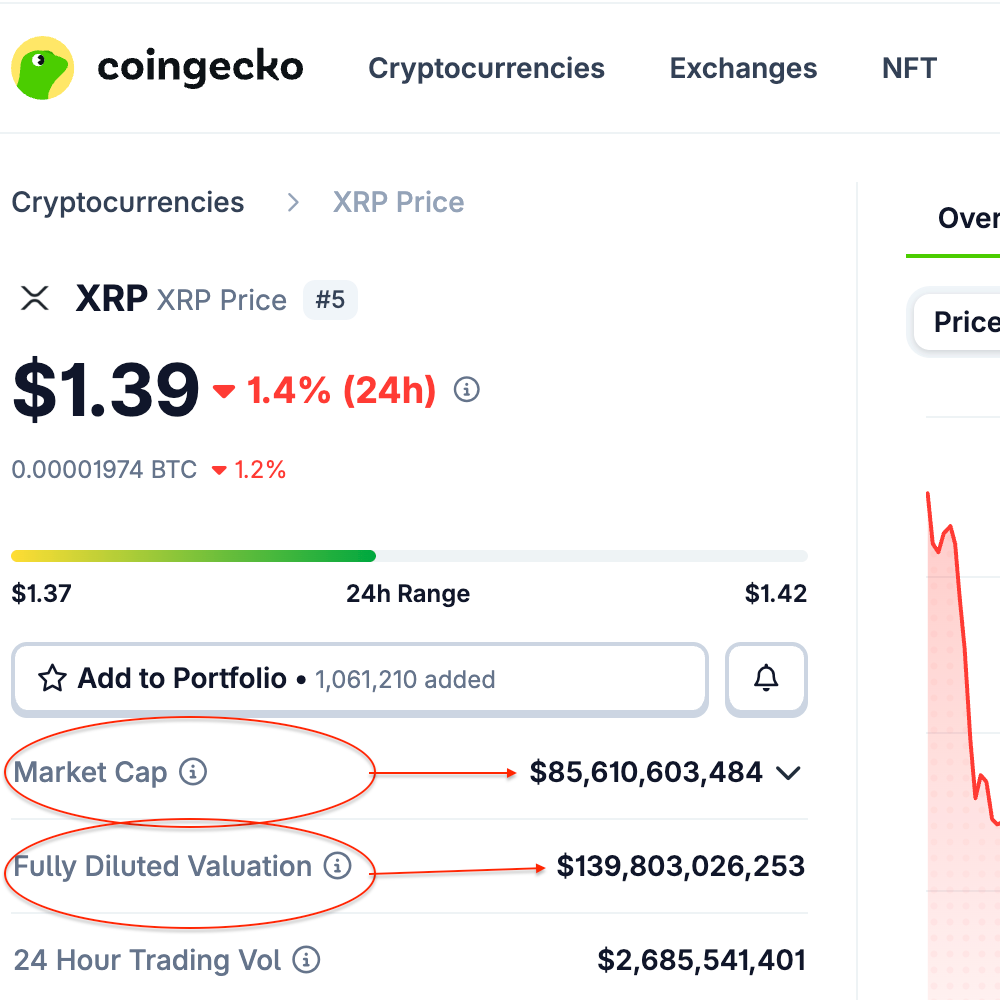
If you have looked up a crypto project on sites like CoinGecko or CoinMarketCap, you have probably seen two numbers side by side: market cap and FDV. They often look very different, and the gap between them tells an important story.
FDV — fully diluted valuation — is one of the most commonly displayed metrics in crypto. It is also one of the most misunderstood.
A high FDV can make a project look huge and successful. But if you do not understand the meaning of FDV in crypto, those huge numbers can lead you to wrong conclusions.
In this article, we explain FDV — from how it is calculated to why it matters, and how beginners should interpret it. Whether you have just seen “FDV crypto” on a data site and wondered what it means, or you are trying to compare projects, this guide covers it all.
Let’s break it down!
Key Takeaways:
- FDV — fully diluted valuation — is the theoretical total value of a token if every coin that will ever exist were in circulation today, at the current price.
- FDV is almost always higher than market cap because it includes the entire future supply, not just what is circulating now. The gap between the two shows how much dilution is still ahead.
- Dilution matters. As more tokens enter circulation, each existing token represents a smaller share of the total value. Large unlock events can trigger sharp price drops.
- FDV is theoretical, not a guarantee. It assumes the price stays constant — which rarely happens in practice.
- Never rely on FDV alone. Always check the circulating supply ratio, the unlock schedule, and whether real demand supports the valuation.
What Is FDV?
Simple Definition
FDV stands for fully diluted valuation. The FDV meaning is simple: it answers the question, "What would a crypto token’s total value be if every single coin that will ever exist were already on the market today, at the current price?"
Think of it this way. Imagine a company plans to print 1 billion tickets, but so far only 100 million have been handed out. To get the FDV, you take the price of one ticket today and multiply it by all 1 billion — including the ones that haven't been handed out yet.
That means FDV is not a measure of what a project is worth today. It is a projection — a theoretical number that shows what the valuation would be if every token were circulating at the current price.
FDV Formula: Price × Maximum Supply
The FDV calculation is simple:
FDV = Current Token Price × Maximum Token Supply
For example, if a token is priced at $2 and the maximum supply is 500 million tokens, the FDV is $1 billion. It does not matter whether 50 million or 400 million tokens are currently in circulation — the FDV formula always uses the maximum supply.
Why It’s Called “Fully Diluted”
The word 'diluted' means weakened by adding more of something, like adding water to juice makes it less concentrated.
In crypto, dilution works the same way: as more tokens enter circulation, each existing token represents a smaller share of the total. “Fully diluted” means the calculation assumes maximum dilution: every token that could ever exist is already out there, included into the equation.
This concept is not unique to crypto. In traditional finance, companies calculate a “fully diluted” share count that includes stock options, convertible bonds, and other securities that could become shares in the future. Crypto FDV works on the same principle, but applied to token supply instead of company shares.
Circulating Supply vs Maximum Supply
This is one of the most important distinctions in crypto valuation, and it is where FDV and market cap split apart.
Circulating supply is the number of tokens currently in the hands of the public — available to buy, sell, or use. Maximum supply is the hard cap: the total number of tokens that can ever exist. Some tokens, like Bitcoin, have a fixed maximum supply of 21 million. Others, like Ethereum, have no hard cap at all.
FDV vs Market Cap
What Market Capitalization Measures
Crypto market cap measures the value of the tokens that actually exist and are available right now. It is calculated as:
Market Cap = Current Token Price × Circulating Supply
Circulating supply refers to the number of tokens that are currently out in the market, available for trading, and held by users. This is a snapshot of the present — how much the project is worth based on what exists today.
Many new projects launch with only a small percentage of their total tokens in circulation.
The rest are locked away in vesting schedules — planned timelines for gradually releasing tokens.
Why FDV Is Usually Higher Than Market Cap
Because FDV uses the maximum supply, and market cap uses circulating supply, FDV is almost always the larger number. For newly launched projects, the gap can be enormous.
Here is an example. Suppose a token trades at $5. The circulating supply is 10 million tokens, but the maximum supply is 100 million. The market cap would be $50 million. The FDV, however, would be $500 million — ten times higher. That gap represents all the tokens that have not yet entered circulation but will eventually.
When you see a project with a $50 million market cap but a $500 million FDV, it means 90% of the token supply is still locked and will be released over time. That released supply could push the price down — so understanding the gap before you buy matters.
Why FDV Matters
Understanding Token Dilution
Just as adding water to juice makes it weaker, adding more tokens to the market can reduce each token’s value — unless demand grows at the same pace.
FDV helps you anticipate this. If a project’s FDV is five times its market cap, that means roughly 80% of the total token supply has not yet been released.
As those tokens enter the market through scheduled unlocks, the increased supply can put downward pressure on the price — even if nothing else changes about the project.
Early-Stage Token Valuation Distortions
New tokens often launch with a very small circulating supply. This can create a misleading picture.
Imagine a token launches at $10 with just 1 million tokens in circulation. Its market cap is $10 million, which looks small on its own. But if the maximum supply is 1 billion tokens, the FDV is $10 billion. That would place this brand-new, unproven project in the same valuation range as some of the largest protocols in crypto.
This is not necessarily a problem, but it is a signal. A sky-high FDV on a new token tells you that the current price already assumes an enormous future valuation.
If the project does not grow into that number, the price will likely correct as more tokens enter circulation.
Token Unlock Schedules and Vesting
Most crypto projects do not release all their tokens at once. Instead, they follow a token unlock schedule — a plan that specifies when locked tokens become available.
Vesting — the process of gradually releasing tokens over time — is commonly used for team members, early investors, and advisors. A typical schedule might lock tokens for one year, then release them in monthly portions over the next two to three years.
Why does this matter for FDV? Because every token unlock event increases the circulating supply. If a large unlock is approaching and the project’s FDV is already very high, the newly released tokens could flood the market and push the price down. Checking a project’s unlock schedule before buying is one of the most practical things a beginner can do.
When FDV Can Be Misleading
High FDV with Low Circulating Supply
This is the most common trap for beginners: seeing a very high FDV and assuming the project is already worth that amount.
It isn't — and here is why.
A token with a low circulating supply can have its price driven up quickly because there are simply fewer tokens available to trade. That inflated price then gets multiplied by the massive maximum supply, producing an FDV that looks enormous.
WARNING: A high FDV on a newly launched token with very little circulating supply does not mean the project is worth that amount. It means a small number of tokens traded at a certain price, and the price was applied to the entire future supply. |
Unrealistic Assumption of Constant Price
The FDV formula assumes the price stays exactly the same, no matter how many tokens are released. In reality, this happens very rarely.
When millions of new tokens suddenly become available, the increased supply typically pushes the price down — basic economics of supply and demand. So the “valuation” that FDV suggests is almost always an overestimate, because the price used in the calculation was set when far fewer tokens existed.
Why FDV Is Theoretical, Not Guaranteed
Think of FDV as a ceiling estimate under ideal conditions — not a target the project is likely to reach. The conditions it assumes — a fixed price and a fully released supply — rarely exist at the same time in practice.
WARNING: FDV is not a prediction of future value. It is a snapshot calculation that says: “If every token existed right now at today’s price, this is what the total value would be.” It does not account for changing demand, market conditions, or whether the project will even survive long enough for all tokens to be released. |
FDV and Tokenomics
To properly understand any token’s FDV, you need to look at its tokenomics — the set of rules that govern how a token is created, distributed, and managed over time. A good place to start is understanding the different ways supply is measured, because not all supply numbers mean the same thing.
Maximum Supply vs Total Supply
These two terms sound similar but mean different things, and mixing them up leads to errors in crypto valuation.
Maximum supply is the absolute upper limit of tokens that can ever exist. For Bitcoin, that number is 21 million — no more will ever be created.
Total supply is the number of tokens that have been created so far, including those that are locked or not yet released to the public. Total supply can be less than or equal to maximum supply, but never more.
Some tokens do not have a maximum supply at all. Ethereum, for instance, has no hard cap. In those cases, FDV becomes harder to calculate because there is no fixed maximum number to multiply by. Data aggregators may display FDV using total supply instead, which can lead to confusion.
Inflationary vs Fixed Supply Tokens
A token with a fixed supply — like Bitcoin — has a clear FDV because the maximum number of tokens is known and unchangeable. No new tokens will ever be created beyond that limit.
Inflationary tokens, on the other hand, continuously create new tokens through emissions — newly minted tokens distributed as rewards. For these tokens, the supply keeps growing, which means the FDV is a moving target. Even if the price stays flat, the FDV increases as more tokens are created.
Emissions and Long-Term Dilution
Token emissions refer to the rate and schedule at which a protocol creates and releases new tokens into circulation. Often, these newly created tokens are distributed as rewards to users who provide liquidity — depositing tokens to help others trade — or who stake their tokens, locking them up to support the network. While these rewards attract participants, the steady increase in supply is what drives long-term dilution.
This is long-term dilution in action. If a project emits 5% more tokens every year, holders need the token price to rise by at least 5% annually just to maintain the same value. If the price stays flat or drops, each existing token is worth less in real terms.
When evaluating a token’s FDV, always check the emissions schedule. A project with aggressive token release may show an attractive price today, but the steady flood of new tokens could reduce that value over months and years.
Risks Behind Ignoring FDV
Dilution Risk
If you buy a token without checking its FDV, you might not realize that billions of additional tokens are scheduled for release.
As those tokens hit the market, the increased supply can push the price down — even if the project itself is doing well. Your share of the network’s total value shrinks with every unlock.
Unlock Event Volatility
Large token unlock events often trigger sharp price drops. When a significant portion of a token’s supply becomes tradable on a single day, some holders — especially early investors who bought at much lower prices — may sell immediately at a profit.
This is commonly known as dumping. Such sudden selling pressure can cause rapid (and sometimes severe) price declines.
Projects with transparent unlock schedules make it possible to anticipate these events. But if you are not paying attention to FDV and the gap between circulating and maximum supply, an unlock can catch you off guard.
WARNING: Large token unlock events can trigger sharp and rapid price drops. If you are not tracking the gap between circulating and maximum supply, an unlock event can happen without warning. |
Psychological Valuation Traps
Without looking at FDV, it is easy to fall into the trap of judging a project by its price per token instead of its overall valuation. Always look at the full picture before concluding whether a token is a good deal.
WARNING: A common beginner mistake is assuming that a low token price means the project is cheap or undervalued. A token trading at $0.01 might seem like a bargain — but if the maximum supply is 100 billion tokens, the FDV is $1 billion. That is not cheap at all. |
How to Evaluate FDV Safely
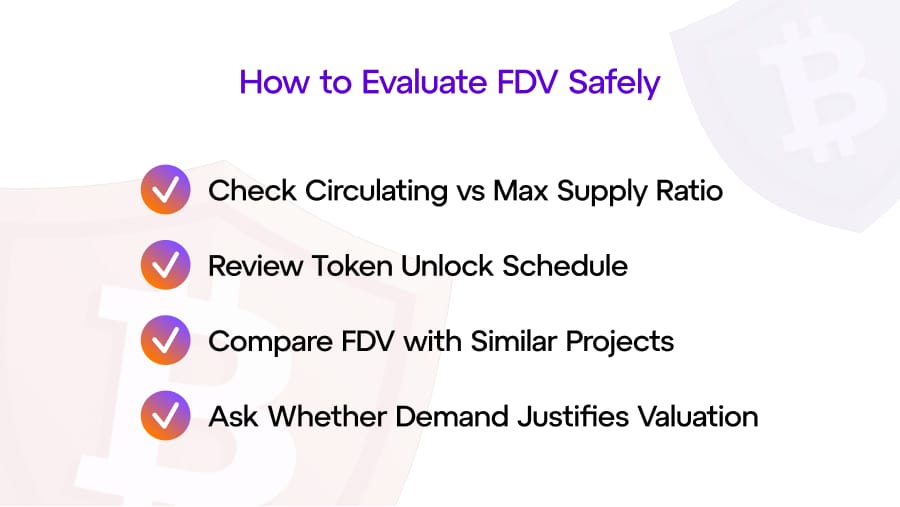
- Check Circulating vs Max Supply Ratio
Start by looking at how much of the total token supply is already in circulation. On websites like CoinGecko or CoinMarketCap, you can usually find it next to the max supply crypto data.
If a token has only 10% of its maximum supply circulating, that means 90% of the tokens are still locked. That is a large amount of future selling pressure.
A higher ratio — say 70% or more — means most of the dilution has already happened. The gap between market cap and FDV is smaller, and the valuation is more likely to reflect reality.
- Review Token Unlock Schedule
Look for the project’s token unlock schedule. When are the next large releases? How much of the supply will be unlocked over the next 6 to 12 months? Projects that are transparent about their vesting and unlock schedules are generally more trustworthy than those that keep this information vague.
- Compare FDV with Similar Projects
One of the most useful things you can do is compare a project’s token FDV with established projects that do the same thing.
If a brand-new lending protocol has a higher FDV than a well-known protocol with years of proven activity, that is a red flag. The new project would need to grow massively just to justify its current theoretical valuation. Looking at token FDV comparisons is one of the simplest ways to spot overvaluation.
- Ask Whether Demand Justifies Valuation
This is the most important question. A high FDV is not automatically bad — but it needs to be backed by real demand. Does the project have active users? Is there genuine trading volume? Are people actually using the protocol, or is the valuation based entirely on hype and speculation?
If a token’s FDV suggests it is worth billions but the protocol has only a few thousand users and minimal activity, the valuation is likely inflated. Demand is what ultimately supports any valuation — whether in crypto or traditional markets.
Frequently Asked Questions
Is High FDV Bad?
Not automatically. A high FDV simply means the project would have a very large valuation if all tokens existed today at the current price. For a well-established project with strong demand and real revenue, a high FDV can be perfectly reasonable. The concern arises when a new or unproven project has a sky-high FDV with very little circulating supply — because it suggests the current price may not hold once more tokens are released.
Is Low FDV Good?
A low FDV can indicate that a project has room to grow, but it does not guarantee success. A token can have a low FDV because nobody is interested in it, the project lacks real utility, or the team has abandoned development. Always check FDV alongside other crypto fundamentals like actual usage, team activity, and community engagement. Understanding dilution in crypto is just one piece of responsible research.
Does FDV Predict Price Growth?
No. FDV is a snapshot, not a forecast. It tells you what the total valuation would be under a specific assumption — that the price stays exactly the same as all tokens enter circulation. In practice, prices change constantly based on supply, demand, market sentiment, and countless other factors. FDV is one useful data point, not a crystal ball.
Should Beginners Rely on FDV Alone?
Definitely not. FDV is most useful when combined with other metrics. Look at the fully diluted market cap alongside circulating market cap, trading volume, token unlock schedules, and the project’s actual usage. No single number tells the whole story. Think of FDV as one piece of a larger puzzle.