What Is a Bitcoin Treasury Strategy?
 Alex D
You’ve probably heard that some companies are putting Bitcoin on their balance sheets — but why would a business hold cryptocurrency instead of cash? Is it a smart strategy? Or just reckless gambling?
It’s simpler than it sounds.
A Bitcoin treasury strategy is a deliberate decision by a company to hold Bitcoin as part of its financial reserves. Whether called a BTC treasury or simply holding BTC on the balance sheet, the core idea is the same: using Bitcoin as a means to store company money, instead of — or alongside — traditional options like cash or government bonds. This guide breaks down what it means, why companies do it, and whether it actually makes sense.
Key Takeaways
- A Bitcoin treasury strategy means a company holds Bitcoin as part of its financial reserves, alongside or instead of traditional assets like cash and bonds.
- Companies do this primarily to hedge against inflation, diversify reserves, and benefit from Bitcoin’s long-term appreciation potential.
- Implementation involves allocation decisions, secure custody, and compliance with accounting standards.
- This is a strategic, long-term approach — not speculation. But only when done with proper planning and risk management.
- Key risks include volatility, regulatory uncertainty, and custody security.
- A Bitcoin treasury is not right for every company. It works best for organisations with strong cash positions, a long time horizon, and leadership aligned on the strategy.
What Is a Treasury Strategy?
Before we get to Bitcoin, let’s start with the basics. Every company keeps a pool of money — its treasury. This is cash and other financial assets the company holds to pay bills, fund daily operations, and survive difficult periods.
A treasury strategy is how a company decides to manage that pool. Traditionally, businesses keep their reserves in government-issued money like dollars or euros (also known as fiat), bank deposits, government bonds, or short-term securities. It’s safe, predictable, and boring. The goal is to preserve value, not to make risky bets.
Here’s the problem: cash loses purchasing power over time due to inflation. If a company holds $100 million in cash and inflation runs at 3–5% per year (at best), that money slowly loses its value. This is why some companies have started looking for alternatives — and building up reserves in?
Bitcoin as an alternative asset is one of them.
Why Companies Use Bitcoin
Inflation Hedge

Bitcoin has a fixed supply cap of 21 million coins — no more will ever exist. New Bitcoin enters circulation through mining, a process in which computers compete to validate transactions on the network and are rewarded with newly created Bitcoin for doing so.
That reward halves approximately every four years in an event known as the halving, which means the rate at which new Bitcoin is created slows down over time. Eventually, around the year 2140, the last Bitcoin will be mined — and the total supply will be permanently fixed at 21 million, forever.
This built-in scarcity is what makes Bitcoin attractive as a hedge against inflation. Unlike fiat currencies, which central banks can print in unlimited quantities, Bitcoin is released at a fixed, predictable pace set by its code. No government, company, or individual can speed that up or slow it down.
Long-Term Value Preservation
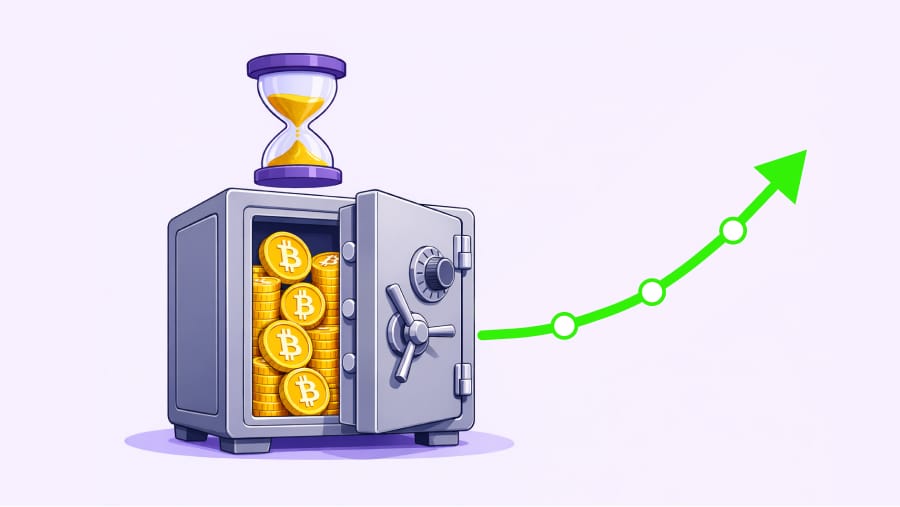
Companies that adopt a Bitcoin treasury strategy aren’t trying to trade for quick profits. On the contrary, they’re betting that Bitcoin’s scarcity and growing adoption will make it a better store of value than cash over long time horizons — years, not months.
Diversification

Holding all reserves in a single currency or asset class creates concentration risk — the danger of having too much tied up in one type of asset.
Bitcoin offers exposure to a fundamentally different kind of asset, one that doesn’t rise and fall together with stocks, bonds, or any specific country’s economy.
How a Bitcoin Treasury Works
In practice, implementing a Bitcoin treasury strategy involves several careful steps. Companies typically follow a structured approach:
- Allocation decision. The company decides what percentage of its reserves to convert to Bitcoin. This is usually a board-level decision backed by profound financial analysis.
- Acquisition. Bitcoin is purchased — either with existing cash reserves, through convertible notes — loans that can later be converted into company shares — or through ongoing purchases over time using dollar-cost averaging, which means buying fixed amounts at regular intervals regardless of the current price.
- Custody. Corporate Bitcoin must be stored securely. Most companies use institutional-grade custody solutions, which are specialized third-party services with advanced security measures. These include multi-signature wallets, where multiple approvals are needed before anyone can access the funds, and cold storage, meaning the Bitcoin is kept on devices not connected to the internet. This is very different from an individual holding Bitcoin in a personal wallet.
- Accounting and compliance. Companies must report their Bitcoin holdings according to accounting standards. Until recently, Bitcoin was classified as an intangible asset — a non-physical asset, like a patent or software license — meaning companies had to write down losses but couldn’t report unrealised gains, which are paper profits that haven’t been locked in by selling yet. That is changing.
Updated rules from FASB, the US body that sets accounting standards, now allow fair value accounting — reporting assets at their current market price. Among major international jurisdictions, IFRS — the accounting framework used across more than 140 countries — is moving in the same direction. Together, these changes make Bitcoin easier to hold on corporate balance sheets.
Treasury Strategy ≠ Speculation
A common beginner misconception is that companies holding Bitcoin are “gambling with shareholder money.” They’re not — at least, not the ones doing it properly.
A real Bitcoin corporate strategy has a clear rationale, risk limits, and a long-term horizon. It’s a planned allocation, not a speculative trade. That said, the line between strategy and speculation depends entirely on how it’s executed.
Real Examples
Interest in corporate BTC has grown significantly since 2020, with several well-known companies leading the way.
The examples include:
- Strategy (now MicroStrategy). The most well-known example. Under CEO Michael Saylor, the company began purchasing Bitcoin in August 2020 and has since accumulated over 200,000 BTC, making it the largest corporate Bitcoin holder in the world. Saylor has funded purchases through cash reserves, debt, and equity offerings — raising money by selling new company shares — treating Bitcoin as the company’s primary treasury reserve asset.
- Tesla. Tesla purchased $1.5 billion worth of Bitcoin in early 2021, briefly accepted it as payment for vehicles, and later sold portions of its holdings. Tesla’s approach was more opportunistic, and its on-again, off-again relationship with Bitcoin highlights the difference between full commitment and partial experimentation.
- Block (formerly Square). Jack Dorsey’s payments company invested $220 million in Bitcoin as a treasury asset, with a clear thesis that Bitcoin aligns with the company’s mission to build open financial infrastructure.
Benefits
Protection against currency debasement. When central banks print more money, reducing its value, cash reserves quietly lose purchasing power. Bitcoin’s fixed supply offers a hedge against this.
Potential for significant appreciation. Bitcoin has outperformed most traditional assets over the past decade, though past performance is never a guarantee of future results.
Growing institutional acceptance. With spot Bitcoin ETFs — exchange-traded funds that track Bitcoin’s price — now approved in multiple countries, and updated accounting standards in place, holding Bitcoin is more mainstream and operationally simpler than it was just a few years ago.
Signal of innovation. For some companies, holding Bitcoin signals a forward-thinking approach and attracts investors who are optimistic about digital assets.
Risks and Downsides
Volatility. This is the biggest risk. Bitcoin can drop 30–50% in a matter of weeks. A company that allocates too much of its treasury to Bitcoin could face serious liquidity problems — meaning it may struggle to access enough cash when it’s needed — if a downturn hits at the wrong time.
Regulatory uncertainty. Cryptocurrency regulation varies by country and is still evolving. A change in tax treatment, reporting requirements, or outright restrictions could impact a company’s Bitcoin strategy.
Custody risk. Even with institutional custody, there is always some risk of security breaches, operational failures, or loss of access. Unlike a bank account, there’s no “password reset” for lost Bitcoin.
Shareholder and board pushback. Not all investors are comfortable with Bitcoin exposure. Some may see it as an unnecessary risk, and a large allocation can become a source of internal disagreement.
⚠️ WARNING: A Bitcoin treasury strategy does not eliminate risk — it changes the type of risk. A company trades inflation risk for volatility risk. This trade-off is not right for every organisation.
Is It Right for Every Company?
No. A Bitcoin treasury strategy is not a one-size-fits-all solution. It tends to work best for companies that:
- Have significant cash reserves beyond their immediate operational needs.
- Operate in industries where a long-term, high-risk/high-reward asset fits their overall strategy.
- Have leadership and board support for a non-traditional approach to treasury management.
- Can absorb short-term price swings without affecting day-to-day operations.
For a small business that needs every dollar for payroll and rent, putting reserves into Bitcoin would be reckless. For a cash-rich tech company with a long time horizon, it might make strategic sense — but only as part of a broader, diversified treasury plan.
Frequently Asked Questions
Is a Bitcoin treasury strategy safe?
No investment is “safe” in the absolute sense. Bitcoin is volatile, and its price can drop significantly in short periods. Companies that adopt this strategy typically accept higher short-term risk in exchange for potential long-term upside. The key is proper sizing — never allocating more than the company can afford to see decline sharply.
How much Bitcoin should a company hold?
There’s no standard answer. Allocations range from 1–5% of reserves for a conservative approach to much larger positions like Strategy’s all-in model. Most financial advisors recommend starting small and scaling up only if the company’s risk profile allows it.
Can small businesses adopt a Bitcoin treasury strategy?
In theory, yes — anyone can buy Bitcoin. In practice, small businesses should be extremely cautious. Limited cash reserves, thin margins, and shorter planning horizons make price swings much harder to absorb. If you’re interested, start with a very small allocation and treat it as a learning experience, not a core strategy.