Passive Income In Crypto: What Actually Works (And What Doesn't)
 Alex D
Introduction
Everyone wants to earn money while they sleep. But in crypto, “passive” often means “risky.” Promises of huge returns fill the internet, and separating real opportunity from dangerous hype is not easy — especially if you are new to the space.
Consider this: traditional investments — such as bonds — currently return somewhere around 4–5% a year.
On the other hand, some crypto platforms advertise yields of 50% or more. This might sound interesting… but it should also make you cautious.
We put together this guide with one thought in mind: to find strategies where yield and security are in balance. We will walk through time-tested passive income ideas, explain the tools you need for proper research, and highlight the traps you should avoid.
Key Takeaways
Crypto passive income is real — but so are the scams built around it. This guide walks you through the methods that actually work, the tools you need to evaluate them, and the red flags that should make you double your research or should stop you in your tracks.
Safety first: True passive income in crypto exists through methods like staking and lending, but it always carries risks — including platform failure and smart contract bugs. Never treat any crypto yield as guaranteed.
Verify before you invest: Always use a crypto profit calculator and a Bitcoin block explorer to check potential returns and confirm that transactions are legitimate before committing funds.
Diversify: Never put all your assets into a single strategy. Consider mixing traditional options like high-yield online savings accounts with crypto strategies such as restaking to balance risk and reward.
The 3 Pillars of Legit Crypto Passive Income
Not every crypto income strategy is a gamble. Some methods have been around for years, generate returns from real economic activity, are supported by well-known protocols, and generate returns from real economic activity. In this section, we cover three of them — staking and restaking, lending and yield farming, and affiliate and learn-to-earn programs.
Staking (The Low-Effort Route)
Staking is one of the simplest ways to earn passive income in crypto. When you stake tokens, you lock them into a proof-of-stake blockchain — a type of network where deposited tokens act as a guarantee that participants will behave honestly. In return for helping keep the network secure, you receive a share of the rewards the network generates — paid out in the same token you staked.
Think of it like a security deposit that earns interest. You commit your tokens, the network uses them to validate transactions, and you get paid for your contribution.
One important tip: if you plan to stake tokens, store them in a reputable hardware wallet — widely considered the best crypto wallet option for long-term holders. Hardware wallets keep your private keys offline, which is a core part of strong Web3 security. Recent crypto wallet security news has shown that online wallets and exchange-based wallets remain common targets for hackers, so taking your keys offline is a smart precaution.
Restaking
A newer development is restaking — the practice of taking tokens that are already staked on one network and pledging them to secure additional protocols at the same time. Restaking can increase your total yield, but it also adds a layer of risk. If one of the protocols you are securing through restaking fails or gets attacked, your staked tokens could be affected.
Lending (Medium Risk)
Another proven way to earn passive income in crypto is lending — putting your assets to work for borrowers who pay you interest in return. There are two main ways to do this.
CeFi lending — short for Centralized Finance lending — works through a company that acts as a middleman, similar to a traditional bank. You deposit crypto, the company lends it out, and you receive interest. Platforms like Nexo or YouHodler offer this model to their users. The advantage is simplicity: you deposit, you earn, you withdraw. The risk is that you are trusting a centralized company with your funds — history has shown that some of these companies can fail or freeze withdrawals without warning.
DeFi lending — short for Decentralized Finance lending — removes the middleman entirely. Smart contracts — self-executing programs on the blockchain — handle everything automatically. Rates adjust based on supply and demand, and the process is open to anyone with a crypto wallet. The trade-off is that you take on smart contract risk: if the code has a bug, your funds could be lost.
When comparing lending options, you will often see two numbers: APR and APY. Although it’s easy to confuse them, they have a crucial difference.
APR — Annual Percentage Rate — is the simple interest rate over one year, without compounding.
APY — Annual Percentage Yield — includes the effect of compounding, where your earned interest starts generating its own interest over time. APY is always the larger number, which is why many platforms like to display it. Always check which number you’re looking at — your real returns will be closer to the APR unless you are regularly reinvesting.
Yield Farming
With yield farming, you can go a step further. You deposit pairs of tokens into a liquidity pool on a decentralized exchange, earn trading fees, and on top of that, receive bonus tokens from the protocol. Returns can be quite attractive, but yield farming introduces a specific risk called impermanent loss. This happens when the price of your deposited tokens shifts from one another, leaving you with less total value than if you had simply held the tokens. Moreover, this risk increases with more volatile token pairs.
Quick Comparison: Staking, Lending, Yield Farming
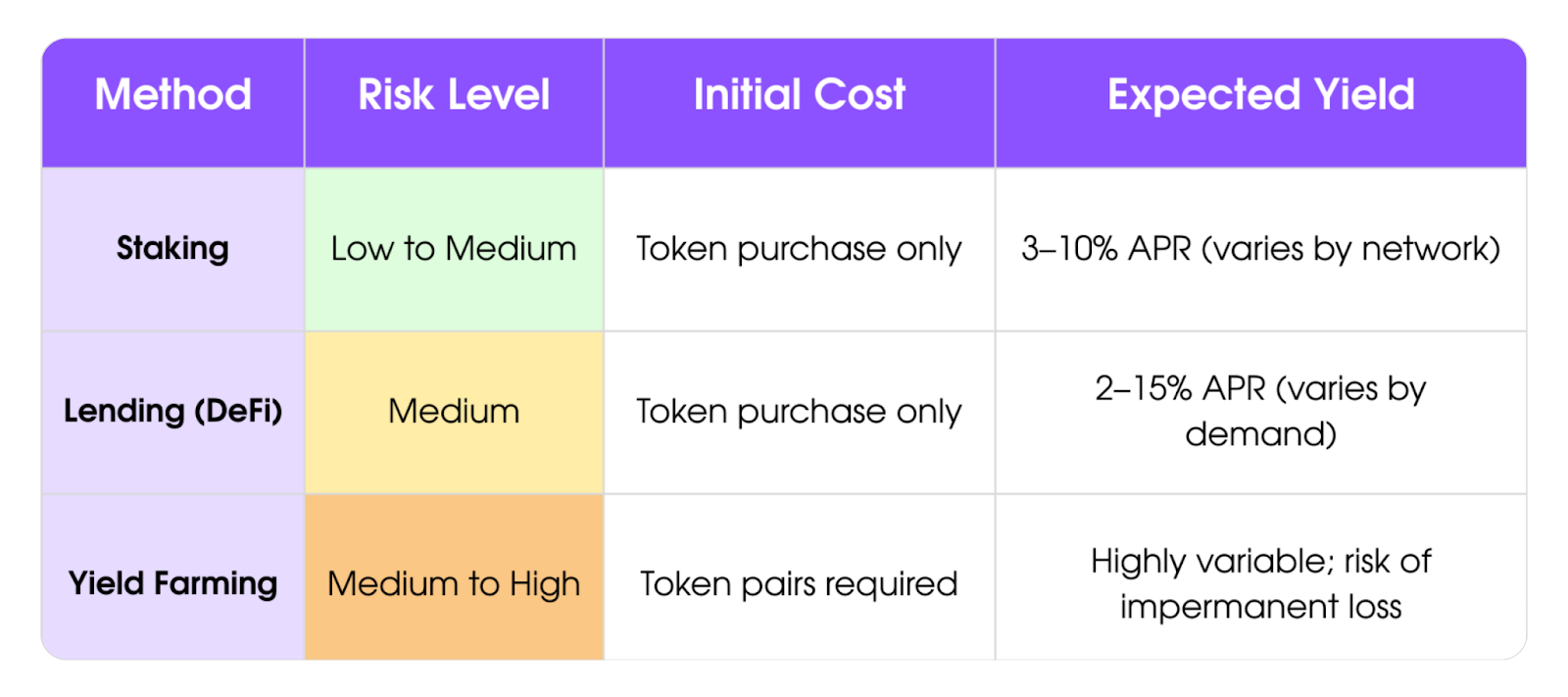
DeFi lending and yield farming involve many additional mechanics beyond the basics covered here. For a deeper explanation of how DeFi yield strategies work in practice, see our article “What Is DeFi Yield, and How Does It Really Work?”.
WARNING: Impermanent loss is one of the most misunderstood risks in DeFi. Before providing liquidity to any pool, make sure you understand how price changes between the two tokens can reduce your overall value.
Affiliate and Learn-to-Earn Programs
If you want to explore crypto without having to contribute your own funds, learn-and-earn crypto programs are a great starting point. Platforms like major exchanges offer small rewards — paid in crypto — for completing educational courses and quizzes. The payouts are modest, but this requires no financial commitment on your end, and you build knowledge that ultimately helps you make better decisions.
At GoMining Academy, you can study our courses and get real BTC for learning about Bitcoin.
Another option worth knowing about are faucet crypto sites — platforms that distribute tiny amounts of cryptocurrency for completing simple tasks like viewing ads, solving captchas, or watching videos. The concept has been around since the early days of Bitcoin, originally designed as a way to introduce newcomers to crypto without any financial commitment. In theory, it is zero-risk. In practice, the rewards are so small that the time investment rarely makes sense — most faucets pay fractions of a cent per task.
The bigger concern is safety. Some faucet sites are legitimate but low-value. Others are designed to expose you to malware, phishing links, or deceptive sign-up flows that harvest your personal data. Before using any faucet site, check whether it has been reviewed by a credible source, and never connect your main crypto wallet to one. If you want to explore crypto without financial risk, learn-and-earn programs from established exchanges are a much safer and more rewarding starting point.
High-Risk “Passive” Ideas: What to Avoid
Not every opportunity that calls itself “passive income” deserves your attention. Some of the most heavily advertised strategies in crypto are also the most dangerous.The scale of the risk is significant: according to security auditing firm Hacken, $3.1 billion in crypto was lost to crime in just the first six months of 2025, making it the worst year for crypto crime on record. Much of that loss came from exactly the kind of high-yield traps described below.
Cloud Mining: A Closer Look
If you have spent any time searching for the best cloud mining options, you have probably seen websites promising easy Bitcoin profits with no effort. The idea sounds appealing: you rent mining power from a remote data centre, and the company handles everything while you collect rewards.
The reality is very different. The vast majority of cloud mining offers are either outright scams or so unprofitable that you would have been better off simply buying Bitcoin directly. Real Bitcoin mining requires serious hardware — a dedicated Bitcoin mining rig with specialized chips — and access to cheap electricity. That said, not every mining-related product works this way.
GoMining, for example, takes a different approach: digital miners represent ownership of real mining infrastructure stored in our mining facilities across the globe. Your returns are tied to actual hardware performance and network conditions, not a fixed promise. That distinction matters: the risk is real and transparent, rather than hidden behind an attractive headline number.
The “Too Good to Be True” Yields
Any project promising fixed daily returns — such as 1% per day, every day — is almost certainly a Ponzi scheme or a pyramid scheme. These projects pay early investors with money from newer participants rather than from any real returns. Eventually, they always collapse.
History is full of examples. Every major market downturn has exposed dozens of platforms that turned out to be fraudulent — projects that looked legitimate during a bull run but collapsed the moment new money stopped flowing in. The pattern is always the same. If a yield source cannot clearly explain where the returns come from, that is your signal to walk away.
If you do fall victim to a scam, recovery is extremely difficult. Crypto transactions are irreversible by design — once funds leave your wallet, there is no bank to call and no chargeback to file.
This has given rise to a whole industry of so-called "crypto scam recovery" services that promise to trace and retrieve stolen funds. The majority of these services are themselves scams, targeting people who have already lost money and are desperate to get it back. Prevention is not just the better option — in most cases, it is the only option.
Essential Tools for Due Diligence
Before committing any funds, use the right tools to verify what you are being told.
Crypto profit calculator: These tools let you model different scenarios — what happens to your returns if the token price drops 30%? What if the yield rate falls by half? Running these numbers helps you set realistic expectations instead of relying on best-case projections.
Block explorer: A block explorer lets you look up any transaction on the blockchain. You can verify that a protocol is actually processing real transactions, check wallet balances, and confirm that the activity behind a yield source is genuine. If a project claims thousands of users but the block explorer shows minimal activity, that is a red flag.
Earnings calendar: Tracking token unlock dates and governance votes helps you anticipate changes that could affect your position. A large token unlock, for example, can increase supply and push prices down — reducing the real value of your yield.
Risks and Limitations
No guide to passive income ideas in crypto would be complete without an honest look at the risks. Here are the ones every investor should understand.
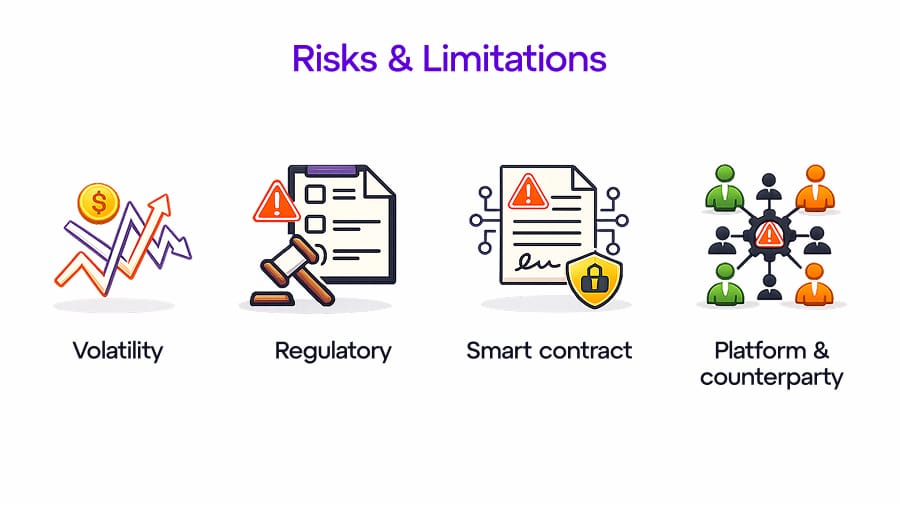
Volatility: Earning 20% APY means nothing if the underlying token drops 50% in value. Every past crypto crash has shown that token prices can fall sharply and without warning. Always consider the worst-case scenario for the assets you hold.
Regulatory risk: Crypto regulation is evolving rapidly, and it varies widely from country to country. What is legal and accessible today might be restricted or banned tomorrow. A staking service available in one jurisdiction could be shut down in another. Stay informed about the rules that apply where you live.
Smart contract risk: DeFi protocols are powered by code, and code can contain bugs. Even protocols that have been professionally audited have been exploited in the past. The best crypto wallet in the world cannot protect your funds if the protocol you deposit into is compromised.
Platform and counterparty risk: For centralized platforms, you are trusting a company with your funds. If that company becomes insolvent, mismanages funds, or faces legal action, your deposits may be frozen or lost entirely.
WARNING: Never invest more than you can afford to lose. This is not just a common saying — it is the most practical advice in crypto. Treat any yield-generating strategy as an experiment until you fully understand how it works.Even prominent figures in crypto have made this point.
Ethereum co-founder Vitalik Buterin said as early as 2018: "Don't put in more money than you can afford to lose. If you're trying to figure out where to store your life savings, traditional assets are still your safest bet." This reflects Buterin's personal position as a prominent figure in the Ethereum ecosystem, not a consensus view among financial professionals — but the underlying caution remains widely shared.
One area worth watching for long-term opportunities is blockchain in supply chain management. While not a direct source of passive income today, companies building real-world blockchain infrastructure are creating ecosystems where token holders may eventually benefit from genuine economic activity — a much healthier foundation for yield than token emissions alone.
Conclusion
The “best” passive income idea in crypto is not the one with the highest number next to it. It is the one that fits your risk tolerance, your knowledge level, and your financial situation.
Start with the basics: understand what staking, lending, and yield farming actually involve. Use tools like a crypto profit calculator and a Bitcoin block explorer to verify claims before committing funds. Avoid anything that promises guaranteed returns or cannot explain where the yield comes from.
Most importantly, remember that safety matters more than yield. A 5% return on an asset you keep is always better than a 100% return on an asset you lose.
Frequently Asked Questions
Can I make a living from crypto passive income?
It is technically possible, but it requires significant capital, deep knowledge of the protocols you use, and the discipline to manage risk consistently — much like any work-from-home income source. Most people are better off treating crypto yield as a supplement, not a salary replacement.
Is staking AI crypto coins safe?
It depends entirely on the specific project. Some AI-focused crypto tokens are backed by legitimate teams and have passed independent security audits. Others are speculative and carry high risk. Before staking any token, check whether the project has been audited, how long it has been operating, and whether its yield comes from real activity or just token emissions.
What is the difference between APR and APY?
APR — Annual Percentage Rate — is the simple interest you earn over a year, without any compounding. APY — Annual Percentage Yield — includes the effect of compounding, where your interest earns its own interest. At low rates, the difference is small. At high rates with frequent compounding, APY can be significantly larger than APR. Always check which number a platform is showing you.
How do I report crypto income?
Tax rules for crypto vary widely depending on where you live. In many countries, crypto earned through staking, lending, or yield farming is treated as taxable income. Some jurisdictions also apply capital gains tax when you sell or swap tokens. Check the rules in your country and consider consulting a tax professional if your crypto activity is significant.
This article is part of GoMining Academy — a free, continuously updated library of crypto ecovering everything from Bitcoin basics to DeFi, mining, and beyond. No prior knowledge required.
Telegram | Discord | Twitter (X) | Medium | Instagram