How to Pick the Best Crypto Wallet For Your Needs
 Alex D
You wouldn’t store gold bars in a cardboard box. So why store Bitcoin in an app you picked at random?
With thousands of crypto wallets available, choosing the wrong one can lead to total loss — whether through hacks, scams, or simple user error. And if you’ve been following recent crypto wallet security news, you know these threats are very real.
The good news: picking the best crypto wallet doesn’t require a technical background.
This guide will walk you through each one, so you can make a confident choice based on your needs — not someone else’s top-ten list.
Key Takeaways
- The Golden Rule: “Not your keys, not your coins.” Understanding the difference between custodial vs. non-custodial wallets is the first and most important decision you will make.
- Storage Strategy: Use the best crypto wallet for long-term savings — typically a hardware or cold wallet — and a separate hot wallet for daily use. This simple split dramatically reduces your risk.
- Security Checks: Open-source code, two-factor authentication, and a clean security history. Verify all three before trusting any wallet with your funds.
Step 1: Who Holds the Keys? Custodial vs. Non-Custodial Wallets
Before you compare features or download anything, there is one question that matters more than all others: who controls the private keys?
A private key is a unique secret code that proves you own a certain cryptocurrency on the blockchain. Think of it as the only key to a transparent safe that everyone can see into, but only you can open. Your crypto lives on the blockchain — your wallet simply holds the key that unlocks it.
Bitcoin educator Andreas Antonopoulos put it plainly: "Not your keys, not your coins." Without the private key, you have no way to prove ownership — or access your funds at all.
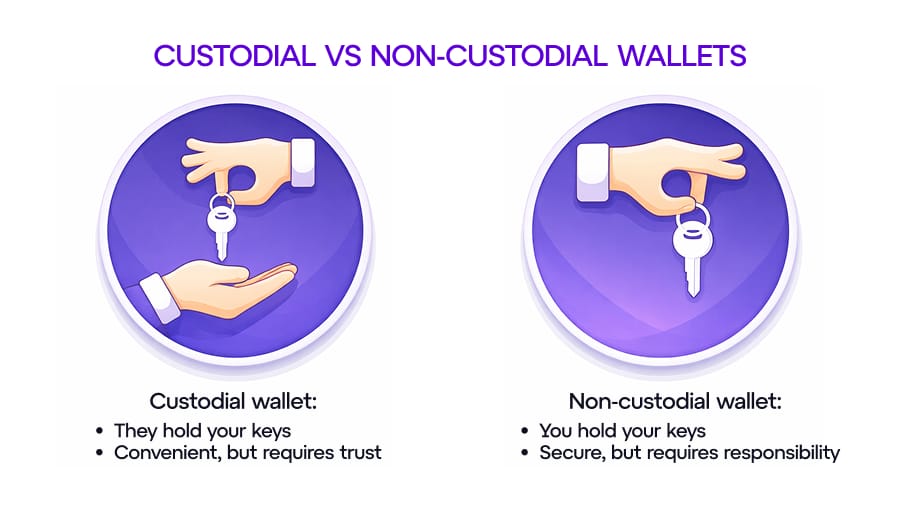
Custodial Wallets: The “Bank” Model
A custodial wallet is one where a third party — usually an exchange like Coinbase, Binance, or Kraken — holds your private keys for you. You access your crypto through an account with a username and password, much like online banking.
The advantage is convenience. Forgot your password? You can reset it. There is no seed phrase to worry about, and some platforms offer limited protections under crypto regulation in their jurisdiction.
The downside is serious: you are trusting a company with your funds. If that company gets hacked, freezes accounts, or goes bankrupt, your crypto may be gone.
The collapse of the FTX exchange in 2022 showed exactly how this can play out. FTX was one of the largest crypto exchanges in the world — until it was revealed that around $8 billion in customer funds had been secretly moved to a sister trading firm without customers' knowledge or consent. When the platform collapsed, users found their accounts frozen overnight. And in those situations, crypto scam recovery is nearly impossible.
This doesn’t mean exchanges are bad. Many people use exchanges for buying and selling, then move the crypto they want to keep long-term into a non-custodial wallet. It is a matter of using the right tool for the right purpose.
Non-Custodial Wallets: The “Safe” Model
A non-custodial wallet gives you full control. When you set up one of these wallets, you receive a seed phrase — a set of 12 or 24 random words that restore access to your private keys. Anyone who has this phrase can access your crypto, so it must be protected carefully.
The advantage is total ownership. No company can freeze your funds or deny you access. The trade-off is total responsibility: if you lose your seed phrase, your crypto is gone forever.
There is no customer support line to call, no password reset button.
Blockchain analytics firm Chainalysis estimates that around 1.5 million Bitcoins are considered permanently lost — most of it due to forgotten passwords and lost keys, not theft.
Step 2: Hot vs. Cold Wallets
Once you decide who should hold the keys, the next question is connectivity. Should your wallet be online or offline?
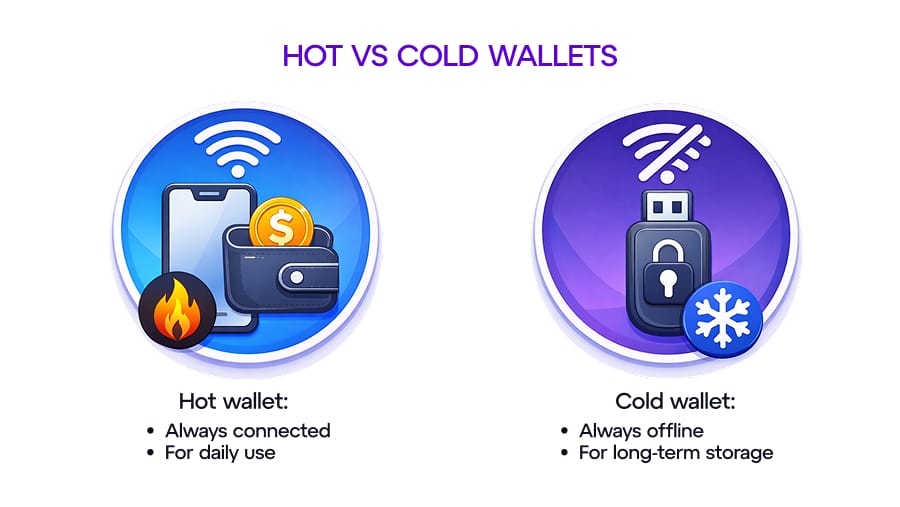
Hot Wallets: Always Connected
A hot wallet is software that runs on your phone, computer, or browser and stays connected to the Internet. Popular examples include MetaMask, Trust Wallet, and Phantom.
Think of a hot wallet like a safe in your home office with a digital keypad. It is convenient — you can access it anytime. But because it is online, it is more vulnerable to threats like malware and phishing, where attackers impersonate legitimate services to trick you into revealing your password or seed phrase.
Hot wallets are best for daily trading, connecting to Web3 applications — the broader ecosystem of blockchain-based services that run without a central company behind them — and holding smaller amounts you use regularly.
Cold Wallets: Completely Offline
A cold wallet is a physical device — often looking like a USB stick — that stores your private keys entirely offline. If you've come across the names Ledger or Trezor, these are the most widely used hardware wallets on the market.
Imagine a fireproof safe bolted to a basement floor with no internet connection. To access it, you must physically be there with your key. That is cold storage: since it never touches the Internet, remote hackers simply cannot reach it.
Cold wallets are ideal for larger amounts you plan to hold long-term, and for storing payouts from a Bitcoin mining rig or any other crypto earnings you do not need to access daily. The trade-off is less convenience — you need the physical device to make transactions.
In short: use a hot wallet for everyday activity and small amounts, and a cold wallet for anything you want to keep safe long-term. Most experienced users have both.
Step 3: Essential Features Checklist
You now know the two big distinctions: custodial versus non-custodial, and hot versus cold.
Before you download or buy anything, the final step would be to run your chosen wallet through these checks. Not every wallet will tick all the boxes — but knowing what to look for puts you in control.
Multi-Chain Support
Does the wallet support only Bitcoin, or does it also work with Ethereum, Solana, and other networks?
If you plan to hold different tokens or explore passive income ideas like staking — which means locking your crypto to help run a blockchain network in exchange for rewards — you will need a wallet that covers multiple chains. Without that, you would have to manage a separate wallet for each network, which quickly becomes complicated and increases your security risk.
Security Features
Look for open-source code, which means anyone can inspect the software for vulnerabilities.
Check whether the wallet supports biometric login and two-factor authentication. Search for recent crypto wallet security news about the wallet you are considering — has it ever been breached? If so, how did the company handle it?
User Interface
A good wallet should feel intuitive, even if you are brand new to crypto. If the interface is confusing or cluttered, that is a red flag.
Poorly designed interfaces increase the chance of costly mistakes, and some of the worst scam wallets hide behind bad design on purpose.
Transaction Verification Tools
Most blockchains have a publicly accessible explorer — a tool that shows every transaction on the network, so you can verify that your crypto actually arrived where you sent it.
For Bitcoin specifically, it is Bitcoin block explorer - one of the most useful tools a beginner can bookmark.
Matching Your Profile: Which Wallet Fits You?
There is no single best crypto wallet for everyone. The right choice depends on what you plan to do:
- The HODLer: You buy crypto and plan to hold it for months or years without touching it. Security is your priority, not convenience.
A hardware cold wallet is the right fit: your keys stay offline, away from hackers and platform failures. During a crypto bubble — when prices surge, and everyone rushes in — your funds are untouched on your device, and the friction of cold storage keeps you from making impulsive decisions you might regret.
- The DeFi Trader: You want to put your crypto to work: swapping tokens, earning yield, or exploring decentralized apps.
Most DeFi traders use a non-custodial hot wallet for this — typically a browser extension like MetaMask. It connects directly to web3 applications and keeps you in control of your keys, without the friction of a hardware device every time you make a move.
- The Beginner: You are just getting started and want to buy your first crypto with minimal setup.
Begin with a reputable exchange app — a custodial wallet. It handles the complexity for you while you learn. As your confidence and holdings grow, consider moving long-term savings into a non-custodial wallet.
Many experienced users combine wallets: a hot wallet for daily activity and a cold wallet for long-term savings.
Risks and Limitations
No wallet eliminates risk entirely. Understanding the dangers helps you prepare for them.
User Error
The biggest risk is human error. Sending crypto to the wrong address is irreversible. Before making a large transfer, test with a small amount first and verify it using a block explorer for that network. Double-check every address character by character.
Phishing and Fake Wallets
Fake wallet apps exist on every app store and browser extension marketplace, and some are nearly impossible to distinguish from the real thing. Always download from the official website of the wallet you choose.
Remember that phishing, malware, and social engineering — deceptive tactics designed to gain your trust — target individual users, not the blockchain itself. The network may be secure; your habits need to be secure too.
Smart Contract Risk
If you connect your wallet to a malicious decentralized app — such as a fake token giveaway or airdrop site — it can drain your funds in seconds.
Only interact with verified, well-known applications, and consider using a separate dedicated wallet for DeFi and web3 activity.
No Deposit Insurance
Unlike a traditional savings account, most crypto wallets carry no government-backed insurance. If funds are lost or stolen, there is no safety net. This is another reason why choosing the right wallet — and practicing strong security habits — matters so much.
WARNING: Never share your seed phrase with anyone. No legitimate wallet provider, exchange, or support agent will ever ask for it. If someone does, it is a scam.
Conclusion
Choosing the best crypto wallet is ultimately a trade-off between security and convenience. The more control you have, the more responsibility you carry.
Start by deciding who should hold the keys: you or a third party. Then choose between hot and cold storage based on how often you need access. Finally, verify the wallet’s security features, multi-chain support, and reputation.
If you are just starting out, begin with a reputable exchange, learn the basics, and gradually move your holdings into a non-custodial wallet as your confidence grows. Use multiple wallets for different purposes, keep your seed phrase offline and secure, and stay up to date with crypto wallet security news.
Security is not a single decision — it is a habit you build over time.
Frequently Asked Questions
Can I use the same wallet for XRP, Bitcoin, and other tokens?
It depends on the wallet. Many modern non-custodial wallets support multiple blockchains, so you can store Bitcoin, XRP, Ethereum, and other tokens in one place. Always check which networks a wallet supports before setting it up.
What happens if I lose my hardware wallet?
Your crypto is not stored on the device itself — it lives on the blockchain. If you lose the physical wallet, you can restore access on a new device using your seed phrase. This is why protecting your seed phrase is far more important than protecting the device.
Are AI crypto tokens stored differently from other tokens?
Usually not. Most AI-related crypto tokens are built on standard blockchains like Ethereum or Solana. Any wallet that supports those networks can hold these tokens.
Is it possible to recover stolen crypto?
In most cases, crypto scam recovery is either extremely difficult or impossible. Blockchain transactions are irreversible by design. Some law enforcement agencies have had limited success tracing funds, but for everyday users, prevention is the only reliable strategy.
Do I need a separate wallet for staking or earning yield?
Not necessarily. Some wallets have built-in staking features that let you earn rewards directly. However, for more advanced passive income ideas like providing liquidity or more advanced DeFi strategies, you may want a browser-based hot wallet that connects to DeFi protocols. To learn more about such strategies, read our article “Staking vs Yield Farming: What’s the Difference?”
This article is part of GoMining Academy — a free, continuously updated library of guides covering everything from Bitcoin basics to DeFi, mining, and beyond. No prior knowledge required.
Telegram | Discord | Twitter (X) | Medium | Instagram