How to Mine Bitcoin on a PC or Phone in 2026 — And Whether It’s Worth It
 Zamy
Zamy
A beginner-friendly guide explaining why Bitcoin mining no longer works on PCs or phones, what to expect if you try anyway, and what you can do instead in 2026.
What You’ll Learn
- Why Bitcoin can no longer be mined on a PC or phone in 2026
- How Bitcoin mining works today, including ASICs, hashrate, and mining difficulty
- What actually happens if you try to mine Bitcoin on a laptop or smartphone
- Which cryptocurrencies can still be mined on a PC, and how beginners get started
- The difference between real mining, simulated mining apps, and common scams
- Ways to get exposure to Bitcoin and mining mechanics without running hardware
Let’s Be Honest: Mining BTC on PC/Phone Doesn’t Work Anymore
You probably landed here after typing something like mine bitcoin on pc and feeling a small rush of hope. Maybe there’s an app. Maybe your laptop can do something overnight.
In Bitcoin’s early years, roughly between 2010 and 2012, people really did mine BTC on regular computers. At the time, the network was small, competition was light, and home mining actually worked.
That version of Bitcoin mining no longer exists.
Today, Bitcoin is mined almost entirely by specialized hardware built for a single purpose: mining. Modern machines produce as much mining power as tens of thousands of PCs, and far more than any phone could handle. At that scale, laptops and phones simply don’t matter anymore.
This guide will help you avoid wasting time, damaging hardware, or falling for mining apps and websites that promise something that simply isn’t possible anymore. We’ll be clear about what no longer works, what still does, and which alternatives make sense if you’re curious and want to learn safely.
Mini glossary
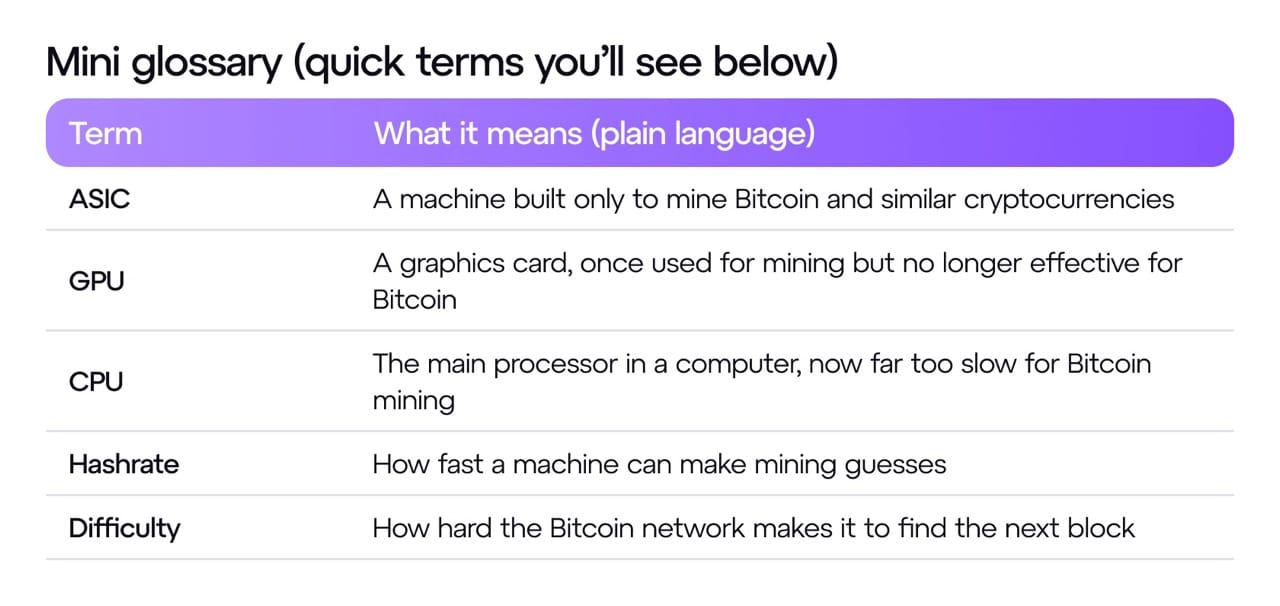
Table of Contents:
- Why You Can’t Mine Bitcoin on a PC or Phone in 2026
- So… What Happens If You Try to Mine Bitcoin on a PC or Phone?
- What You CAN Do Instead
- If You Really Want to Mine Bitcoin — Here’s the Real Way
- Safety Guidelines for Beginners
- FAQ — Mining Bitcoin on PC/Phone
- Conclusion
Why You Can’t Mine Bitcoin on a PC or Phone in 2026
Let’s strip this down to first principles. Bitcoin mining today is not about clever software or hidden tricks. It’s about raw guessing power, and who has the most of it.
1. ASICs Outperform PCs and Phones by 100,000×+
Bitcoin mining works like a massive lottery. Machines make rapid guesses, and when one guess matches what the network is looking for, that machine earns the right to add the next block.
An ASIC is a machine built for this single task. It doesn’t browse the web, run apps, or multitask. It makes guesses, nonstop. A PC or phone is built to do many things. Mining is just one small task among many, and they’re not designed to do it well.
That difference shows up immediately when you compare hardware.
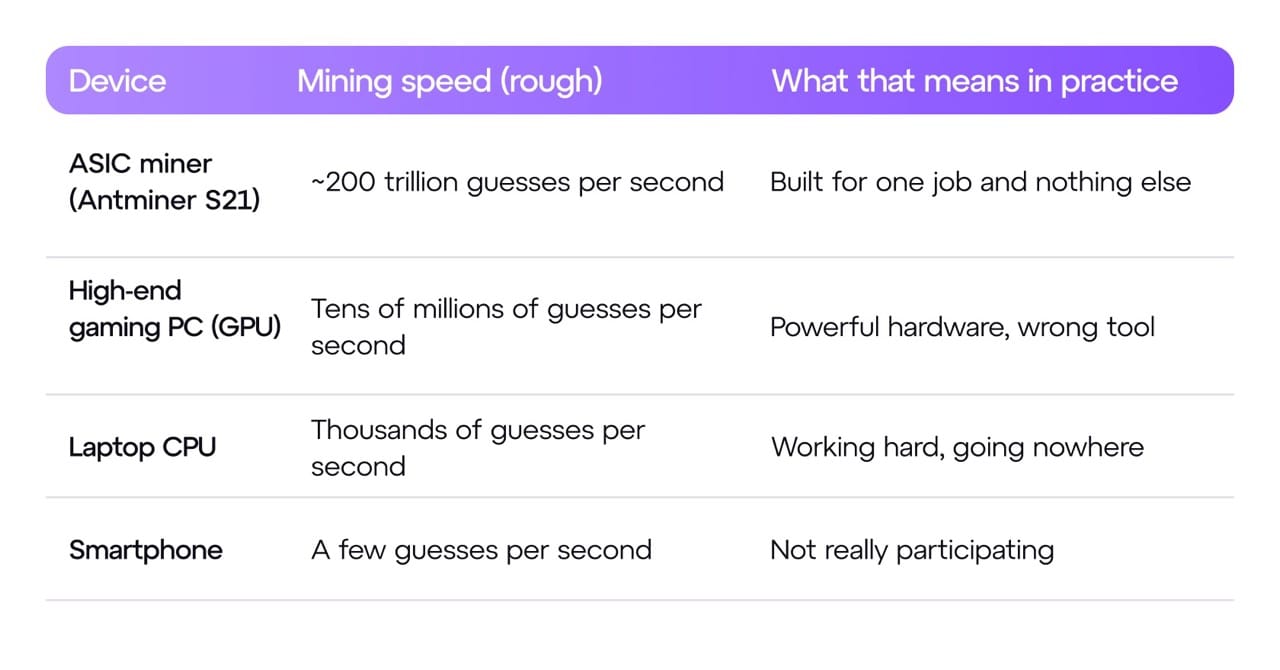
The exact numbers matter less than the scale. One modern ASIC does the work of tens of thousands of PCs. Phones aren’t even in the same race.
Here’s what that scale difference looks like.
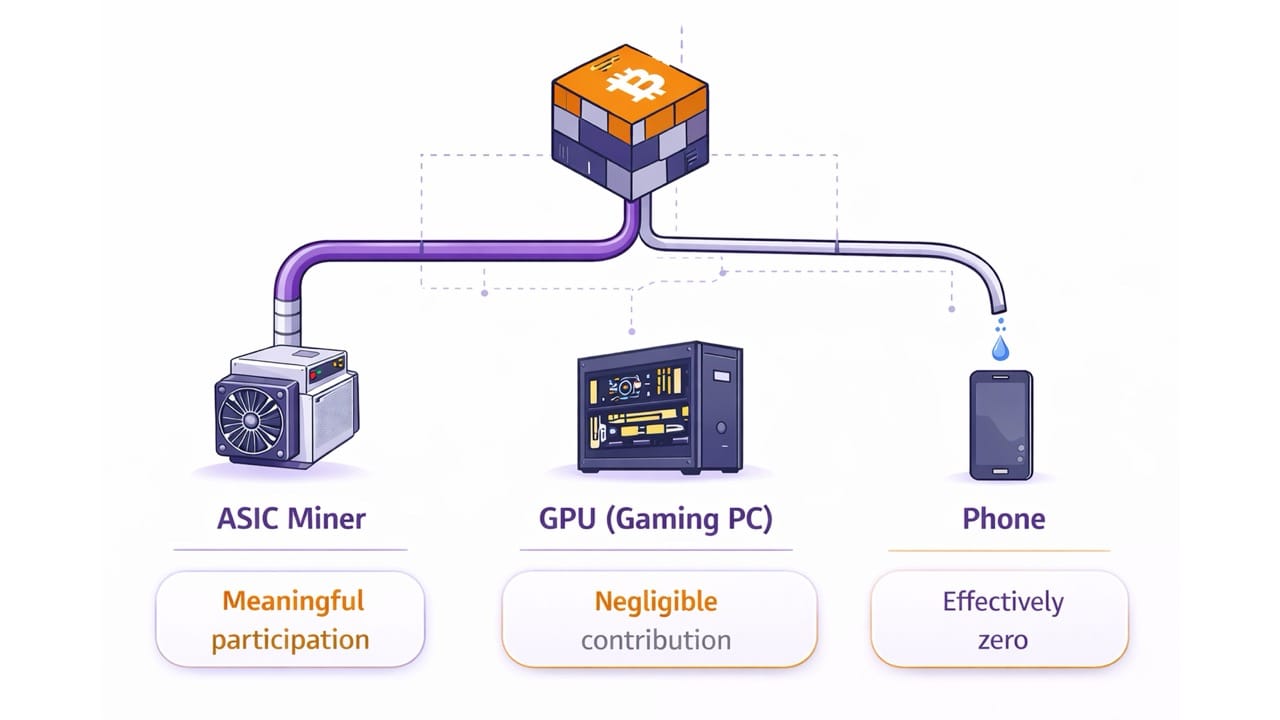
All devices connect to the same Bitcoin network — only ASIC miners operate at the scale the network now expects.
This isn’t something you can fix with better software or settings. Bitcoin mining today depends on specialized hardware, stable power, and proper cooling. That’s why it happens in dedicated facilities, not on everyday devices.
In 2026, Bitcoin mining is no longer general computing but purpose-built infrastructure.
2. Bitcoin Mining Difficulty Is Extremely High
Bitcoin doesn’t allow blocks to be found at random. The network constantly adjusts how hard mining is. This adjustment is called mining difficulty.
Roughly every two weeks, the network checks how quickly miners found recent blocks. If blocks are found faster than expected, difficulty increases. If they are found too slowly, difficulty decreases. This process keeps new blocks arriving at a steady pace, around one every 10 minutes.
As large-scale mining operations joined the network, they brought enormous amounts of computing power with them. Bitcoin responded by raising difficulty to match that increase.
Today, industrial ASIC miners set the pace. General-purpose devices like PCs and phones operate far below what the network now expects.
Difficulty keeps Bitcoin secure and predictable, but it also draws a clear line around who can realistically compete. If you're interested, you can learn more about network difficulty here.
3. Power Cost Makes PC/Phone Mining Impossible
Mining consumes electricity whether you earn Bitcoin or not.
When you run mining software on a PC, the machine works at full load for hours at a time. Fans spin constantly. Power draw stays high. A typical desktop can pull hundreds of watts nonstop. Phones use less power, but they waste most of it because they are not built for mining.
In return, both devices produce almost nothing. Any Bitcoin earned, if it shows up at all, is worth far less than the electricity used to get it.
ASIC miners also use a lot of electricity, but they turn that power into actual mining work. They make trillions of guesses every second. PCs and phones cannot do that, so most of the energy they consume turns into heat instead of results.
That mismatch breaks the math. Even as a short experiment, PC and phone mining costs real money and delivers nothing back.
4. Phones Overheat and Can Be Permanently Damaged
Phones are not built for nonstop heavy computation.
Mining apps keep the processor running at full speed for long periods. The phone heats up. To protect itself, it slows down performance. At the same time, the battery works harder than it was designed to, charging and discharging under constant stress.
Over time, this kind of use shortens battery life and can cause lasting performance problems. The phone may feel slower, run hotter during normal tasks, or lose charge much faster than before.
Apps that claim to “mine safely in the background” cannot change how physics works. Heat, power limits, and battery wear still apply, no matter how the app is labeled.
So… What Happens If You Try to Mine Bitcoin on a PC or Phone?
Let’s say curiosity wins and you try anyway. What you’ll find is the same pattern, regardless of the device.
After about 30 minutes: The device starts working harder. Fans spin up. A laptop or phone feels warm to the touch. The app shows activity, but nothing appears in your wallet yet.
After one day: Heat becomes obvious. Performance drops. The device keeps pulling power nonstop. Any reward, if the app shows one at all, is extremely small.
After one week: Wear starts to show. Batteries drain faster. Hardware has spent days under constant stress. The total Bitcoin earned is still close to zero.
What actually happens, side by side
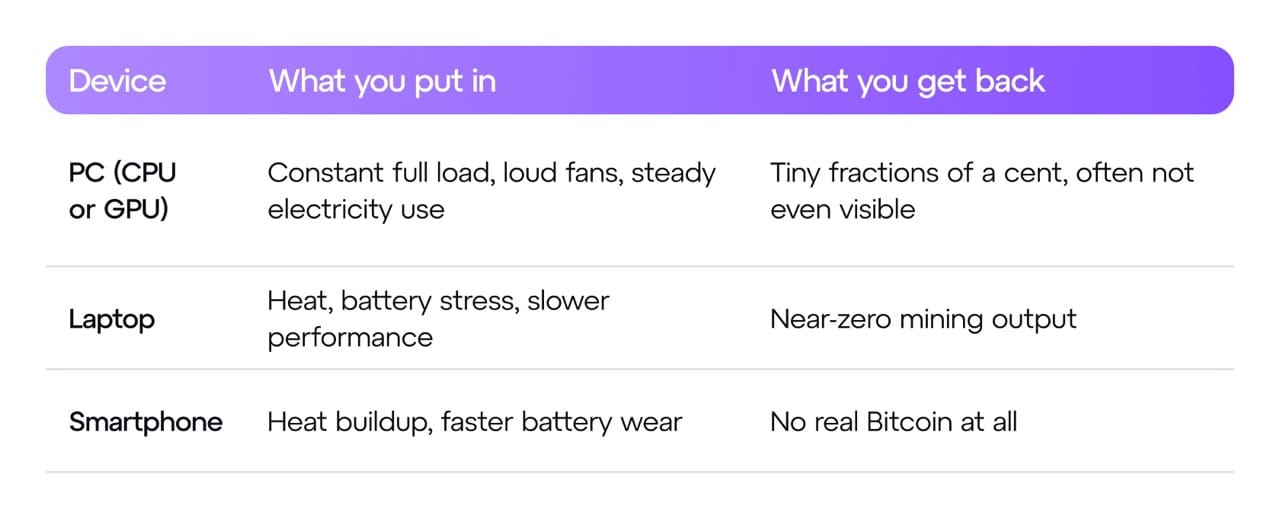
Mining Bitcoin on a phone or PC is like bringing a bicycle to a container port and trying to outwork cranes. You can pedal as hard as you want. The cranes are built to move the port. You’re not.
Most attempts end the same way: more heat, higher power use, and weaker devices, not Bitcoin.
Curiosity about mining makes sense. The key is pointing that curiosity toward options that don’t quietly cost more than they give back.
What You CAN Do Instead
If mining Bitcoin on a PC or phone is a dead end, that doesn’t mean your curiosity is misplaced. It just means the path needs to change.
Before choosing anything below, pause for a second and ask yourself one question:
What are you actually trying to get here?
Learning how mining works? Small rewards? Exposure to Bitcoin without breaking hardware?
Different goals point to different options.
Option 1 — Mine Altcoins on PC (Where GPU Mining Still Works)
When Bitcoin mining shifted to ASIC machines, GPU mining didn’t disappear. It continued on other cryptocurrencies that still rely on graphics cards rather than specialized hardware.
A few names you’ll see come up often are:
- Kaspa (KAS)
- IronFish (IRON)
- Ergo (ERG)
- Ethereum Classic (ETC)
These networks still accept work from GPUs, which makes it possible to participate using a regular desktop PC with a dedicated graphics card.
In practice, this usually means running mining software designed for GPUs and connecting to a mining pool. Instead of competing alone, your card contributes small amounts of work alongside others, and the pool distributes rewards more steadily over time.
Returns are usually small and depend heavily on electricity cost, your GPU, and market conditions. But unlike trying to mine Bitcoin on a PC, this is real mining on a live network, not a simulation or a reward app.
This option makes sense if you already own a GPU and want hands-on experience with how mining actually works, without expecting it to turn into easy income.
Option 2 — CPU Mining (Monero XMR)
Monero is a cryptocurrency designed with privacy in mind. It focuses on keeping transactions harder to trace, and that design choice also shapes how its mining works.
Its mining algorithm, called RandomX, favors CPUs and deliberately resists ASIC hardware. That design choice keeps mining accessible on normal desktops and laptops instead of pushing everything toward industrial setups.
In practice, this means you can mine Monero using the processor already inside a PC or laptop. Setup is relatively simple, and rewards, while small, are real.
This won’t generate meaningful income for most beginners. What it does offer is a safe way to learn how mining software, pools, and rewards work, without stressing your hardware.
This is a good fit if you’re here to understand how mining works, not to chase short-term returns.
Option 3 — Use Mining Simulators or Reward Apps (But With Warnings)
Apps like Bee, Pi, and similar platforms do not mine Bitcoin. In fact, some mining simulators don’t mine any real blockchain at all.
Instead, they usually simulate the idea of mining. The app shows progress, numbers go up, and rewards may appear later, if they appear at all. Behind the scenes, these platforms often make money through ads, referrals, or data collection rather than through mining.
Some people use these apps out of curiosity or as a first exposure to crypto concepts. That’s fine, as long as expectations are clear.
What matters is knowing the limits. These apps won’t generate real Bitcoin, and they shouldn’t ask for sensitive information. If an app requests private keys, wallet access, or promises guaranteed payouts, that’s a red flag.
This option only makes sense if you treat it as an experiment or a learning toy, not as mining and not as an income source.
Option 4 — Buy Hashpower
This category covers very different models, and that’s where beginners often get confused.
Some platforms sell simple cloud-mining contracts with fixed terms and promises. These are the riskiest. Many fail because the operation is unprofitable, fees quietly consume rewards, or the mining activity isn’t fully transparent.
Other models are closer to hosted mining. Real hardware exists, but it runs in professional facilities and gets managed on your behalf. In some cases, platforms go a step further by tying user rewards directly to identifiable, real mining hardware rather than abstract contracts.
These setups can work, but only if you clearly understand how rewards are generated, what costs apply, and how difficulty changes affect payouts.
The main risk is not the idea of remote mining itself. The risk is buying into something without knowing where the mining power comes from or how returns are calculated.
For a broader look at how computing power is being offered and abstracted across crypto today — beyond mining alone — this overview of top crypto cloud computing projects helps show the range of models currently in use.
If a platform cannot clearly explain how mining works behind the scenes, what fees apply, and how payouts change over time, it’s better to step back and learn before committing. At GoMining, you can watch livestreams from our data center and see where your rewards come from.
This option can make sense as long as you stay curious about how rewards are generated and how real mining infrastructure differs from marketing promises.
Option 5 — Earn Bitcoin Without Mining (Beginner-Friendly)
If your goal is exposure to Bitcoin, mining isn’t the only way in. There are simpler options that let you learn how Bitcoin works without running hardware or dealing with mining risks.
Some low-friction ways to get familiar with Bitcoin include:
- Educational reward programs that pay small amounts of Bitcoin for completing lessons
- Tasks or microjobs that offer BTC as payment
- Bitcoin faucets, which distribute very small amounts and are mostly useful for learning
- Running a Lightning node, which doesn’t mine Bitcoin but helps you understand payments and network mechanics
None of these options will replace income. What they offer is familiarity. You learn how wallets work, how transactions move, and how Bitcoin functions in practice, without stressing hardware or increasing your exposure to scams.
This works well if you want to understand Bitcoin and participate safely, not run a mining operation.
If You Really Want to Mine Bitcoin — Here’s the Real Way
If your goal is to mine Bitcoin itself, there are only a few real paths. One involves real infrastructure and real costs. The other is small, educational, and mostly about understanding how mining works, not earning from it.
For many people, this doesn’t mean running machines themselves. It means participating in real mining infrastructure without managing hardware day to day.
GoMining takes this approach by connecting users to Bitcoin mining that runs on real ASIC machines inside professional data centers. The mining happens the same way it does for large operators, but the physical setup, power, cooling, and maintenance are handled for you.
That lets you experience how Bitcoin mining actually works in practice, including how hashrate, efficiency, rewards, and difficulty affect outcomes, without having to turn your home into a mini data center.
If you want direct control over the hardware instead, that means owning an ASIC miner yourself.
Buy an ASIC Miner
Bitcoin mining today runs on ASICs. There’s no practical way around that.
When people talk about Bitcoin miners, they usually mean machines like:
- Antminer S21
- Whatsminer M66
- Antminer S19 XP
You don’t need to decode every specification to compare them. Two numbers matter most:
- TH/s (terahashes per second): how much mining work the machine can do
- J/TH (joules per terahash): how much energy it uses to do that work
Higher TH/s means more mining power. Lower J/TH means the machine uses energy more efficiently.
Even with the right hardware, outcomes depend on things you don’t control, such as electricity cost, network difficulty, and market conditions. Tools like the GoMining reward calculator help you test different scenarios, but they don’t promise results.
In practice, buying an ASIC feels less like installing software and more like running a small piece of infrastructure. You need stable power, proper cooling, and the patience to deal with changing conditions.
Host It in a Mining Facility
For most people, running an ASIC at home creates more problems than it solves. That’s why many miners choose to host their machines in professional facilities instead.
Mining facilities are built for this kind of hardware. They offer stable electricity, proper cooling, and systems designed to handle constant load. At home, the same machine can mean nonstop noise, excess heat, and real electrical risk if the setup isn’t right.
Hosting removes a few common headaches. You don’t deal with fan noise. You don’t need to manage cooling yourself. You also reduce the risk of overheating or stressing household wiring.
What hosting does not do is remove uncertainty. Electricity prices still matter. Network difficulty still changes. Market conditions still affect outcomes. Hosting makes mining easier to run, not easier to predict.
Or Start With a Small Home Miner
If your goal is learning rather than profit, there’s a much lighter way to explore Bitcoin mining.
Small devices like GekkoScience USB miners or NerdMiner-style units can mine Bitcoin at a tiny scale. They plug into a computer, make a bit of noise, and earn almost nothing.
That’s intentional.
These devices help you see how mining works from the inside. You can watch how a miner connects to a pool, how shares get submitted, and how blocks and rewards are tracked. The feedback loop is real, even if the rewards are not.
They won’t generate meaningful Bitcoin, and they’re not meant to. Think of them as learning tools, not mining businesses.
If you want to compete in Bitcoin mining, you need ASICs and proper infrastructure. Everything else sits firmly in the category of education and curiosity, not production.
Safety Guidelines for Beginners
If mining on a PC or phone doesn’t work, why do so many mining apps and offers still exist?
Because the word mining suggests effort turning into rewards. People search for it. Some platforms use the term honestly. Others use it to blur what’s really happening behind the scenes.
Knowing the difference is what keeps you safe.
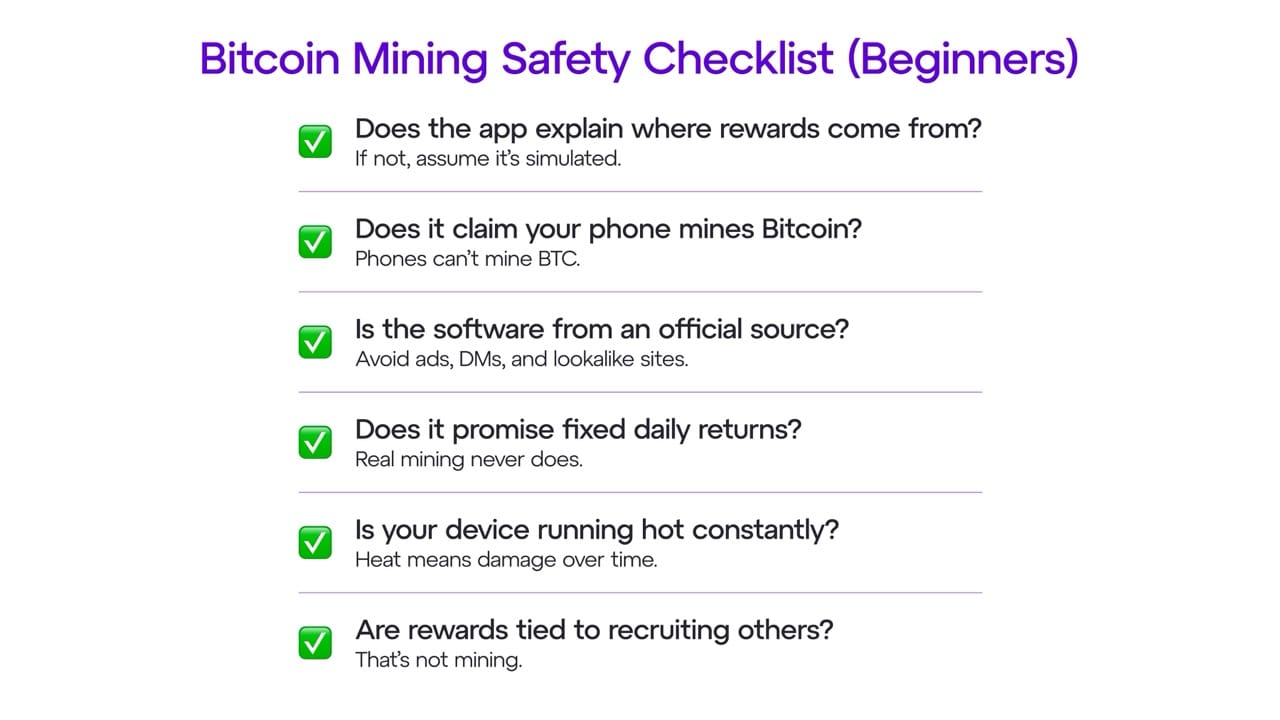
Avoid fake “mobile BTC mining apps”
If an app claims your phone is mining Bitcoin, stop and question it.
Phones can’t perform real Bitcoin mining. When an app suggests otherwise, rewards usually come from ads, tasks, referrals, or data collection, not from mining itself. That doesn’t make every app malicious, but it does mean expectations should stay grounded.
So, if the app can’t clearly explain how rewards are generated, then treat it as a simulation, not mining.
Never download mining software from random websites
Real mining software is easy to verify. It’s discussed openly in mining communities and distributed through official sources.
Risk starts when software arrives through ads, private messages, or lookalike websites promising “easy BTC.” Malware often hides inside fake miners and runs quietly in the background.
If you don’t know who maintains the software or what it actually does, don’t install it.
Monitor temperatures on all devices
Mining creates heat, even when done correctly.
Laptops and phones aren’t built for constant heavy workloads. Heat damage shows up gradually, through reduced battery life and permanent performance loss. Legitimate mining setups plan for cooling from the start.
If a device stays hot for long periods, something isn’t right.
Beware of Ponzi-style mining platforms
Mining rewards fluctuate. Costs are visible. No one can promise fixed daily returns.
Be cautious of platforms that guarantee profits, focus heavily on recruiting others, or avoid explaining where rewards come from. If the value flow isn’t clear, step back and reassess.
Staying safe doesn’t mean avoiding everything labeled “mining.” It means understanding how rewards are created and whether the process is transparent.
FAQ — Mining Bitcoin on PC/Phone
Can I mine Bitcoin with a laptop? No, not in any meaningful way. A laptop is far too slow and inefficient for Bitcoin mining today. At best, it will produce almost nothing while generating heat and long-term wear.
Why was PC mining possible in 2011 but not now? Early on, very few people were mining and the network was small. Difficulty stayed low, so regular computers could keep up. As more miners joined and ASIC machines appeared, Bitcoin automatically adjusted. Mining became far more competitive, and PCs fell behind.
Will PC mining ever return? Extremely unlikely. Bitcoin relies on high mining power to stay secure. Moving back to weaker hardware would reduce that security, not improve it.
Can I damage my computer by trying to mine Bitcoin? Yes. Mining pushes CPUs and GPUs to run at full load for long periods. Heat builds up, components wear faster, and batteries degrade. Laptops and phones are especially vulnerable.
What is the easiest coin to mine today? That depends on your hardware. For beginners, CPU mining Monero (XMR) is often the simplest way to learn. GPU mining still works for some altcoins, but profits are usually modest and closely tied to electricity costs.
Are mobile mining apps real? They’re real apps, but they usually don’t mine Bitcoin. Most simulate mining or distribute rewards through ads, tasks, or referrals. Always check how rewards are actually generated.
Do USB miners work? Yes, but only at a tiny scale. USB miners can connect to the Bitcoin network and submit work, but the rewards are negligible. They’re useful for learning how mining works, not for earning Bitcoin.
Conclusion
Mining Bitcoin on a PC or phone no longer works in 2026. ASIC miners dominate the network, and general-purpose devices simply can’t compete.
That doesn’t mean participation is off the table.
There are still realistic ways to get involved today:
- Mining altcoins with GPUs to learn how mining works in practice
- Mining Monero with a CPU to understand pools, rewards, and difficulty
- Using simulators or reward apps to explore the mechanics safely
- Mining Bitcoin directly through ASICs, either at home or hosted in a facility
The key isn’t trying to force old tools to work. It’s choosing an approach that matches what you’re actually looking for: learning, hands-on experience, or exposure to real mining infrastructure.
Bitcoin mining has changed but participation hasn’t disappeared. You just have to choose the right way in.