How to Earn Crypto by Learning
 Alex D
Most people who get curious about crypto start with the same question:
How do I get into crypto? How do I buy some?
That makes sense. But buying crypto isn’t the only way you can get it. In fact, there’s a way that does not require you to spend any money at all.
Imagine: you can earn cryptocurrency simply by.. Learning about crypto. Sounds unbelievable, right? But that’s true. You can earn some crypto simply by completing short lessons about how it works!
It sounds almost too good, and you are right to be a little skeptical. So let's break down exactly what these programs are, what you can realistically expect, and how to get started without any previous experience.
Key Takeaways:
- Learn-To-Earn programs reward you with small amounts of cryptocurrency for completing short educational lessons — videos, readings, and quizzes.
- Rewards are small by design, typically a few dollars' worth per course. This is a learning tool, not an income source.
- Major exchanges like Coinbase and Binance, individual project platforms like GoMining Academy, and dedicated apps — all offer learn-to-earn opportunities.
- Most platforms require KYC verification, which means proving your identity before you can participate.
- Regional restrictions are common — not every program is available in every country.
Any cryptocurrency you earn, no matter how small the amount, can change in value and may be subject to tax rules in your country.
What "Learn-To-Earn" Actually Means
You might be wondering: why would anyone pay me to watch a video or take a quiz?
Crypto projects and exchanges want people to understand — and eventually use — their products. But for many projects, the goal goes further than that: community matters enormously in crypto, and a user who genuinely understands what a project is trying to do is far more likely to support it, talk about it, and stick around.
Learn-to-earn is one of the most effective ways for projects to build that kind of community from the ground up. Basically, they offer a small reward in exchange for your attention. You watch a short video or read a brief explainer about a specific token or blockchain feature, answer a few questions to prove you actually absorbed the material, and as a reward for your efforts — receive a small amount of cryptocurrency.
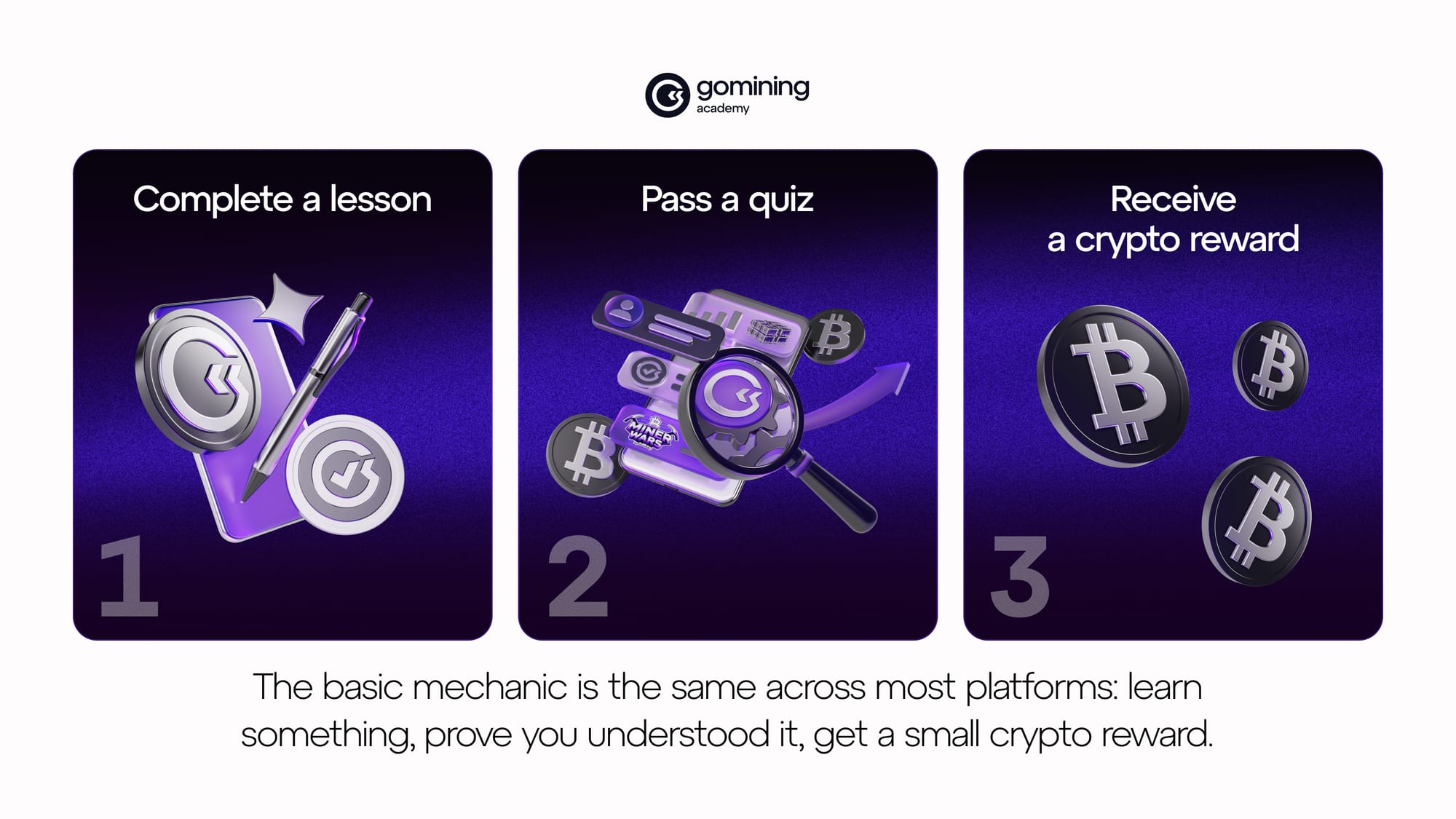
This model is sometimes called learn-to-earn. The "earn" part is real, but the amounts are deliberately small. Behind every learn-to-earn program is a simple opportunity: get paid to understand something that might actually be worth knowing. Your reward is how that marketing budget works in your favor.
Being upfront about this matters. Learn-to-earn is not charity, and it is not a trick. It is a trade: your time and attention for a small crypto reward and some genuine knowledge. When you understand both sides of that trade, you can decide whether it is worth it to you.
What You Can Realistically Earn
Alright. Let's be real about the numbers.
Most learn-to-earn programs offer rewards in the range of a few dollars' worth of crypto per lesson or course. Some offer less. A handful offer slightly more during promotional periods. It’s very unlikely that someone can make a living this way, and no legitimate platform suggests you can.
So why should you even bother? Well, think about it like this.
The real value is not the dollar amount — it is the combination of two things happening at once. You learn how a specific part of the crypto world works, and you end up with a small amount of actual cryptocurrency in your account. For someone who has never owned any crypto before, that second part can be surprisingly useful. You now have something real to look at, track, and experiment with.
That said, even small amounts of crypto are subject to price changes. A reward worth three dollars today could be worth two dollars next week — or four. This is a normal feature of cryptocurrency, not a flaw in the program. If you’re new to this, it is good to understand that from the start: the value of almost any crypto you receive will go up and down over time.
WARNING: Crypto rewards, no matter how small, can fluctuate in value. Never treat any crypto holding — including learn-to-earn rewards — as a guaranteed store of value.
Now that you know what to expect, the next question is where to find these programs. They show up in a few different places.
Where You Can Do It
You won't have to look hard. Learn-to-earn has become a standard feature across much of the crypto industry.
Major exchanges such as Binance and KuCoin are the most common starting points. They have programs that reward users for completing short lessons on specific tokens, built directly into platforms where people buy, sell, and trade crypto. Because these are large, established platforms, the experience tends to be polished, but availability depends on where you live.
Individual crypto projects sometimes run their own educational programs. These are more focused: instead of covering a range of tokens, they teach you about one specific ecosystem. GoMining Academy is a good example of this. It's a learning platform built around a specific project, covering broad crypto topics but with a natural focus on GoMining's own technology and ecosystem.
The reward, though, is what makes it stand out: you earn actual Bitcoin. Not a project-specific token you've never heard of — Bitcoin. For many beginners, that's a pretty compelling reason to start here.
Dedicated learn-to-earn apps also exist. These are standalone platforms built entirely around the idea of rewarding users for learning. Some partner with multiple projects to offer a variety of lessons and tokens. CoinEasy, BitDegree, and CoinMarketCap Earn are well-known examples — each with its own format, but the same basic idea: learn something, answer a few questions, collect a reward."
One important note across all of these: regional restrictions are common. Not every platform is available in every country, and some features may be limited depending on where you are. Always check a platform's availability in your region before investing time in setting up an account.
Before You Sign Up, Read This
Learn-to-earn is a legitimate category — but it attracts impostors. Before you sign up anywhere, it's worth knowing what a real program looks like versus a fraudulent one.
The most important rule: a legitimate learn-to-earn platform will never ask you to connect your crypto wallet just to access educational content. If a site asks you to connect a wallet before you've completed a single lesson, leave immediately. Connecting your wallet to an untrusted platform can give it access to your funds.
A few other red flags to watch for: promises of unusually large rewards for simple tasks, pressure to act quickly before an offer expires, requests for upfront payment to unlock lessons, and platforms with no verifiable track record or company behind them.
Stick to platforms you can verify — established exchanges, well-known projects, or apps with a clear reputation and real user reviews.
How To Get Started — Step-By-Step
Here is a practical walkthrough. The exact details will vary depending on which platform you choose, but the general process looks the same almost everywhere.
Step 1: Find an active program. Don't start by picking a platform — start by finding a program that interests you. Check what's currently running on major exchanges like Binance or KuCoin, browse dedicated platforms like BitDegree or CoinEasy, or head straight to a project-specific program like GoMining Academy. Availability and active campaigns change regularly, so it's worth spending five minutes checking what's live before committing to a platform.
Step 2: Create an account. This is where you will likely encounter your first piece of friction. Most platforms require KYC — which stands for "know your customer" — a verification process where you confirm your identity by submitting documents like a government-issued ID. This is a regulatory requirement in most countries, not something unique to learn-to-earn. It can take anywhere from a few minutes to a few days, depending on the platform and your location.
Step 3: Find the learn-to-earn section. Since you already know the program exists, this should be quick. On exchanges, it's usually labeled 'Learn,' 'Earn,' or 'Rewards.' On project-specific platforms, the educational content is typically front and center.
Step 4: Complete a lesson. Lessons are typically short — a few minutes of video or reading, followed by a brief quiz. The quiz questions are usually based directly on the material you just reviewed, so paying attention to the material really matters.
Step 5: Claim your reward. After completing a lesson and passing the quiz, the reward is usually credited to your account automatically or with a single click. On an exchange, this means the tokens appear in your exchange wallet — the account the platform manages for you. On standalone apps, you may need to connect or set up a crypto wallet, which is a tool that lets you store, send, and receive cryptocurrency. Be careful when connecting the wallet. Always doublecheck that the link you've clicked on belongs to a trustworthy company.
Step 6: Check where your reward went. Take a moment to find your new tokens. On an exchange, look in your portfolio or asset list. Verify the balance if you're using a different wallet. Getting comfortable finding and tracking your crypto is part of the learning process.
That is genuinely all there is to it. The entire loop — lesson, quiz, reward — usually takes five to fifteen minutes.
What To Do With What You Earn
Once you have your first crypto rewards, you have a few options — and you do not need to decide right away.
Hold it. The simplest option. Leave the tokens where they are and check back periodically. This gives you a low-pressure way to watch how crypto prices move over time.
Convert it. Most exchanges let you swap one cryptocurrency for another. If you earned a token you are not interested in, you can often convert it into USDT, Bitcoin, or any other cryptocurrency you would rather hold. Keep in mind that some conversions involve small fees.
Use it to explore further. Some tokens give you access to features within their ecosystem — staking, governance votes, or specific tools. Your earned tokens can be a way to try those things without spending your own money.
Whatever you choose, remember that even small amounts of crypto are real financial assets. Their value will change over time, and in many countries, even small gains may have tax implications. The amounts involved in learn-to-earn are modest, but the principle still applies.
Common Misconceptions
A few things tend to trip up beginners with learn-to-earn. Let's clear them up.
"I can earn significant money this way." You cannot. Learn-to-earn rewards are small by design — typically a few dollars' worth per course. The programs exist primarily to educate and promote, not to pay you a meaningful income. If any platform promises large returns just for completing lessons, treat that as a serious red flag.
"All platforms work everywhere." They do not. Many learn-to-earn programs have regional restrictions due to local regulations. A program that works well for someone in one country may be completely unavailable in yours. Always verify availability before creating an account.
"The crypto I earn is always worth holding." Not necessarily. Some tokens given as learn-to-earn rewards are for newer or smaller projects. Their prices can be especially volatile — meaning they can change in value quickly and unpredictably. It is worth researching any token you receive — even if it is free — to understand what it is and whether you want to keep it.
FAQ
Is learn-to-earn free to use?
Yes. The core mechanic is that you trade your time and attention for crypto rewards. You should never have to pay to access a legitimate learn-to-earn program. If a platform asks for payment upfront, that is a warning sign.
Do I need a crypto wallet before I start?
Not always. If you use a major exchange like Coinbase or Binance, the platform manages a wallet for you. You earn, and the tokens show up in your exchange account. Standalone learn-to-earn apps may require you to connect an external wallet — a tool for holding crypto independently — but the app will usually walk you through that setup.
Are the rewards taxable?
In many countries, yes. Crypto received as a reward may be treated as taxable income at the time you receive it, based on its market value at that moment. Tax rules vary significantly by country, so check your local regulations or consult a tax professional if you are unsure.
Can I do this on mobile?
Most learn-to-earn platforms are available on mobile, either through a dedicated app or a mobile-friendly website. In fact, the short lesson format is well suited to a phone — you can complete a module in a few spare minutes.
Is GoMining Academy a learn-to-earn platform?
Yes — and its approach is a little different from most. GoMining Academy covers broad crypto topics, from Bitcoin basics to blockchain fundamentals, as well as the GoMining ecosystem in depth. When you complete a course, you earn extra Bonus Miner power on a free digital miner that every new user receives. That miner is connected to real mining hardware, so your reward isn't a token airdrop: it's actual Bitcoin, generated by real mining activity. For many beginners, that distinction matters.
What happens if a token I earned loses all its value?
It is possible. Some tokens — especially those from newer projects — can lose significant value or even become worthless. This is why it is important not to think of learn-to-earn rewards as guaranteed money. The educational value of the program remains regardless of what happens to the token price.