How Is Crypto Taxed?
 Alex D
Nobody gets into crypto thinking about taxes.
Mostly people think about the tech, the opportunity, maybe the chaos of watching a green candle go up at 2 am. Taxes feel like something to deal with later, right?
The problem is that “later” has a habit of arriving faster than expected — usually around the time you realize you’ve made real money, or lost some, and have no idea what any of it means for what you owe. Crypto regulation has been catching up fast. For years, most tax authorities didn't quite know what to do with crypto.
Was it currency? Property? Something else entirely?
Many people treated that uncertainty as permission to ignore the question. That’s changed.
Tax authorities in the US, the EU, the UK, and dozens of other countries now treat digital assets as taxable property. Ignoring that won’t make the obligation disappear. But understanding how it works, even at a basic level, puts you in a much better position than most people who own crypto.
The exact rules vary by country, so you’ll need to check what applies where you live, but the underlying logic is similar almost everywhere.
Key Takeaways
- In most countries, crypto is treated as property or an asset: selling, swapping, or spending it can trigger a tax bill.
- Two categories of taxation apply to most crypto activity: capital gains tax on profits from buying and selling, and income tax on crypto you earn.
- Not every crypto transaction is a taxable event. Simply buying and holding does not create a tax obligation in most jurisdictions.
- Losses count too. Selling at a loss can reduce your overall tax bill in many countries — a strategy called tax-loss harvesting.
- Staking rewards and yield are generally treated as income, taxed at the time you receive them.
- It is your responsibility to keep records of every transaction, such as dates, amounts, and prices. It really matters.
What Governments Actually Think Crypto Is
Before you can understand the tax treatment, you need to understand how most governments classify crypto. They don’t treat it as currency — at least not in the legal sense. They treat it as property, the same way they treat stocks or real estate.
That classification has a specific consequence: every time you sell crypto, trade it for another coin, or use it to buy something, you’ve completed a transaction that may be subject to tax. What’s being taxed is the gain between what you paid for it and what you received when you let it go.
In the US, the IRS has treated crypto as property since 2014. In the UK, HMRC applies capital gains rules. The EU is moving toward consistent treatment across member states under its MiCA framework.
The details differ, but the core idea is the same across most of the world: crypto has a value when you acquire it, and a value when you dispose of it. That difference is precisely what the tax system cares about.
Capital Gains: The Main Category
Capital gains tax is what you pay on the profit from selling or exchanging an asset. If you bought Bitcoin at $20,000 and sold it at $35,000, you made a $15,000 gain. That gain is what gets taxed.
Many countries split gains into two categories depending on how long you held the asset. The exact terms and thresholds differ from country to country, but the underlying logic is common. For instance, in the US, the IRS sets the threshold at one year:
- Short-term gains apply when you sell within a year of buying. These are taxed at your regular income rate, which can be high.
- Long-term gains apply when you hold for more than a year. These are taxed at a lower rate, as a way of encouraging longer-term investment.
Other countries use different thresholds or don’t make the same distinction at all. Germany, for instance, exempts crypto gains entirely if you hold crypto assets for over a year. How long you hold often affects how much you owe, so it’s worth checking the rules where you live before you buy or sell your crypto.
Swapping one crypto for another is also a taxable event in most jurisdictions — something that catches a lot of beginners off guard. Say you’re trading Bitcoin for Ethereum. That would be treated as selling Bitcoin: you realize a gain or loss at the moment of the swap, even if you never converted to local currency. When in doubt, assume that any crypto-to-crypto exchange counts.
What Counts as a Taxable Event
Not everything you do with crypto triggers a tax. Most jurisdictions define the following as taxable events:
Taxable:
- Selling crypto for fiat currency — government-issued money like dollars, euros, or pounds
- Trading one crypto for another
- Using crypto to pay for goods or services
- Receiving crypto as payment for work or services
Generally not taxable:
- Buying crypto and holding it
- Moving crypto between your own wallets
- Receiving crypto as a gift (though gifting it to someone else may have rules attached)
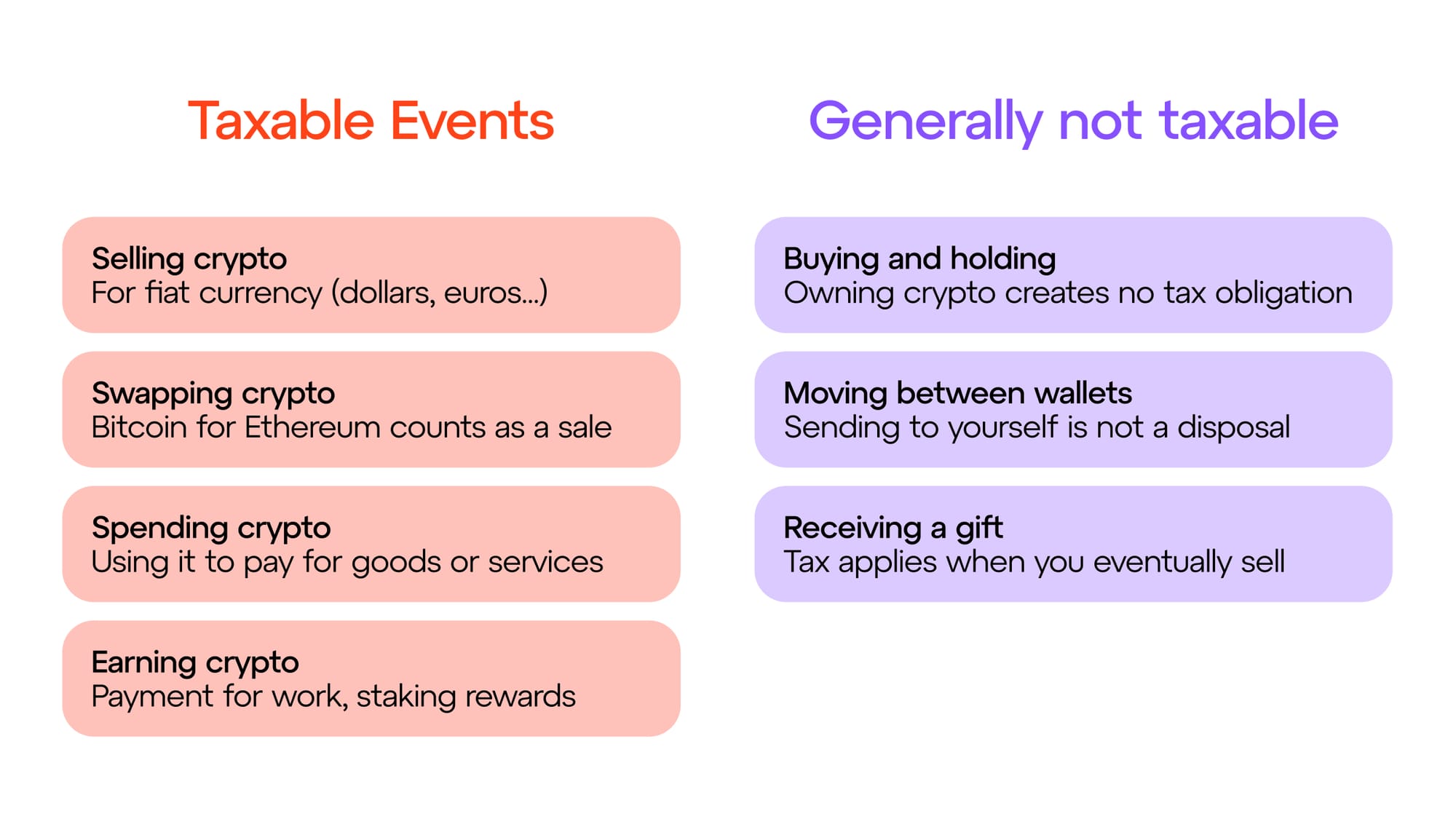
Many beginners assume that just holding crypto and watching it go up creates a tax bill. It doesn’t, in most places. The bill only arrives when you actually do something with it. That said, rules vary, and some countries do tax unrealized gains in specific situations, so checking local rules is always worth doing.
Earning Crypto: The Income Side
Capital gains cover buying and selling. But what about the crypto you earn? This is where income tax comes in.
If you receive crypto as payment for work, as a reward for staking, or through a yield-generating product, most tax authorities treat that as income. The value of the crypto at the time you receive it is what gets counted as earnings, and you’re taxed at your regular income rate.
Staking, which means locking up crypto to help validate transactions on a blockchain network in exchange for rewards, is a good example. Most jurisdictions now treat those rewards as taxable income on the day you receive them. Let’s say you’re earning APY (annual percentage yield) — the rate at which your holdings grow through staking or lending. That growth is usually taxed as income each time it’s paid out, not just when you eventually sell.
Your rewards are taxed when you receive them, and then taxed again as capital gains if they grow in value before you sell. These are two separate events, but both lead to potential tax obligations.This is what happens when you earn.
But… what if you lose? Let’s consider that scenario as well.
When You Lose Money: Tax-Loss Harvesting
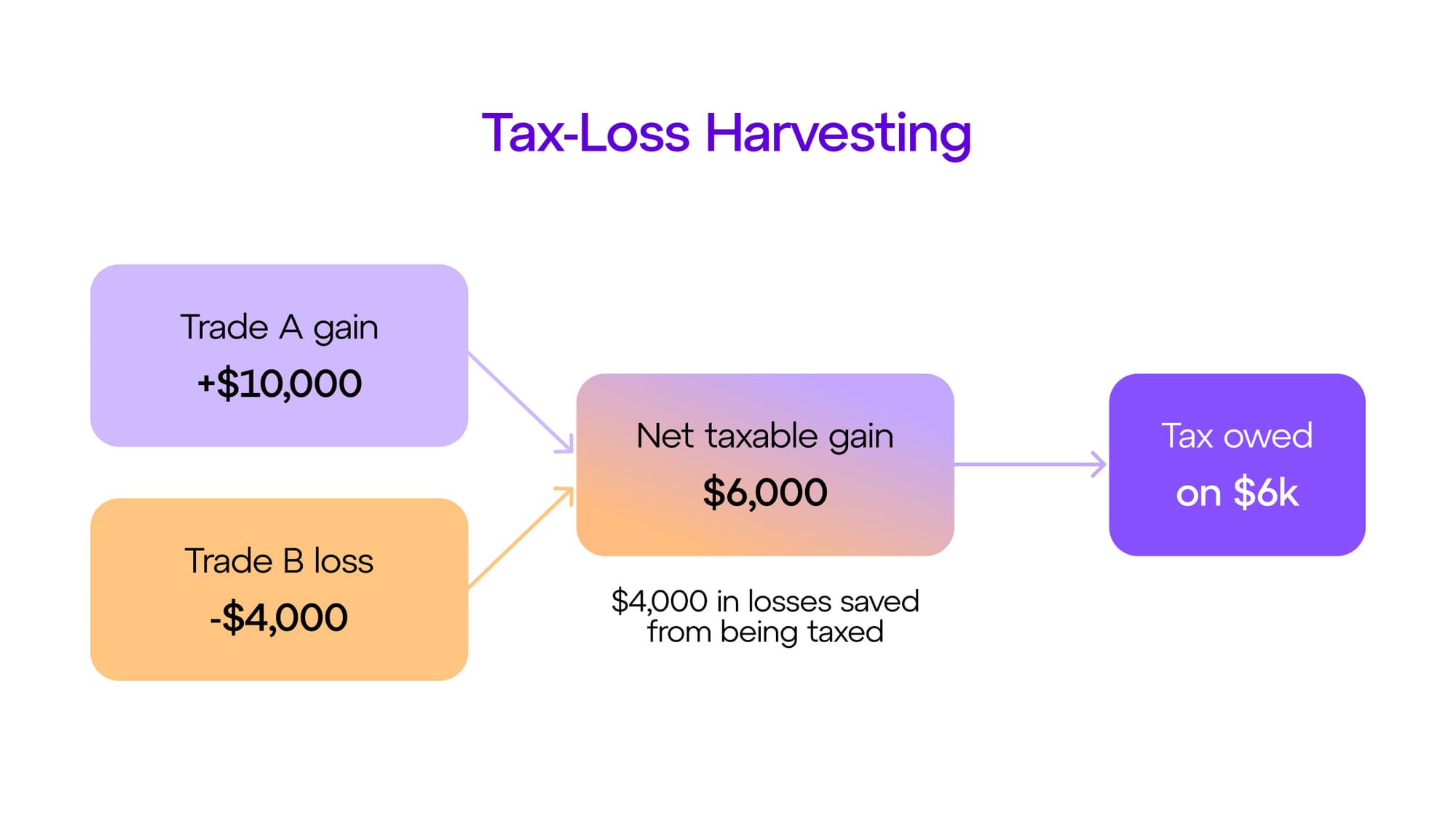
By this time, you must have learned: crypto is volatile. After a crypto crash or a prolonged downturn, many people find themselves sitting on assets worth less than they paid for them. That’s painful, but the tax system actually has something to offer here.
In most countries, you can use losses to offset gains. If you made $10,000 on one trade and lost $4,000 on another, in some jurisdictions you might only owe tax on $6,000. This is called tax-loss harvesting — deliberately realizing losses to reduce your overall tax bill.
Some countries also allow you to carry unused losses forward to future years.
In the US, you can carry capital losses forward indefinitely. In the UK, unused losses can also be carried forward, but you need to register them with HMRC even in years you don't owe tax. Australia works similarly — losses roll forward until you have gains to offset them against. Essentially, if you had a bad year and your losses exceeded your gains, that excess might reduce your tax in the year ahead.
In most cases, you have to actually sell the losing asset to realize the loss. Some jurisdictions do allow claims on assets that have become entirely worthless, like when a token was simply abandoned. However, the rules around this are strict and vary significantly by country. When in doubt, selling is the cleaner route.
Keeping Records: The Part Everyone Ignores
This is the least exciting part of crypto tax, and the most practically important. Tax authorities expect you to know the exact price you paid for every asset, when you bought it, and what it was worth when you sold or exchanged it.
That’s your cost basis — the starting point for calculating any gain or loss.
Most exchanges let you download a transaction history, which is the easiest starting point for pulling your records together. If you use multiple wallets and platforms, consider using a crypto profit calculator — a dedicated tool that pulls in your transaction data and calculates your gains, losses, and taxable events automatically. Tools like Koinly, CoinTracker, and others are designed specifically for this. They don’t replace a tax advisor, but they make the record-keeping far less painful.
The longer you wait to organize this, the harder it gets. Every trade, swap, or staking reward is a record you might need. Start keeping track now, even if tax season feels far away.
A Common Misconception: “Crypto Is Anonymous, So It’s Untaxed”
This assumption is easy to make. It’s understandable: transactions are pseudonymous, no one knows it’s me, so there’s nothing to declare… right? Alas, that logic has recently collapsed.
Most major exchanges now collect identity information and are legally required to report account activity to tax authorities in their countries. The IRS, HMRC, and tax agencies across the EU have all received reporting from crypto platforms. In many cases, they already have your data before you file — and they’re cross-referencing it.
Don’t treat crypto like it’s a tax-free zone just because it feels anonymous. This is a serious risk. The penalties for unreported crypto gains can be significant, and the infrastructure for catching them has improved sharply.
Where to Find Reliable Crypto Tax Info
Tax rules change, and a lot of what circulates online is outdated, jurisdiction-specific, or just wrong.
A few places worth checking:
- Your country's official tax authority website: This is always the primary source. IRS (US), HMRC (UK), ATO (Australia), CRA (Canada), and most equivalents have dedicated crypto guidance pages that are updated when rules change.
- Official government and regulator announcements: When a country updates its crypto tax rules, it usually comes through a press release or policy update on the regulator's site before it reaches the news.
- Established crypto news outlets: Sites like CoinDesk and The Block cover regulatory developments as they happen. Useful for staying on top of changes without monitoring every regulator yourself.
- Crypto tax tool blogs: Koinly, CoinTracker, and similar platforms publish country-specific guides and update them regularly. That’s more reliable than random Google results.
- Local crypto communities: Country-specific Telegram groups and Reddit communities (r/UKPersonalFinance, r/PersonalFinanceCanada, etc.) often surface new guidance quickly and can point you toward local professionals.
FAQ
Do I pay tax just for buying Bitcoin?
No. Buying and holding crypto is not a taxable event in most countries. The tax obligation starts when you sell, trade, or earn crypto.
What if I only made a small amount?
Many countries have a minimum threshold below which small capital gains aren’t taxed. But the rules vary — in some places, every gain counts regardless of size. Check what applies in your country.
Is receiving crypto as a gift taxable?
Usually not for the person receiving it, though the giver may have rules to follow. And when the recipient eventually sells it, the capital gains calculation typically starts from the original purchase price, not the date of the gift.
Do I owe taxes if my crypto loses value?
You don’t owe tax on losses. In fact, realized losses can reduce your tax bill by offsetting gains you made elsewhere.
Do I need a tax advisor?
For simple situations, like when you do a few trades on one exchange, a crypto tax calculator may be enough. For anything more complex like multiple platforms, staking, DeFi activity, and just moving large amounts, a tax advisor familiar with crypto is worth the cost.
Taxes aren’t very exciting, and crypto tax isn’t either. But it’s genuinely one of the areas where being uninformed has real, concrete consequences. The mechanics aren’t that complicated once you see how they work.
Still have questions? GoMining Academy is a free, ever-growing collection of courses, guides, and articles on everything crypto — written for real people. No tech jargon. No prior crypto knowledge required. Start anywhere.
Telegram | Discord | Twitter (X) | Medium | Instagram