How Is Crypto Regulated?
 Alex D
Every few weeks, we see the same news. A regulator sues a major exchange.
A government announces it's banning crypto.
Or a major market publishes new rules that finally give the industry some clarity.If you're new to this space, that raises an obvious question: who's actually in charge here?
Globally? Nobody. There is no single authority overseeing the whole crypto market. Every country is writing its own rules at its own pace; each of them has its own perspective. Some embrace crypto, some restrict it, and most are still trying to figure it out.
This article explains how crypto regulation works, why it's complicated, what the key frameworks actually do… and, of course, what any of it means for you.
Key Takeaways
- There is no global crypto regulator. Each country sets its own rules, and those rules vary widely.
- In the US, crypto regulation is split across multiple agencies — and which one has authority depends on how a cryptocurrency is classified.
- The EU's MiCA framework is currently the most complete crypto regulatory structure in the world — but most countries are still writing their own rules.
- Behind every regulatory framework are the same three concerns: consumer protection, financial crime, and systemic stability.
- Regulation affects you directly: through identity checks, tax obligations, and which products you can access, depending on where you live.
- Regulation reduces some risks — but prices can still fall sharply, and no rulebook changes that.
Why Do Governments Want to Regulate Crypto?
Crypto has grown too large to ignore. Trillions of dollars move through crypto markets every year, ordinary people are putting real savings into it, and businesses are building on top of it. Governments regulate financial systems because things go wrong — people get defrauded, platforms collapse, money gets laundered. And where there’s money, there’s tax. Crypto is no different. The question was never really whether to regulate it, but why — and the answer comes down to three things.
What Regulators Are Actually Trying to Achieve
Behind the different frameworks, the goals are broadly the same. Most crypto regulation comes down to three concerns.
Consumer protection
Crypto markets have seen dramatic collapses — sometimes described as a crypto bubble bursting — that have wiped out real money for ordinary people. Regulators want investors to understand the risks and have some recourse when platforms fail.
Security is the other side of this: centralized exchanges and individual wallets have been compromised repeatedly. Regulations requiring exchanges to hold reserve funds and meet cybersecurity standards exist precisely because of those incidents. This is why web3 security at regulated platforms is held to a higher standard than at unregulated ones.
Preventing financial crime
Governments worry that crypto's pseudonymous nature makes it useful for moving money illegally. Research consistently shows that the vast majority of crypto transactions have nothing to do with crime. In fact, cash is used for illegal purposes far more often. But regulators apply the same anti-money-laundering standards to crypto that they apply to banks, which is why KYC checks are now mandatory at every legitimate exchange.
Financial stability
The bigger crypto gets, the more regulators worry about its connection to the traditional financial system. Stablecoins have drawn particular scrutiny. The TerraUSD stablecoin collapse in 2022 erased roughly $40 billion in value within days, which accelerated regulatory efforts in nearly every major market.
Why Is Crypto So Difficult to Regulate?
Traditional financial systems were built around identifiable institutions such as banks, exchanges, and clearinghouses, so regulators knew who to supervise. Crypto breaks that model. It's borderless, so a Bitcoin transaction between two people on opposite sides of the planet doesn't pass through any system a regulator can monitor. It's also pseudonymous — wallet addresses aren't automatically linked to real identities. Still, nobody can agree on what it actually is… A currency, a commodity like gold, or a security like a stock? Different regulators have reached different conclusions, and the answer determines which laws apply.
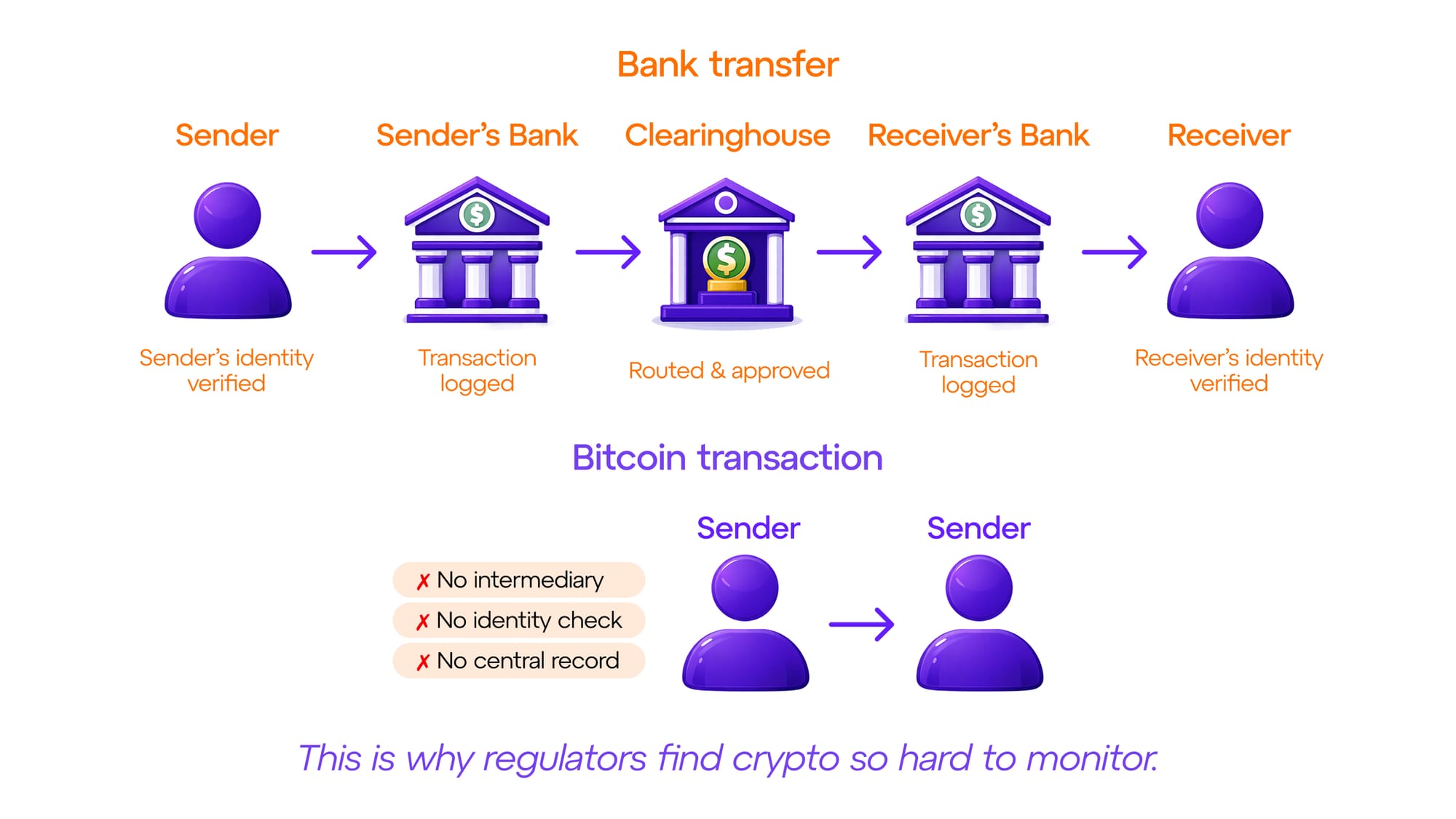
New products keep appearing, such as DeFi protocols — decentralized financial applications running on blockchain networks without any central company behind them. And it all happens before anyone agrees on a framework to handle them.
The Question That Drives Most of the Legal Debate
In the US, whose regulatory decisions tend to ripple across global markets, the biggest question in crypto law is this: is a given cryptocurrency a security?
It sounds technical, but the stakes are simple: a security is a financial instrument representing ownership or a right to future value, like a stock or a bond.
Now here’s why it’s important: securities always come with strict legal requirements. Issuing one without registering with the SEC, the US Securities and Exchange Commission, is illegal. Most crypto projects have never gone through that process, which is why this classification question has generated years of lawsuits.
For this particular purpose, courts use a special tool called the Howey Test.
The Howey Test: A 1946 framework applied to 2024 technology
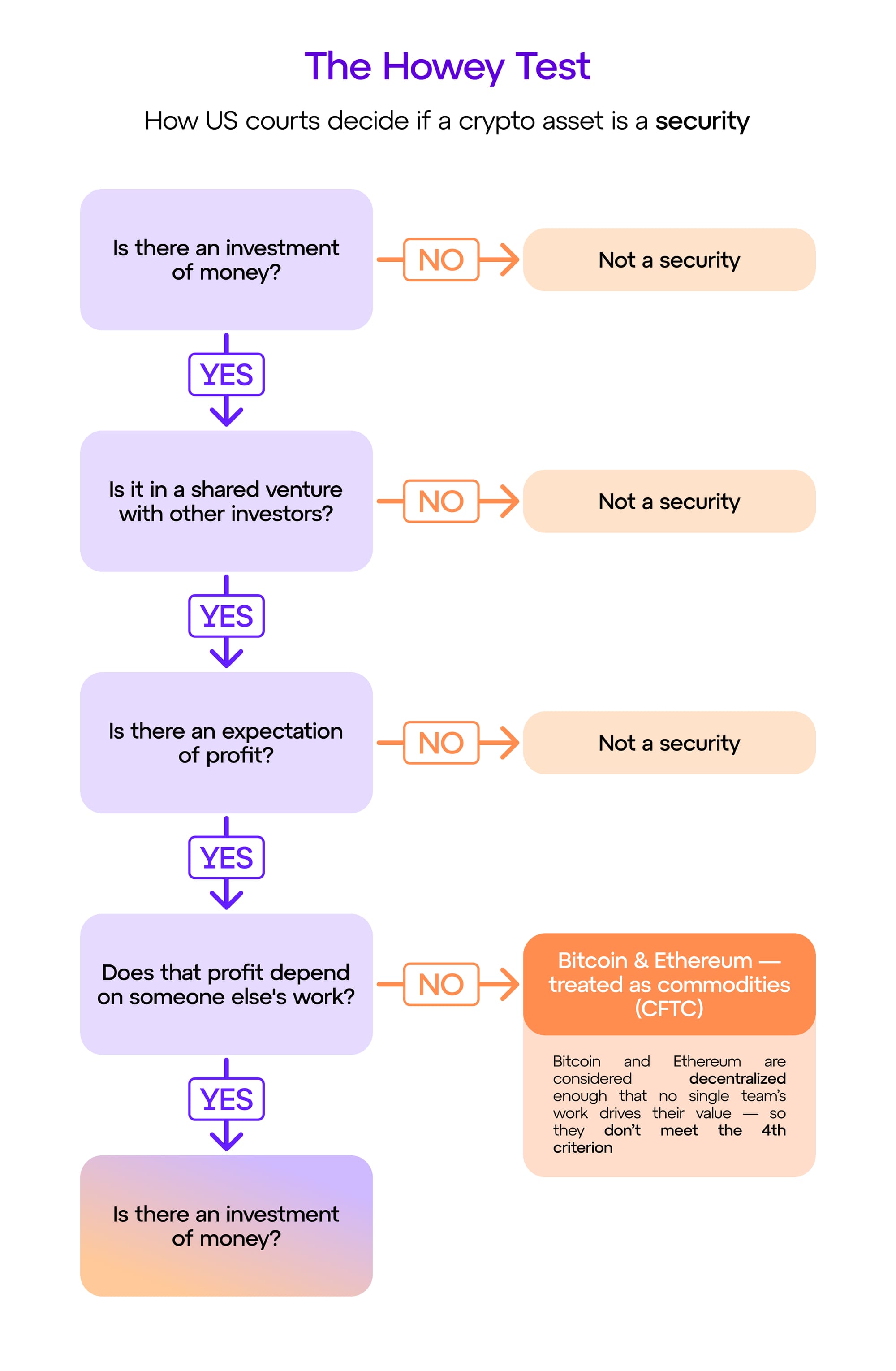
US courts use the Howey Test to decide whether something is a security. It’s a four-part framework the Supreme Court developed in 1946 from a dispute about Florida orange grove investments. Something qualifies if it involves an investment of money, in a shared venture, with an expectation of profit depending on other people's work.
The SEC argues that many token sales fit: people invested money, expected profit, and relied on the founding team. That argument was made successfully for both Bitcoin and Ethereum — genuinely decentralized networks where no single team's work determines value. Bitcoin has been treated as a commodity under the CFTC (Commodity Futures Trading Commission) for years. Ethereum took longer and faced more legal scrutiny, but now sits in the same category.
How Major Markets Approach It
With that legal backdrop in mind, here's how the biggest markets handle crypto regulation today.
United States: Four agencies, no single answer
The US has no single crypto regulator.
- The SEC claims authority over tokens it considers securities.
- The CFTC oversees Bitcoin and Ethereum as commodities.
- FinCEN requires exchanges to follow anti-money-laundering rules and implement KYC (Know Your Customer), verifying users' identities before they can trade.
- The IRS treats crypto as property, so selling or trading it can trigger a capital gains tax.
Four agencies with overlapping authority have predictably produced confusion. Court rulings are slowly clarifying things, but the US remains one of the more complicated places for crypto businesses to operate.
European Union: The most complete framework so far
The EU took a unified approach. MiCA (Markets in Crypto-Assets) came into full effect in 2024 across all 27 member states. It covers token issuers, exchanges, and wallet services. It also covers stablecoin providers — companies that issue digital assets pegged to a fixed value, usually a major currency like the dollar or euro. Firms must be licensed before operating, and the framework sets rules against market manipulation and insider trading.
MiCA doesn't yet cover DeFi protocols, but it's the most thorough crypto regulatory framework in the world right now, and other governments are studying it as a potential model.
The Rest Of The World: A genuinely mixed picture
Beyond the US and EU, the range is wide:
- Japan: It was one of the first countries to legally recognize Bitcoin after the Mt. Gox collapse happened on its soil in 2014. That context makes the early regulation feel like a response to something real, not just forward-thinking policy.
- Singapore: The Monetary Authority of Singapore licenses crypto firms under the Payment Services Act. Coinbase, Crypto.com, and others have obtained licenses there The fact that major global players chose Singapore says more than any policy document could.
- China: The digital yuan (e-CNY) is already in active pilot across dozens of cities, with millions of users. That detail sharpens the contrast: they didn't reject digital money, they just want to control it entirely.
- UK: The FCA has been notably strict in practice: it rejected the majority of crypto firms that applied for registration in the early rounds. That's a more telling detail than just "phased approach."
To sum up, the same exact activity can be perfectly legal in one country and banned in another.
What does that mean for you, though?
What This Means for You
The legal debate plays out far from your day-to-day experience. But regulation touches you in a few direct ways.
- Identity checks. Every regulated exchange will ask you to verify your identity before you can withdraw funds or convert to local currency. This is a legal requirement.
- Tax. In most countries, crypto is treated as property or a capital asset, meaning selling at a profit creates a taxable event. Rules vary significantly by country, and most tax authorities have issued guidance well ahead of broader legislation, so not knowing the rules doesn't protect you from penalties.
- Access. Some DeFi products and token offerings are blocked for users in certain countries because they haven't met local regulatory requirements. If a platform geo-blocks you, that's why it happens.
- Platform safety. Regulated exchanges are required to segregate customer funds, maintain reserves, and meet security standards. That doesn't make them failure-proof: not all regulated exchanges are equal, so always research a platform before depositing funds.
FAQ
Is crypto legal?
In most countries, yes. A small number (including China) have banned it outright. Even where it's legal, it typically comes with tax obligations and identity verification requirements. Check the specific rules where you live.
Is Bitcoin regulated?
The Bitcoin network has no owner and no regulator. However, most major markets regulate the platforms you use to buy, sell, and store it. It’s still a commodity under CFTC oversight in the US, and under MiCA & anti-money-laundering rules in the EU.
What is the Howey Test?
The legal framework that US courts use to decide whether something is a security. If an asset involves investing money in a shared venture with an expectation of profit driven by other people's work, it likely qualifies. Many token sales have been found to meet this definition — Bitcoin and Ethereum generally have not.
What is KYC?
Know Your Customer: the identity verification process exchanges run before allowing you to trade or withdraw. Typically, a government-issued ID and proof of address are required. It's a regulatory requirement designed to prevent money laundering.
Does regulation make crypto safer to invest in?
It removes certain risks — like an exchange disappearing with your funds. It doesn't remove market risk. Crypto prices can still fall dramatically. Never put in more than you can afford to lose.
What is MiCA?
Markets in Crypto-Assets — the EU's regulatory framework for crypto, fully in effect since 2024. It covers token issuers, exchanges, and stablecoin providers across all 27 EU member states, and is the most complete crypto regulatory framework anywhere in the world.
Still have questions? GoMining Academy is a free, ever-growing collection of courses, guides, and articles on everything crypto — written for real people. No tech jargon. No prior crypto knowledge required. Start anywhere.
Telegram | Discord | Twitter (X) | Medium | Instagram