Can You Actually Recover Stolen Crypto?
 Alex D
You wake up, open your wallet, and… The balance reads zero. The sick feeling hits before your brain has even caught up.
Your first instinct is to search for a solution — how to recover stolen crypto, get my Bitcoin back, anything. That search is completely understandable. But it is also dangerous, because the Internet is full of people waiting for you to take a wrong step.
Let’s start with the hard truth: blockchain transactions are permanent. There is no customer support line, no dispute department, and no technical “undo” button. When crypto leaves your wallet even without your consent, the blockchain records it as a final, valid transaction — regardless of how it happened.
That does not mean every situation is hopeless, though. There are legitimate steps worth taking, and in a narrow set of circumstances, recovery is possible. But those circumstances are specific, the odds are long, and it involves actual law enforcement — not someone who just slid into your DMs offering to help.
This article explains what those steps are, what your chances are, and above all, how to avoid losing even more money to the scammers who prey on people in exactly this kind of situation.
Key Takeaways
- Blockchain transactions are permanent. There is no “undo” button. Once funds leave your wallet, they cannot be reversed by anyone.
- Recovery is rare, not impossible. It requires the thief to move funds to a regulated exchange, and involves law enforcement. Even then, it might take months or years.
- The recovery scam industry is real. The moment you post about being hacked online, scammers will find you. Anyone who DMs you promising to recover your funds is trying to rob you a second time.
- Your best move right now: secure what remains, trace the funds, file a police report, and contact the exchange if that’s where the money went.
- Prevention is the most reliable protection. Once you've worked through the steps in this article, shifting focus to securing what remains and hardening your setup for the future is the most productive thing you can do.
The “Recovery Scam” Industry: Read This First
Here is something that happens within minutes of a hack going public: scammers find you.
The moment you post publicly about being hacked — on Reddit, X (former Twitter), Telegram, anywhere — bots and scammers scan those posts within minutes. They will reach out to you directly, presenting themselves as crypto scam recovery specialists, blockchain investigators, or even former hackers who can “hack back” your funds.
Remember: they are not.
They are running a second scam on top of the first one.
The mechanics vary, but the playbook is consistent. They ask for an upfront fee to “start the investigation.” Or they ask you to sign a transaction granting them wallet access. Or, worst of all, they ask for your seed phrase, claiming they need to “scan the wallet.” Every one of these requests ends the same way: you lose more money.
Never share your seed phrase with anyone, under any circumstances. Whoever has it owns your wallet.
The red flags are usually obvious once you know what to look for:
- Technically impossible promises
- Requests to move to a private channel
- A fee that needs to be paid before any work begins
- Fabricated screenshots of “previous recoveries” to build credibility.
Legitimate blockchain forensics firms — companies, like Chainalysis or TRM Labs, work with law enforcement agencies, not with individuals on Telegram.
If you want their help, the path runs through a police report, not a cold DM. So that is what not to do. Now for the harder question: is there any legitimate path forward at all?
When Is Recovery Actually Possible?
Recovery is rare — but not impossible. There are two realistic scenarios where stolen funds have been returned. However, both depend on factors outside your direct control.
Scenario 1: The Hacker Moves Funds to a Regulated Exchange
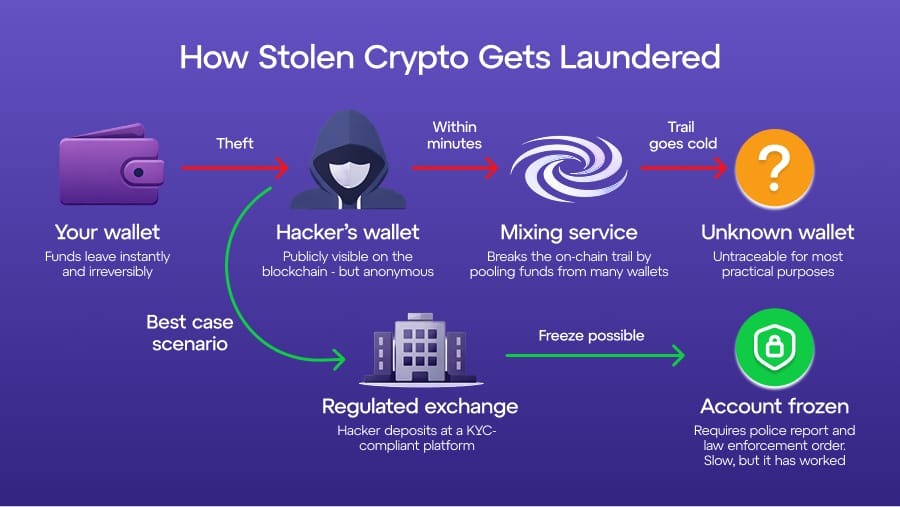
This is the most realistic path to recovery. Centralized exchanges (e.g. Coinbase, Binance, Kraken) require identity verification, known as KYC, to withdraw funds. If a hacker moves stolen crypto to one of these platforms, there is a paper trail, and the exchange can freeze the account.
Now here’s the catch: getting an exchange to act requires a formal legal process. You need a police report, and in most jurisdictions, law enforcement would need to issue a subpoena or a court order for the exchange to hand over account details or freeze the funds. That process is slow (often months), and expensive if you hire a lawyer.
It also depends on jurisdiction. If the hacker is based in a country with no cooperation agreements, a US or EU court order may not mean much to an exchange operating elsewhere.
Scenario 2: A White Hat Negotiation (DeFi Protocol Hacks)
This one is almost exclusively relevant to large-scale DeFi protocol hacks, not individual wallet thefts. When a protocol loses tens of millions of dollars to an exploit, the development team sometimes publicly offers the hacker a “bounty” — keep 10%, return the rest, and we will not pursue legal action.
Occasionally, it works. The hacker is often a developer themselves, and the prospect of keeping a legitimate sum without the risk of prosecution is appealing. But that can only happen if the hacker is rational, technically sophisticated, and not already mixing the funds. If your wallet was drained by a phishing attack, this scenario does not apply to you.
What to Do Right Now: The Actual Steps Worth Taking
If you have just been hacked, speed matters.
Not because you will reverse the transaction (you won’t), but because the faster you act, the better your chances if funds do hit a regulated exchange.
Step 1: Trace the Funds
The first thing worth doing is following the money. A Bitcoin block explorer like Mempool.space lets you enter a wallet address and see every BTC transaction in and out. For Ethereum and EVM-compatible chains, Etherscan does the same. For Solana, it’s Solscan — and so on.
The main question to keep in mind is: did the funds move directly to a wallet address associated with a known exchange? Many exchanges have their hot wallets publicly labeled in block explorers. If you see “Binance Hot Wallet” or “Coinbase Deposit” in the destination, that is your most important lead.
It is also worth checking whether the hacker used a mixer. If funds went through a service like Tornado Cash or a cross-chain bridge immediately, the trail is effectively cold for most practical purposes. It does not make the other steps pointless, but it does significantly lower the odds.
Step 2: Check How They Got In
Before touching the compromised wallet again, most users go straight to Revoke.cash (for EVM chains). This tool shows every token approval your wallet has ever signed — meaning every smart contract that has permission to spend your funds. A single bad approval from a phishing site can drain a wallet silently, and many victims only discover this after the fact.
Revoking old permissions will not recover what was taken, but it stops the same attack from happening twice.
Step 3: File the Reports
This part rarely feels productive, and results are never fast. But people who do eventually see exchange cooperation or law enforcement action almost always have one thing in common: a case number on file. Without it, there is no standing to request anything.
- IC3 (FBI Internet Crime Complaint Center). The primary reporting portal for cybercrime in the US. You can file your report at ic3.gov.
- Local police. Even if the officer does not fully understand crypto, a police report number is the document that unlocks exchange cooperation.
- Your country’s financial regulator. Outside the US, report to the relevant authority. In the UK, that's Action Fraud. In the EU, such cases are handled by national cybercrime units.
- The exchange directly. If the funds landed on a centralized exchange, a support ticket should be opened immediately, with the police report attached. Exchanges have compliance teams that can act faster than courts if contacted quickly.
Step 4: Secure What Remains
The compromised wallet is gone. Most people in this situation move any remaining funds to a completely fresh wallet — one generated on a trusted device that has never been used before — and never return to the old one.
The Honest Reality: Risks and Limitations
It would be unfair to walk you through those steps without being direct about the odds. Here is what typically works against recovery, even when you do everything right.
- Jurisdiction gaps. A large share of crypto theft is traced to actors in countries with no extradition treaties or law enforcement cooperation. A US police report has no practical reach in those jurisdictions.
- Cost versus amount lost. Hiring a blockchain forensics firm or a lawyer who specializes in crypto asset recovery typically costs $5,000 or more to even begin. If your loss was $1,000, the math simply does not work.
- Time. Even successful recovery cases take months to years. Legal processes are slow. By the time a freeze order is executed, the value of the recovered assets may look very different from what you lost — market volatility does not pause for your legal case.
- Mixers and bridges. If the hacker ran your funds through a mixing service or a cross-chain bridge within minutes of the theft, the on-chain trail becomes extremely difficult to follow without professional forensics tools.
The FBI and FTC have both issued public warnings on this point. The FTC has noted that impersonation scams — including fake recovery services — cost Americans alone hundreds of millions of dollars annually. The second loss, to the recovery scammer, is often larger than the first.
The Only Thing That Actually Works: Prevention
The tools that would have prevented this are simple, cheap, and widely available. That is the frustrating part. Here is what they are.
Use a Hardware Wallet
The reason most phishing attacks work is that your private keys are stored somewhere internet-connected. A hardware wallet, a physical device like a Ledger or Trezor, removes that vulnerability entirely. This is the single best solution for crypto/web3 security. Your private keys never touch the internet.
A phishing site cannot drain a hardware wallet because it cannot access the keys required to sign a transaction. For any meaningful amount of crypto, a hardware wallet is a non-negotiable.
Treat Every Approval as a Risk
Most people who get drained by a phishing attack never clicked a single suspicious link. They just approved a transaction they did not fully read. Get in the habit of checking what you are signing, and revoke old permissions regularly using a tool like Revoke.cash.
Separate Your Wallets
Think of it like a bank card versus a savings account. You would not hand your savings account details to every website you buy from.
The wallet you use to click around on the internet gets exposed to risk. The wallet that holds your savings should be as isolated as possible — ideally on hardware, and never connected to anything you did not choose deliberately.
Verify Everything Before You Click
Most crypto theft does not happen because the blockchain was hacked. It happens because a user was tricked — fake websites, fake token approvals, fake support accounts. What gets compromised are wallets, keys, and the humans holding them. This means that the defense is behavioral, not technical.That covers what you can do individually. But there is also a broader question worth asking: is the system itself getting better at protecting people?
Is Crypto Regulation Helping?
Slowly, yes. Crypto regulation is evolving in ways that give victims more recourse than they had a few years ago. In the EU, the MiCA framework (Markets in Crypto-Assets) imposes stricter requirements on exchanges, including obligations around freezing funds flagged by law enforcement. In the US, regulatory pressure on major exchanges has resulted in more robust compliance teams that respond faster to verified theft reports.
None of this, however, makes recovery easy or guaranteed. But the regulatory environment in 2026 is much better than it was in 2018, when exchanges had little obligation to cooperate with anything. If your funds did reach a major regulated exchange, you now have more leverage than previous victims did.
Everything’s moving toward greater accountability — but the pace is slow, and none of it applies to decentralized protocols, self-custodied wallets, or exchanges operating in jurisdictions outside the reach of Western regulators.
Conclusion
OK, bottom line: can you recover stolen crypto? Honestly… probably not. But it depends on exactly what happened, and the steps are almost always worth taking.
If the funds hit a regulated exchange and you move fast, there is a legitimate path. If they went into a mixer or a decentralized protocol with no KYC anywhere in the chain, the chances drop close to zero. Either way, the legitimate response — tracing, reporting, contacting the exchange — is the same.
What is never a legitimate response is paying someone on Telegram who promises they can fix it. That path leads to a second loss on top of the first.
The experience is painful. The practical lesson it teaches — about hardware wallets, approvals, and separating funds — is one that most people in crypto eventually learn. The only question is whether you learn it before or after something goes wrong.
Frequently Asked Questions
Can blockchain transactions actually be reversed? No. Blockchain transactions are final by design — it is what makes trustless transactions possible. There is no administrator, no central authority, and no mechanism to reverse a confirmed transaction.
What is a recovery scam, and how do I spot one? Someone poses as a blockchain investigator and offers to retrieve your funds — for a fee. Red flags: unsolicited contact, promises to "reverse" the blockchain, requests for your seed phrase, upfront payment. No legitimate service operates this way.
Is it worth hiring a lawyer or forensics firm? Depends on the amount. Professional blockchain forensics typically starts at $5,000 or more. If your loss was smaller than that, the cost of help likely exceeds what you could recover.
What should I do first if my wallet is hacked? Four things, as fast as possible: trace the funds using a block explorer, revoke wallet approvals using Revoke.cash, file a report with law enforcement, and if funds hit a centralized exchange, contact them immediately with your police report attached.
I've filed the report and traced the funds. What are the realistic odds of actually getting anything back? Honestly, low — but not zero. The cases that succeed tend to share two things: the thief moved funds to a KYC platform, and the victim reported it fast. Beyond that, the most productive focus is securing what you still have.
Still have questions? GoMining Academy is a free, ever-growing collection of courses, guides, and articles on everything crypto — written for real people. No tech jargon. No prior crypto knowledge required. Start anywhere.
Telegram | Discord | Twitter (X) | Medium | Instagram